Socio economic dimensions and policy relevance of population census
Source:Indian Express ↗
ఇది ఎందుకు ముఖ్యం
The Census is foundational for Indian governance, federal dynamics, welfare scheme targeting, and policy formulation. Understanding its broader socio-economic dimensions is crucial for GS2.
సారాంశం
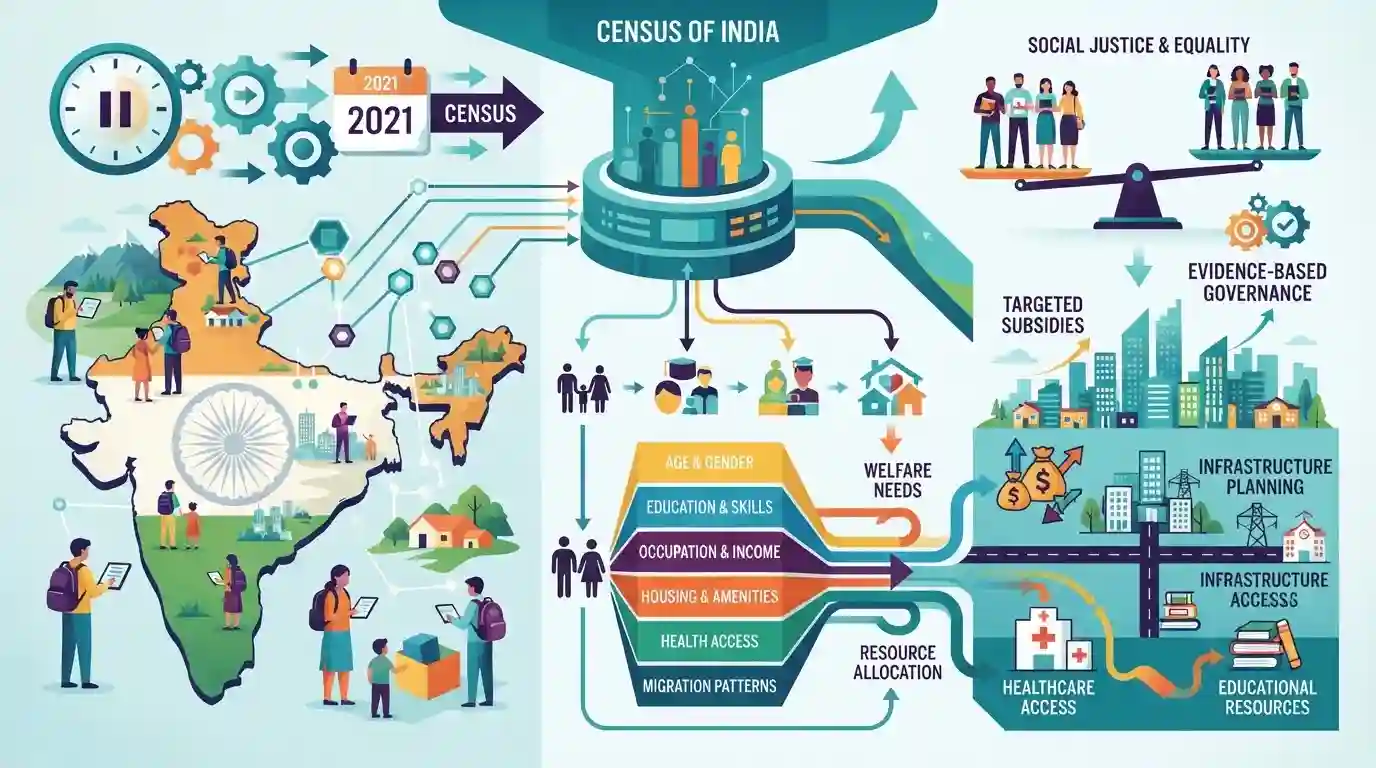
The editorial discusses the significance of conducting the long-overdue Census of India, emphasizing that it must transcend basic headcounts to become a comprehensive tool for capturing socio-economic transitions, migration, and welfare needs to drive effective public policy.
ముఖ్య అంశాలు
- The long-delayed Census of India is essential not just for collecting basic population statistics, but as a critical instrument for evidence-based policymaking and resource allocation.
- A modern census must capture complex socio-economic realities, migration trends, urbanisation pressures, and employment shifts rather than mere headcounts.
- Reliable demographic data is vital for navigating complex federal issues, future parliamentary delimitation, and targeted welfare delivery.
- Bridging gaps in data infrastructure helps address structural inequalities and ensures equitable representation across states and social groups.
ముఖ్యమైన పదాలు
Census of India

The comprehensive decennial enumeration of India's population covering demographic, social, and economic parameters, conducted by the Registrar General and Census Commissioner under the Ministry of Home Affairs.
UPSC context
GS Paper II (Governance) & GS Paper I (Population and Associated Issues); tests understanding of demographic dividend, welfare targeting, and evidence-based policy formulation.
Government of India
The central executive authority of the country responsible for policy-making, administration, governance, and implementing statutory obligations like the national census under the Census Act, 1948.
UPSC context
GS Paper II (Constitution and Polity, Governance); tests knowledge of administrative machinery, federal structure, and executive functions in public delivery.
ప్రిలిమ్స్ ఉచ్చు
The Census is merely an administrative statistical exercise conducted under executive guidelines without statutory obligations on citizens.
Aspirants often assume the Census Commissioner of India or Registrar General has arbitrary powers under administrative orders, missing the strict statutory backing of the 1948 Act and mandatory confidentiality clauses.
అనుసంధానమైన స్థిర భావనలు
What are the legal framework and constitutional provisions governing the Census of India?
- Census Act 1948: Statutory Basis: Conducted under the Census Act of 1948, which makes sharing true information legally mandatory for citizens and penalizes non-compliance or false answers.
- Union List Entry: Constitutional Entry: Listed as Entry 69 in the Union List (Seventh Schedule) of the Constitution of India, giving Parliament exclusive power to legislate on it.
- Executing Body: Administrative Authority: Conducted by the Office of the Registrar General and Census Commissioner, under the Ministry of Home Affairs.
- Strict Confidentiality: Data Confidentiality: Individual census responses are strictly confidential and cannot be used as evidence in any court of law or by any authority under tax or other laws.
అంతర-అంశ నమూనాలు
Census Demographics + Fiscal Federalism Divolving Formulas
Population numbers directly dictate the Finance Commission's tax devolution formula, linking demographic management to fiscal federalism and cooperative federalism disputes between North and South.
Demography + Parliamentary Delimitation & Federal Power
Shifting population shares across states will alter Lok Sabha seat counts during delimitation, directly impacting federal representation and regional political power balances.

Census delays + Delimitation freeze + Finance Commission criteria make demographic data a prime multi-statement prelims topic.
అనుసంధాన PYQలు · 2
అనుసంధాన PYQలు · 2
- 2022MainsGS2
Discuss the role of the National Commission for Backward Classes in the wake of its transformation from a statutory body to a constitutional body.
- 2021MainsGS2
“Pressure groups play a vital role in influencing public policy making in India.” Explain how the business associations contribute to public policies.
