Census Exercise as a Tool for Inclusive Welfare and Policy
Source:Indian Express ↗
কেন এটি গুরুত্বপূর্ণ
The Census is foundational to India's administrative framework, democratic representation (delimitation), and welfare architecture. Understanding its holistic role is vital for GS2 (Governance and Social Justice).
সারসংক্ষেপ
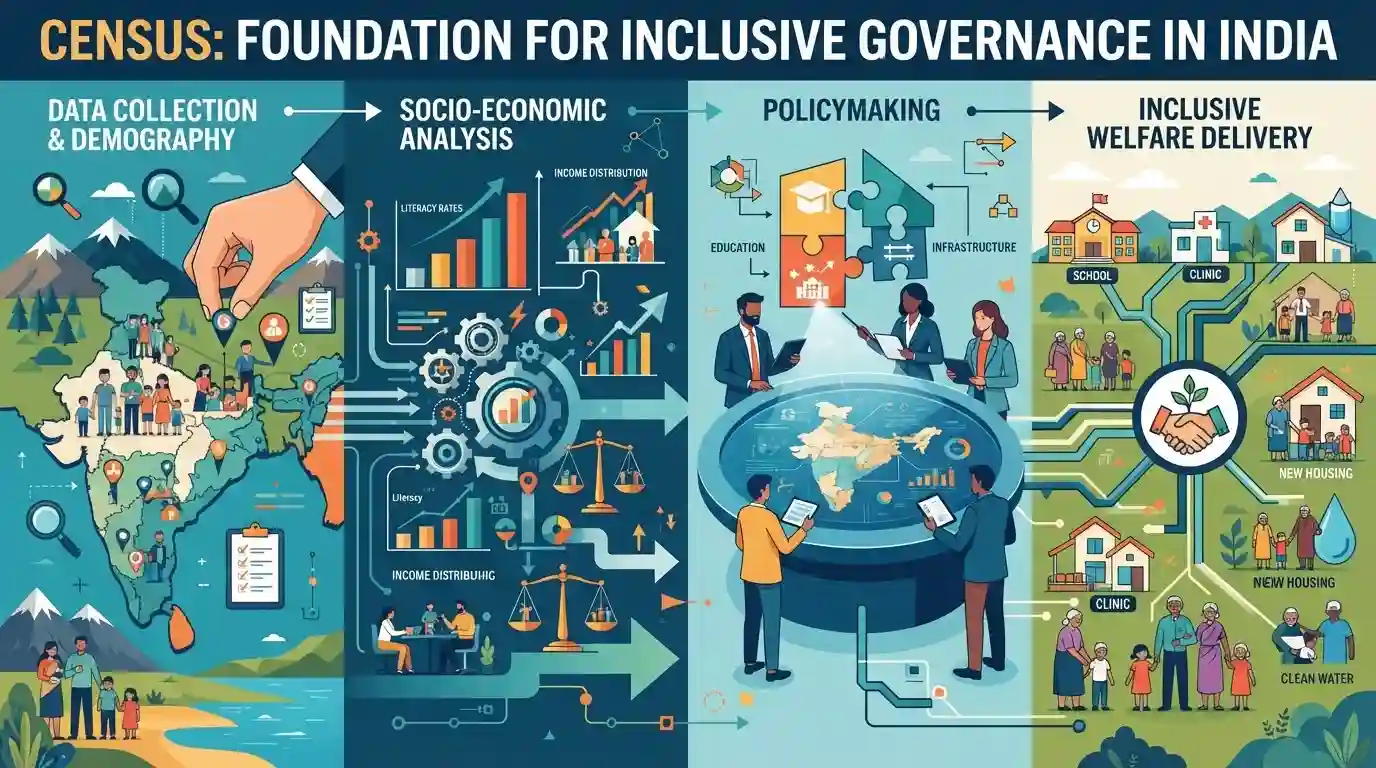
The editorial discusses the significance of conducting the Census in India, emphasizing that it should not be treated merely as a statistical compilation exercise. Instead, it must serve as a comprehensive tool for democratic governance, socio-economic analysis, policy formulation, and inclusive welfare delivery.
মূল বিষয়
- The Census is a crucial foundational exercise that goes beyond mere statistics, serving as an instrument for evidence-based policymaking, resource allocation, and targeted welfare delivery.
- A comprehensive census helps map demographic shifts, socio-economic inequalities, and urbanization patterns, ensuring that marginalized sections are adequately represented and served.
- Integrating modern digital tools and expanding the scope to capture evolving socio-economic realities (including potential caste or economic parameters) makes the census more responsive to contemporary developmental challenges.
গুরুত্বপূর্ণ শব্দ
Census of India

A decennial statutory exercise conducted by the Registrar General and Census Commissioner of India under the Census Act, 1948, providing comprehensive demographic, social, and economic data for governance and policymaking.
UPSC context
UPSC Prelims & GS Paper II/III (Governance, Demography, Inclusive Growth): Tests understanding of population statistics, welfare targeting, and resource allocation mechanisms.
Government of India
The constitutional executive authority of the country responsible for policy formulation, national administration, financial resource distribution, and the execution of socio-economic welfare schemes.
UPSC context
UPSC GS Paper II (Polity and Governance): Tests the structure, functions, and responsibilities of executive organs in delivering inclusive public policy.
প্রিলিমস ফাঁদ
The Census of India is a constitutional body established under Article 246 of the Constitution.
Aspirants often assume the Census is a constitutional body or explicitly mandated by a specific Article of the Constitution, whereas it is governed by a statutory framework (Census Act, 1948).
সংযুক্ত স্থির ধারণা
What are the key statutory and administrative features of the Census of India?
- Statutory Basis: Central Legislation enacted under the Union List (Entry 69) of the Seventh Schedule of the Constitution.
- Nodal Authority: Conducted by the Office of the Registrar General and Census Commissioner, under the Ministry of Home Affairs.
- Data Confidentiality: Data collected during the census is strictly confidential and protected under Section 15 of the Census Act, 1948; it cannot be used as evidence in any court of law.
আন্তঃবিষয় প্যাটার্ন
Census Demographics + Fiscal Federalism (Finance Commission)
Census data forms the foundational baseline for vertical and horizontal resource devolution recommended by the Finance Commission, linking demographic realities directly to fiscal federalism.
Census Demographics + Electoral Delimitation & Federalism
Accurate demographic counts and migration mapping are critical for determining electoral constituencies, directly impacting political representation and federal power sharing.

Expect a statement-based prelims question on the statutory basis (Census Act 1948), nodal ministry, and its role in Finance Commission devolution.
সংযুক্ত PYQ · 1
সংযুক্ত PYQ · 1
- 2018MainsGS2
E-governance is not only about utilization of the power of new technology, but also much about critical importance of the 'use value' of information. Explain.
