Karnataka Begins First Digital Census with Self Enumeration Window
Source:The Hindu ↗
Why It Matters
The Census provides fundamental demographic and socio-economic baseline data for public policy formulation and resource allocation. Transitioning to a fully digital census highlights advancements in e-governance but also brings 'Right to Privacy' and data protection to the forefront of governance debates.
Summary
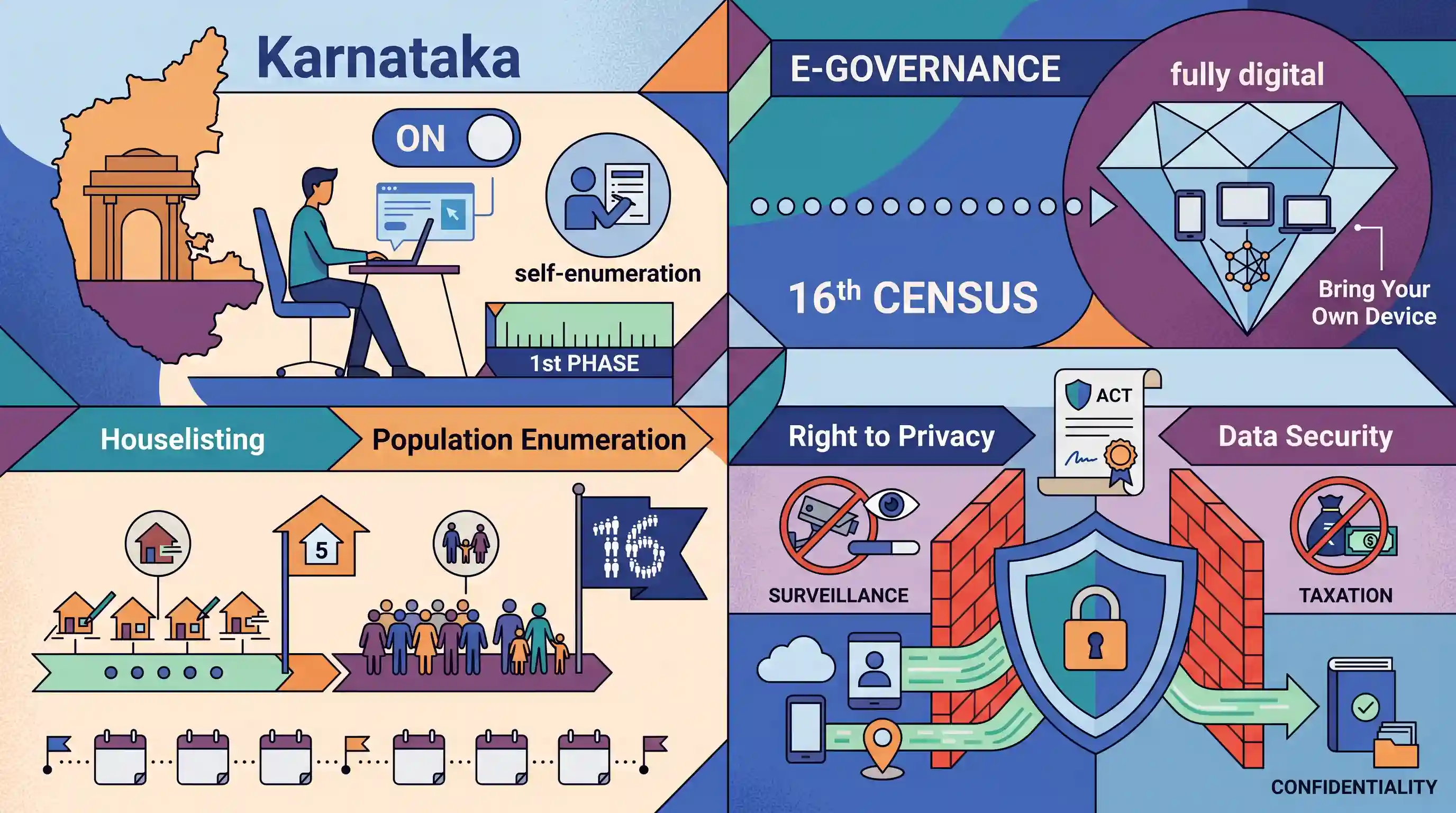
Karnataka has initiated the first phase of the Census of India, 2027, by opening an online self-enumeration window. Marking the 16th census since 1872 and the first fully digital one, it leverages mobile apps and a 'Bring Your Own Device' approach for data collection. The exercise proceeds in stages, with house listing concluding in May 2026 and population enumeration slated for February 2027. To assuage privacy concerns, officials highlighted that data remains strictly confidential under the Census Act, 1948, and is insulated from surveillance and taxation use.
Key Points
- The 16th Census of India (8th since Independence) has officially begun in Karnataka with a self-enumeration window open from April 1 to April 15, 2026.
- This census is the country's first fully digital enumeration, utilizing dedicated mobile apps under a 'Bring Your Own Device' framework.
- The subsequent phase of house listing and housing census will occur from April 16 to May 15, while the primary population enumeration is scheduled for February 2027.
- Authorities assured citizens that the data collected is strictly confidential, protected under the Census Act, 1948, and will not be used for taxation or surveillance.
Important Terms
Census Act, 1948

Enacted to provide a legal framework for census-taking, it makes participation mandatory while guaranteeing strict confidentiality of data, ensuring it cannot be used for surveillance or as evidence in court.
UPSC context
GS Paper 2 (Polity/Governance); tests knowledge of legal safeguards and the constitutional mandate (Union List, Seventh Schedule).
Census Rules, 1990
Subordinate legislation that details the administrative procedures for the census; recently amended in 2022 to allow for 'electronic form' data collection and citizen-led self-enumeration.
UPSC context
GS Paper 2 (E-governance); relevant for understanding the administrative evolution and digital transformation of public data systems.
Houselisting Operations
The first phase of the census involving the identification and categorization of all structures, housing conditions, and household assets (e.g., internet, fuel) to create a frame for population count.
UPSC context
GS Paper 1 (Demography); crucial for understanding how the government assesses living standards and infrastructure needs.
Population Enumeration
The second phase of the census where detailed demographic, socio-economic, and cultural data (including name, age, religion, and caste) of every individual is recorded to update the national profile.
UPSC context
GS Paper 1 (Social Issues) and GS Paper 2; foundational for delimitation of constituencies and welfare targeting.
Self-enumeration
A new digital provision allowing citizens to securely fill their household details on a government portal via mobile OTP before the enumerator's physical visit for verification.
UPSC context
GS Paper 2 (Governance) and GS Paper 3 (IT); tests understanding of citizen-centric digital public infrastructure and data accuracy.
Registrar General and Census Commissioner of India
A statutory office under the Ministry of Home Affairs responsible for conducting the decennial census and the registration of births and deaths across India.
UPSC context
GS Paper 2 (Governance); important for identifying the nodal executive body responsible for national demographic data.
Prelims Trap
Individual Census data can be utilized by the government to identify beneficiaries for welfare schemes.
Under the Census Act 1948, individual data is strictly confidential and inadmissible in courts. Identifying welfare beneficiaries relies on the SECC, not the decadal Census.
Static Concepts Connected
What is the constitutional and statutory mandate for the Census of India?
- Union Subject: Listed under Entry 69 of the Seventh Schedule (Article 246), falling exclusively under the Union government's domain.
- Statutory Backing: Conducted under the Census Act, 1948, championed by Sardar Patel to create a permanent legal framework for enumeration.
- Strict Confidentiality: Individual data is strictly confidential, immune from court subpoena, and cannot be used for surveillance or taxation.
How did the decadal Census evolve during the British colonial period?
- Lord Mayo: Initiated the first non-synchronous census in 1872, covering different parts of the country at different times.
- Lord Ripon: Conducted the first synchronous, regular decadal census in 1881 under Census Commissioner W.C. Plowden.
Cross-Topic Patterns
Census 2027 + Delimitation exercise
The 84th Amendment froze constituency delimitation until the publication of the first census post-2026. This digital census is the direct trigger for redefining Lok Sabha and State Assembly seats.
Women's Reservation + Census linkage
Implementation of the 106th Constitutional Amendment Act (Women's Reservation) is legally contingent on a delimitation exercise, making this 2027 Census the requisite first step for its enforcement.

Expect a multi-statement question interlinking Census 1948 confidentiality, SECC data usage, and the post-2026 Delimitation freeze lifting.
Linked PYQs · 4
Linked PYQs · 4
- 2024MainsGS1
What is the concept of a 'demographic winter'? Is the world moving towards such a situation? Elaborate.
- 2024MainsGS2
Right to privacy is intrinsic to life and personal liberty and is inherently protected under Article 21 of the constitution. Explain. In this reference discuss the law relating to D.N.A. testing of child in the womb to establish its paternity.
- 2018PrelimsGS1
Consider the following statements: 1. Aadhaar card can be used as a proof of citizenship or domicile. 2. Once issued, Aadhaar number cannot be deactivated or omitted by the Issuing Authority. Which of the statements given above is/are correct?
- 2017MainsGS2
Examine the scope of Fundamental Rights in the light of the latest judgement of the Supreme Court on Right to Privacy.
