Decadal census digital framework and caste enumeration phase
Source:Indian Express ↗
Why It Matters
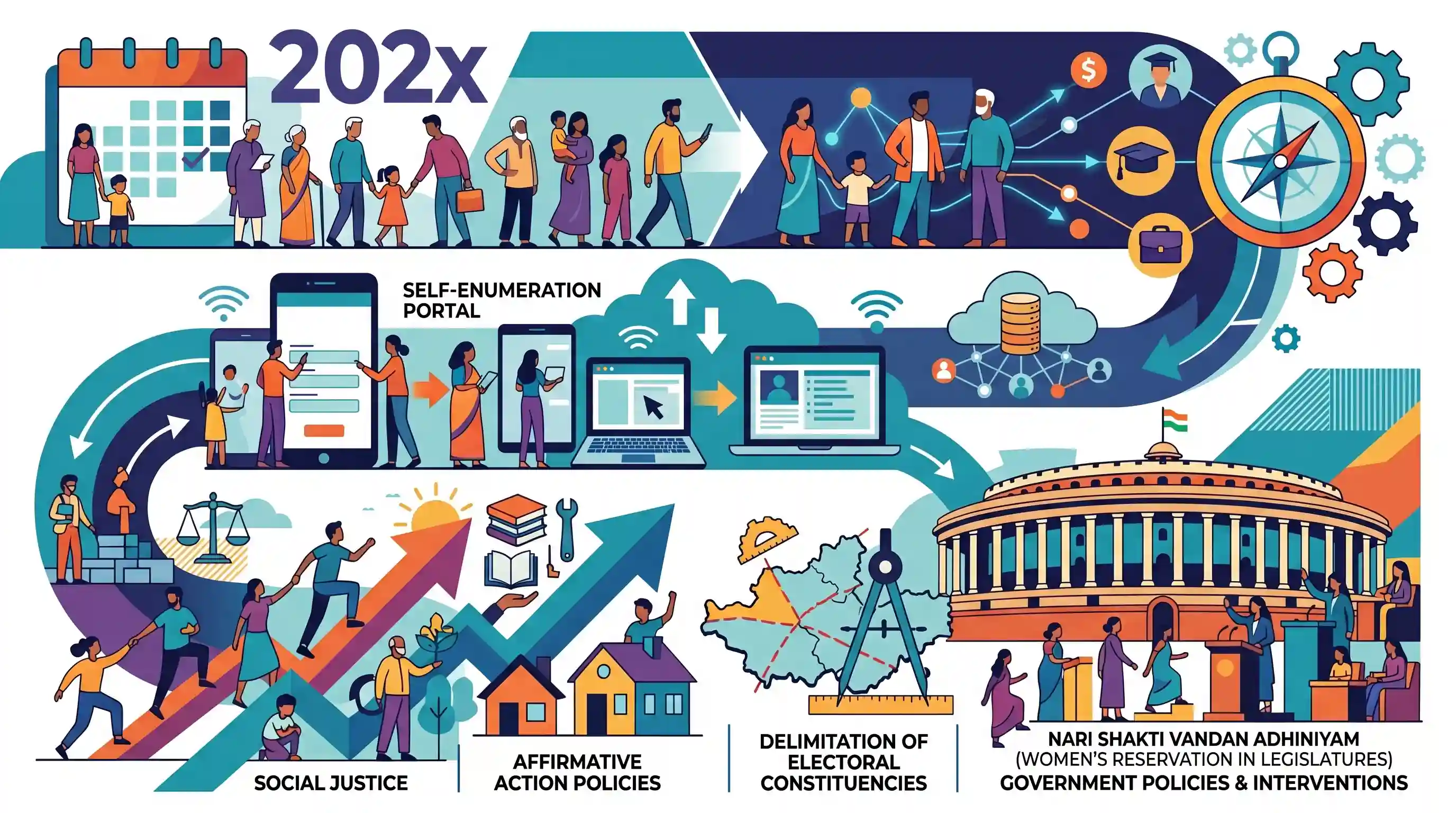
The transition to a digital Census and the political decision to enumerate caste will have profound implications for social justice policy, affirmative action, and welfare targeting. Additionally, the data will trigger the constitutionally mandated delimitation exercise and the historic implementation of women's reservations, fundamentally altering India's electoral map.
Summary
The Census Commissioner has confirmed that the upcoming decadal Census will include caste enumeration during its second phase. Marking a significant administrative shift, the exercise will be heavily digitized, allowing citizens to participate via a self-enumeration portal starting April 1. The inclusion of a caste census addresses longstanding demands for empirical data to assess socio-economic disparities and refine affirmative action policies. Moreover, the successful conclusion and publication of this population data are constitutionally mandated prerequisites for initiating the delimitation of electoral constituencies and operationalizing the Nari Shakti Vandan Adhiniyam (women's reservation in legislatures).
Key Points
- The upcoming decadal Census will incorporate caste enumeration into its second phase, addressing sustained political demands for updated socio-economic and caste data.
- In a major technological shift, the Census will utilize a digital process, offering citizens a self-enumeration facility expected to launch on April 1.
- The first phase will involve houselisting, while the second phase (population enumeration) will capture the detailed demographic and caste profiles.
- The completion of this Census is a critical constitutional prerequisite for the pending delimitation of parliamentary and assembly constituencies, as well as the implementation of the 33% women's reservation quota.
Important Terms
Nari Shakti Vandan Adhiniyam (106th CAA)

The 106th Constitutional Amendment Act (2023) reserving one-third of seats for women in the Lok Sabha and State Legislative Assemblies, effective after the next Census and Delimitation.
UPSC context
GS II (Constitution/Parliament/Social Justice); tests knowledge of women's representation and constitutional implementation triggers.
Delimitation Commission
An independent, high-powered body appointed by the President to redraw boundaries of electoral constituencies based on population data to ensure equitable representation ('One Vote One Value').
UPSC context
GS II (Elections/Federalism); crucial for understanding the reorganization of legislative power and Articles 82/170.
Caste Enumeration
The tabulation of population data based on caste status to assess socio-economic disparities and provide quantifiable data for refining affirmative action and reservation policies.
UPSC context
GS I (Indian Society), GS II (Social Justice); central to debates on sub-categorization and evidence-based policy for backward classes.
Registrar General and Census Commissioner of India
The statutory authority under the Ministry of Home Affairs responsible for executing the decennial Census and maintaining the Civil Registration System (births and deaths).
UPSC context
GS II (Statutory Bodies/Governance); tests knowledge of the administrative machinery for demographic data and policy planning.
Census Act, 1948
The legal framework for India's decadal census, empowering the government to appoint officials, mandate citizen participation, and guarantee the absolute confidentiality of individual data.
UPSC context
GS II (Governance/Legislative Acts); tests understanding of the legal safeguards and obligations in national data collection exercises.
Prelims Trap
The 33% women's reservation under the 106th Constitutional Amendment Act came into effect immediately upon receiving the President's assent.
The 106th CAA explicitly states that women's reservation will only come into effect after a delimitation exercise is conducted based on the relevant figures of the first Census published post-enactment.
Static Concepts Connected
How does the Delimitation Commission function under the Constitution?
- Constitutional Basis: Under Article 82, Parliament enacts a Delimitation Act after every census to readjust the allocation of seats in the Lok Sabha and State Assemblies.
- Composition: The Commission is appointed by the President. It typically includes a retired Supreme Court judge, the Chief Election Commissioner, and State Election Commissioners.
- Binding Nature: Its orders have the force of law and cannot be questioned before any court, ensuring that electoral maps are drawn without judicial delays.
What is the historical timeline of caste enumeration in India's census?
- 1931 Benchmark: The 1931 Census was the last synchronous exercise to collect and publicly release comprehensive caste data for all groups.
- Post-Independence Policy: From 1951 to 2011, the decadal census only enumerated and published data for Scheduled Castes (SCs) and Scheduled Tribes (STs).
- SECC 2011: The Socio-Economic Caste Census (SECC) was conducted separately in 2011, but the raw caste data was never officially published due to purported inaccuracies.
Cross-Topic Patterns
Caste Data & the 50% Quota Ceiling
Empirical caste data from the new census will likely fuel state-level constitutional challenges and legislative maneuvers aimed at breaching the 50% reservation ceiling established in the Indra Sawhney judgment.
Delimitation vs. Southern Political Representation
Linking parliamentary delimitation to this census re-ignites federalism debates. Southern states fear losing Lok Sabha proportional representation as a "penalty" for their successful demographic and population control measures.
Digital Census & Data Privacy Act
The shift to a fully digital, self-enumeration census portal involves massive PII collection, setting up a major test case for state exemptions under the new Digital Personal Data Protection (DPDP) Act.

Expect a complex 2026 Prelims question linking the 106th CAA's implementation timeline with Article 82 (Delimitation) and the Census Act.
Linked PYQs · 3
Linked PYQs · 3
- 2024MainsGS1
Despite comprehensive policies for equity and social justice, underprivileged sections are not yet getting the full benefits of affirmative action envisaged by the Constitution. Comment.
- 2024MainsGS1
Intercaste marriages between castes which have socio-economic parity have increased, to some extent, but this is less true of interreligious marriages. Discuss.
- 2001PrelimsGS1
Consider the decadal Census data given below: Decadal Population (in millions) Population 1961 10.7 1971 14.3 1981 16.2 1991 18.9 The above data refer to which one of the ‘Population by Religion’ Groups?
