Kolkata engages local schools for first digital census rollout
Source:economic-times ↗
Why It Matters
The shift to a digital census is a monumental step in Indian administration and e-governance. Understanding how local and state governments mobilize human resources—such as school teachers—for constitutional exercises like the census is crucial for topics relating to public administration and demographics.
Summary
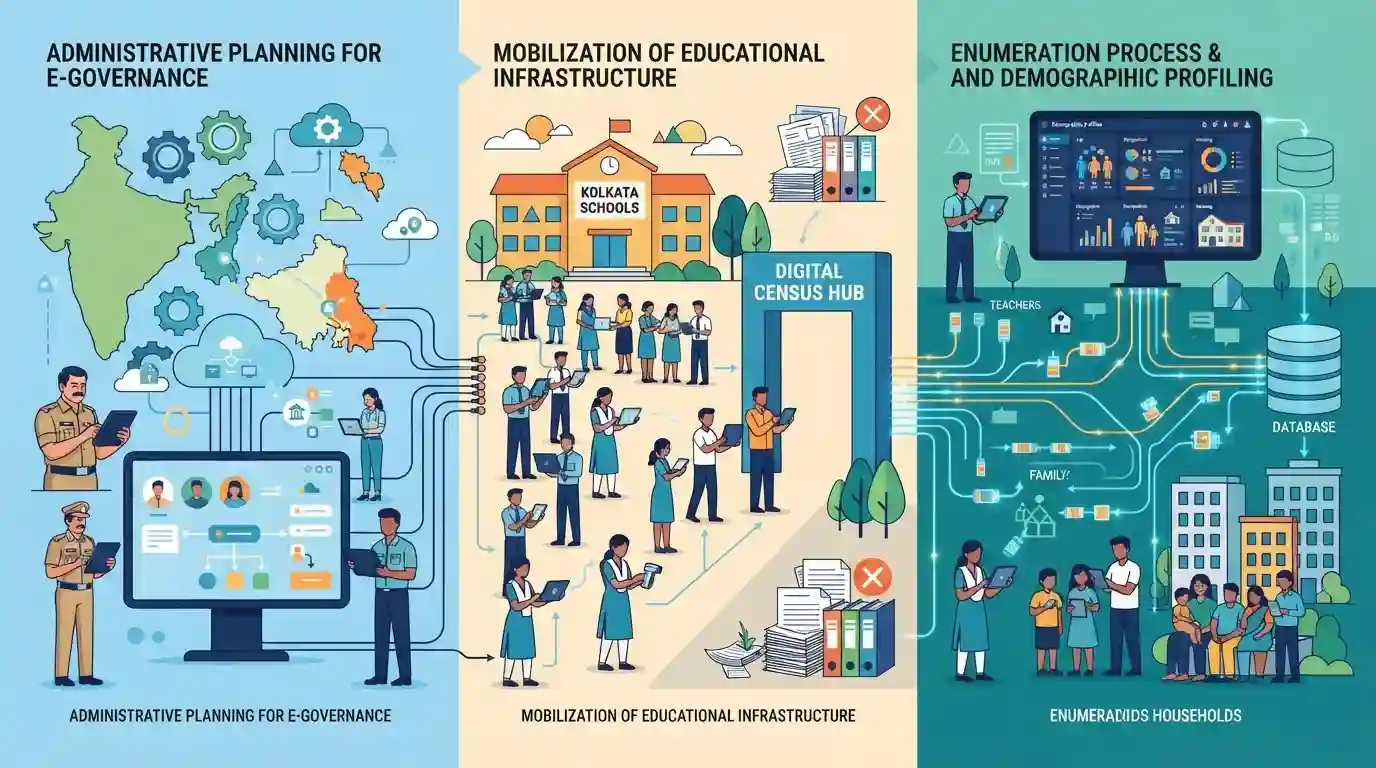
Preparations are underway for India's upcoming census, which is set to be the nation's first fully digital and paperless enumeration exercise. In West Bengal, the local administration in Kolkata has mobilized around 1,000 schools to participate in the data collection process. This move leverages the existing educational infrastructure and workforce, such as teachers who traditionally serve as enumerators, to handle the massive administrative and technological transition required for electronic demographic profiling.
Key Points
- The upcoming Census is expected to be India's first fully digital, paperless demographic enumeration.
- The Kolkata administration has roped in approximately 1,000 schools to support field operations for West Bengal's segment of the digital census.
- Teachers and educational staff are traditionally utilized as field enumerators under the Census Act, 1948, necessitating significant administrative coordination and technological training.
- A digital census utilizes mobile applications and self-enumeration portals to ensure real-time data collection, faster processing, and improved accuracy.
Important Terms
Census of India

India's 16th decennial demographic survey (Census 2027) and first fully digital census. Overseen by the RGI under the Census Act, 1948, it introduces mobile app-based data collection, self-enumeration, and comprehensive caste data recording.
UPSC context
GS-1 (Population) and GS-2 (Governance). Foundational for state resource allocation, welfare planning, and parliamentary delimitation.
Self-Enumeration (SE)
A digital facility introduced for Census 2027 allowing citizens to voluntarily submit their household demographic data online before physical field enumeration, generating a unique SE ID for subsequent verification.
UPSC context
GS-2 (E-Governance). Tests knowledge of digital transitions in governance, citizen participation, and mechanisms to improve data accuracy.
Enumerator
A primary grassroots census functionary, often drawn from teaching or local government staff, responsible for verifying digital entries and conducting door-to-door physical demographic data collection within designated blocks.
UPSC context
GS-2 (Governance). Highlights grassroots administrative machinery, capacity building, and implementation dynamics in large-scale state exercises.
Registrar General of India (RGI)
An office established in 1949 under the Ministry of Home Affairs, responsible for organizing, conducting, and analyzing the decennial Census of India and managing the national Civil Registration System.
UPSC context
GS-2 (Statutory/Executive Bodies). Crucial for understanding the institutional framework governing India's demographic data and civil registration.
Census Management and Monitoring System (CMMS)
A centralized, web-based digital platform introduced for Census 2027 to plan, manage, execute, monitor field progress in real-time, and consolidate records across all administrative levels.
UPSC context
GS-2 (E-Governance). Relevant for questions on technological interventions addressing logistical and real-time monitoring challenges in administration.
Prelims Trap
The RTE Act prohibits the deployment of school teachers for any non-educational administrative duties, including the decennial Census.
Section 27 of the RTE Act explicitly exempts three specific duties: the decennial population census, disaster relief, and election duties. Teachers can legally be drafted for these.
Static Concepts Connected
What is the constitutional and legal mandate for conducting the Census of India?
- Union List: Mandated under Article 246, Entry 69 of the Seventh Schedule, making it an exclusive Union subject.
- Legal Framework: Conducted under the Census Act of 1948, which provides the statutory backing for data collection and penalties for non-compliance.
- Nodal Agency: Executed by the Office of the Registrar General and Census Commissioner (ORGI) under the Ministry of Home Affairs.
What are the RTE Act exceptions for deploying teachers in non-educational duties?
- General Prohibition: Section 27 of the RTE Act, 2009 generally prohibits non-teaching deployments to protect instructional hours and ensure quality education.
- Three Exceptions: Statutory exemptions strictly include only three areas: the decennial population census, disaster relief operations, and election-related duties.
Cross-Topic Patterns
Union mandate, State execution
Although the Census is strictly a Union subject, executing it relies almost entirely on state government personnel (like local school teachers), highlighting functional cooperative federalism in India's administrative design.
E-governance & Data Privacy
Transitioning to a fully digital census using mobile apps intersects with broader Digital India infrastructure, raising potential cross-syllabus themes of data privacy (DPDP Act) and digital literacy barriers.

Expect a multi-statement Prelims question intertwining the Census Act 1948, RTE Act exceptions, and Union List jurisdiction.
Linked PYQs · 4
Linked PYQs · 4
- 2024WBCS_PRELIMSGS1
The 2026-2027 Census of India represents a significant milestone as it is the country's first
- 2020WBCS_PRELIMSGS1
Rank of West Bengal in India with reference to total population, vide 2011 census report is
- 2013WBCS_PRELIMSGS1
West Bengal accounts for of the population of India
- 2020WBCS_PRELIMSGS1
Literacy rate in West Bengal census 2011 —
