Congress Criticizes Census Questionnaire Design and Caste Questions
Source:The Hindu ↗
हे का महत्त्वाचे आहे
The Census is India's foundational demographic exercise, determining delimitation, policy formulation, and welfare distribution. The methodology of caste enumeration is politically and socially sensitive, directly impacting affirmative action. Additionally, gathering granular parentage data sparks significant debate over privacy rights and state surveillance.
सारांश
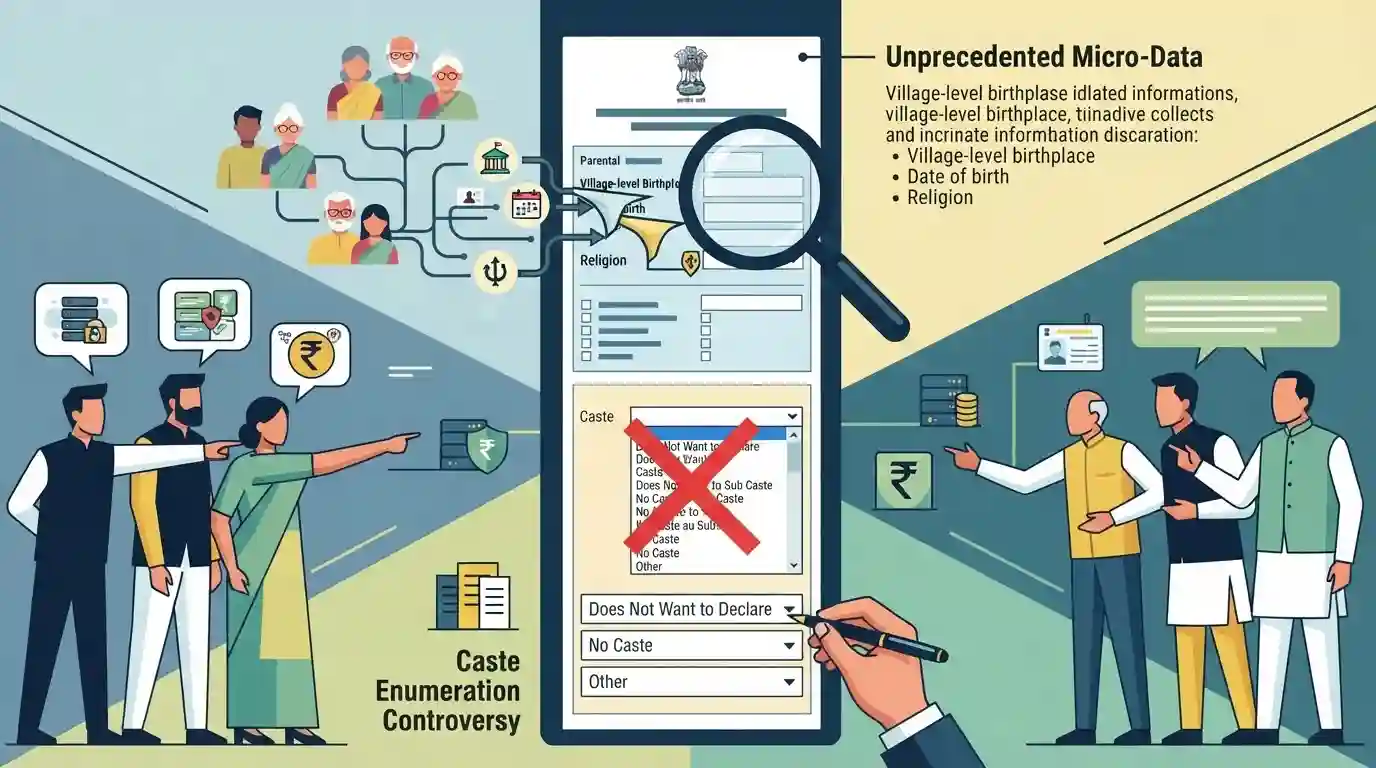
The Congress party has strongly criticized the methodology of the upcoming Census 2027, alleging it harbors a "nefarious purpose." Congress MP Jairam Ramesh highlighted that the new questionnaire intrusively seeks unprecedented micro-data about respondents' parents, such as their religion, date of birth, and birthplace down to the village level. Furthermore, the party questioned the government's decision to omit a drop-down menu for caste enumeration—a method the Centre itself endorsed in a 2021 Supreme Court affidavit to avoid the confusing proliferation of caste and sub-caste names. By allowing options like "does not want to declare caste" or "no caste," critics argue the methodology is designed to deliberately flaw the caste enumeration process, raising broader concerns over data privacy, welfare targeting, and potential linkages to citizenship registries.
मुख्य मुद्दे
- The Congress party alleges that the Census 2027 questionnaire has a "nefarious purpose" due to new, highly intrusive questions.
- The questionnaire seeks unprecedented micro-data about respondents' parents, including their religion, date of birth, and village of birth.
- Congress criticized the omission of a drop-down menu for caste selection, noting the Centre itself argued in a 2021 Supreme Court affidavit that open-field caste questions cause massive data confusion.
- Respondents are allowed to choose "does not want to declare caste" or "no caste," which critics argue deliberately undermines a comprehensive caste census.
महत्त्वाच्या संज्ञा
Census 2027

The forthcoming decennial national population enumeration exercise. Its methodology has drawn scrutiny for introducing open-ended caste questions without standardized drop-down menus and for requiring unprecedented micro-data about respondents' parents.
UPSC context
Relevant for GS Paper I (Population Issues) and GS Paper II (Data Governance, Right to Privacy).
Supreme Court of India
The apex judicial body in India. It is featured in this context due to a 2021 Centre affidavit submitted to it, which endorsed structured drop-down menus for reliable caste data collection.
UPSC context
Covers GS Paper II (Functioning of the Judiciary). Highlights the Court's role in examining government policies.
Government of India
The central administrative authority responsible for conducting the Census. It faces criticism for opting against a structured caste enumeration menu and for seeking granular personal data, raising privacy concerns.
UPSC context
Essential for GS Paper II (Functions and Responsibilities of the Union, Government Policies).
Congress
A primary national opposition party in India. It has actively scrutinized the Census 2027 methodology, alleging that the omission of standard caste categories and intrusive micro-data queries harbor nefarious purposes.
UPSC context
Relates to GS Paper II (Role of the Opposition in a Democracy, Transparency and Accountability).
पूर्वपरीक्षा सापळा
Census 2027 employs a uniform, standardized drop-down methodology for all caste enumerations to ensure data accuracy.
Only Scheduled Castes and Scheduled Tribes use a predetermined drop-down. General/OBC respondents must use an open text field or choose 'No Caste'.
संबंधित स्थिर संकल्पना
How is the Population Census legally and constitutionally mandated in India?
- Union List: Under Article 246, the Census is a Union subject listed as Entry 69 in the Seventh Schedule of the Constitution.
- Census Act 1948: It provides the statutory framework for enumeration, which is overseen by the Registrar General and Census Commissioner of India.
- Data Confidentiality: Information collected is strictly confidential, guaranteed under the Census Act, and cannot be accessed even by courts.
What is the historical trajectory of caste-based enumeration in Indian Censuses?
- 1931 Census: This was the last decennial census in British India to publish comprehensive, disaggregated caste-wise data.
- Post-Independence Policy: Since 1951, the decennial Census has only collected data on Scheduled Castes and Scheduled Tribes to fulfill constitutional reservation mandates.
- SECC 2011: A separate Socio-Economic Caste Census was conducted, but raw general caste data was largely withheld due to classification complexities.
आंतर-विषय नमुने
Census parent data and NPR/NRC fears
Asking for parents' birthplace and date of birth overlaps heavily with the National Population Register (NPR) parameters, fueling debate on whether the Census is a backdoor to a citizenship registry.
Data Minimization and Privacy Rights
The expansion from 29 to 40 questions triggers Right to Privacy debates under the Puttaswamy judgment, questioning if such micro-data passes the test of proportionality and necessity.

Expect a question contrasting the statutory backing of the decennial Census with the SECC, testing the asymmetrical caste methodology.
संबंधित PYQ · 4
संबंधित PYQ · 4
- 2023MainsGS2
“Development and welfare schemes for the vulnerable, by its nature, are discriminatory in approach.” Do you agree? Give reasons for your answer.
- 2024MainsGS2
Right to privacy is intrinsic to life and personal liberty and is inherently protected under Article 21 of the constitution. Explain. In this reference discuss the law relating to D.N.A. testing of child in the womb to establish its paternity.
- 2017MainsGS2
Examine the scope of Fundamental Rights in the light of the latest judgement of the Supreme Court on Right to Privacy.
- 2024MainsGS1
What is the concept of a 'demographic winter'? Is the world moving towards such a situation? Elaborate.
