Census 2027 enlists private teachers and institutional members
Source:The Hindu ↗
Why It Matters
Understanding administrative adaptations and resource mobilizations for foundational national exercises like the Census is critical for evaluating governance capabilities and data collection mechanisms in India.
Summary
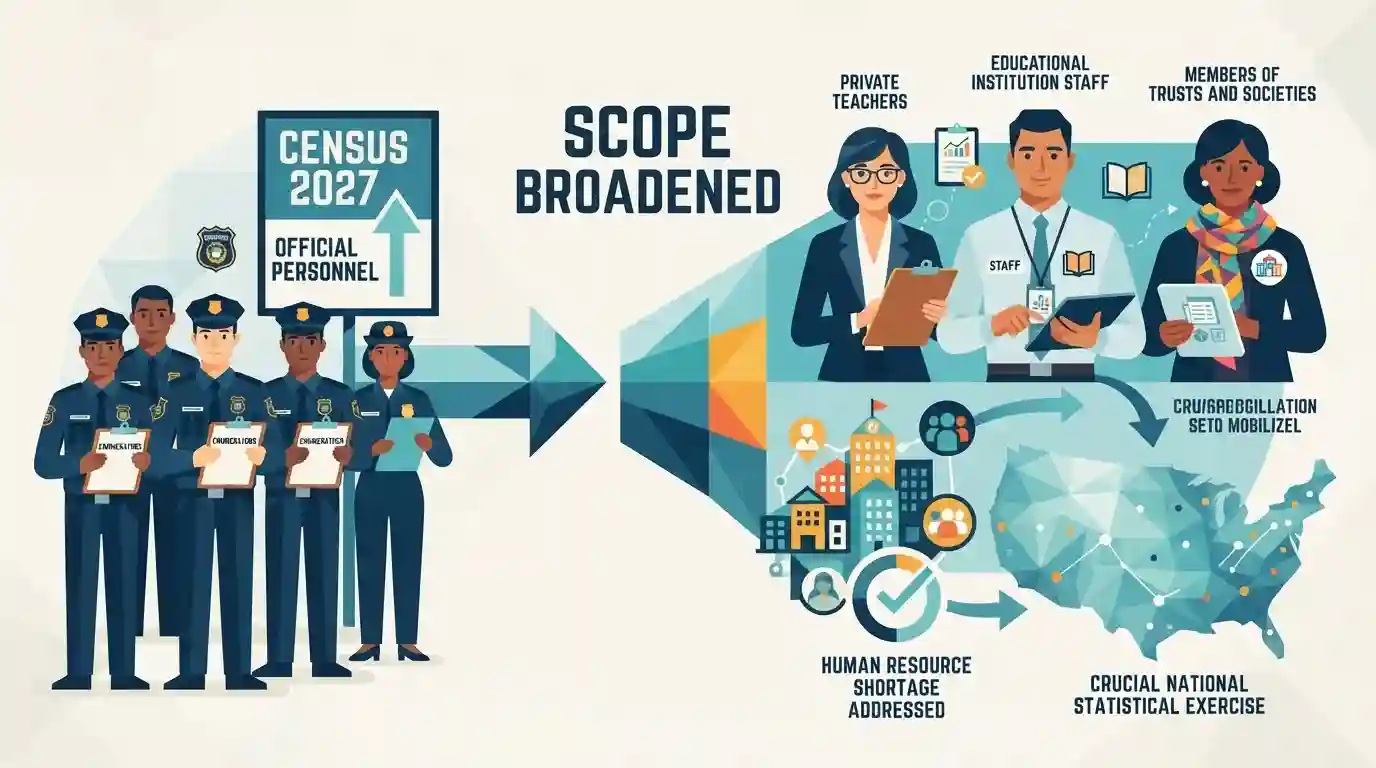
The government has broadened the scope of personnel who can serve as enumerators for Census 2027 by opening roles to private teachers, staff of educational institutions, and members of trusts and societies. This move addresses potential administrative and human resource shortages by mobilizing non-governmental community resources for a crucial national statistical exercise.
Key Points
- The Indian government has expanded the eligibility criteria for enumerator roles for Census 2027 to include private teachers, educational institution staff, trust members, and society members.
- Traditionally, census enumeration was restricted primarily to government and public sector school teachers or government employees.
- This administrative shift aims to overcome manpower shortages and ensure smooth, efficient data collection across vast demographics for the upcoming census.
- The Census is a statutory exercise conducted under the Census Act, 1948, providing vital demographic, social, and economic data necessary for public policy and resource allocation.
Important Terms
Census Act 1948

The primary legislation enacted in 1948 that empowers the Central Government to conduct the decennial population census and outlines the duties and obligations of census officials and citizens.
UPSC context
GS Paper II (Governance / Statutory Framework): Tests knowledge of statutory mandates and legal frameworks governing national statistical exercises.
Office of the Registrar General and Census Commissioner
The official body under the Ministry of Home Affairs responsible for planning, conducting, and analyzing the decennial population census and civil registration in India.
UPSC context
GS Paper II (Governance): Important for questions on administrative machinery, demographic data collection, and executive bodies.
Ministry of Home Affairs
The nodal central ministry responsible for internal security, domestic policy, and administrative oversight of vital demographic and statistical bodies like the Census of India.
UPSC context
GS Paper II (Polity and Governance): Tests understanding of ministerial jurisdiction, administrative control, and central government machinery.
Prelims Trap
Only government and public sector employees can legally serve as enumerators for the national decennial Census in India.
Aspirants assume only government servants can conduct the census. Under updated rules for Census 2027, private teachers and trust members can also be appointed, and they legally acquire the status of public servants while performing census duties.
Static Concepts Connected
What are the key statutory and administrative features of the Census in India?
- Statutory Act: Statutory basis conducted under the provisions of the Census Act, 1948.
- Nodal Authority: Administrative control rests with the Office of the Registrar General and Census Commissioner, under the Ministry of Home Affairs.
- Public Servant Status: Persons appointed as census officers or enumerators are legally deemed to be public servants under Section 15 of the Act.
- Data Confidentiality: Individual census records are strictly confidential and cannot be used as evidence in any court of law under statutory mandates.
Cross-Topic Patterns
Census enumeration expansion and administrative federalism
Census enumeration involves deploying millions of personnel. Expanding eligibility intersects with administrative governance, public-private human resource mobilization, and electoral roll coordination.
Census statutory confidentiality and citizen data privacy
Data collection confidentiality under Section 15 of the Census Act links directly with data protection frameworks and digital privacy debates.

Census Act 1948 provisions, enumerator legal status under Section 15, and statutory confidentiality are high-yield static-dynamic links.
