Caste Enumeration and Demographic Data Integration in Upcoming Census
Source:Indian Express ↗
हे का महत्त्वाचे आहे
The inclusion of caste enumeration in the national census is a landmark policy shift with profound implications for federal governance, social justice frameworks, welfare distribution, and electoral politics in India.
सारांश
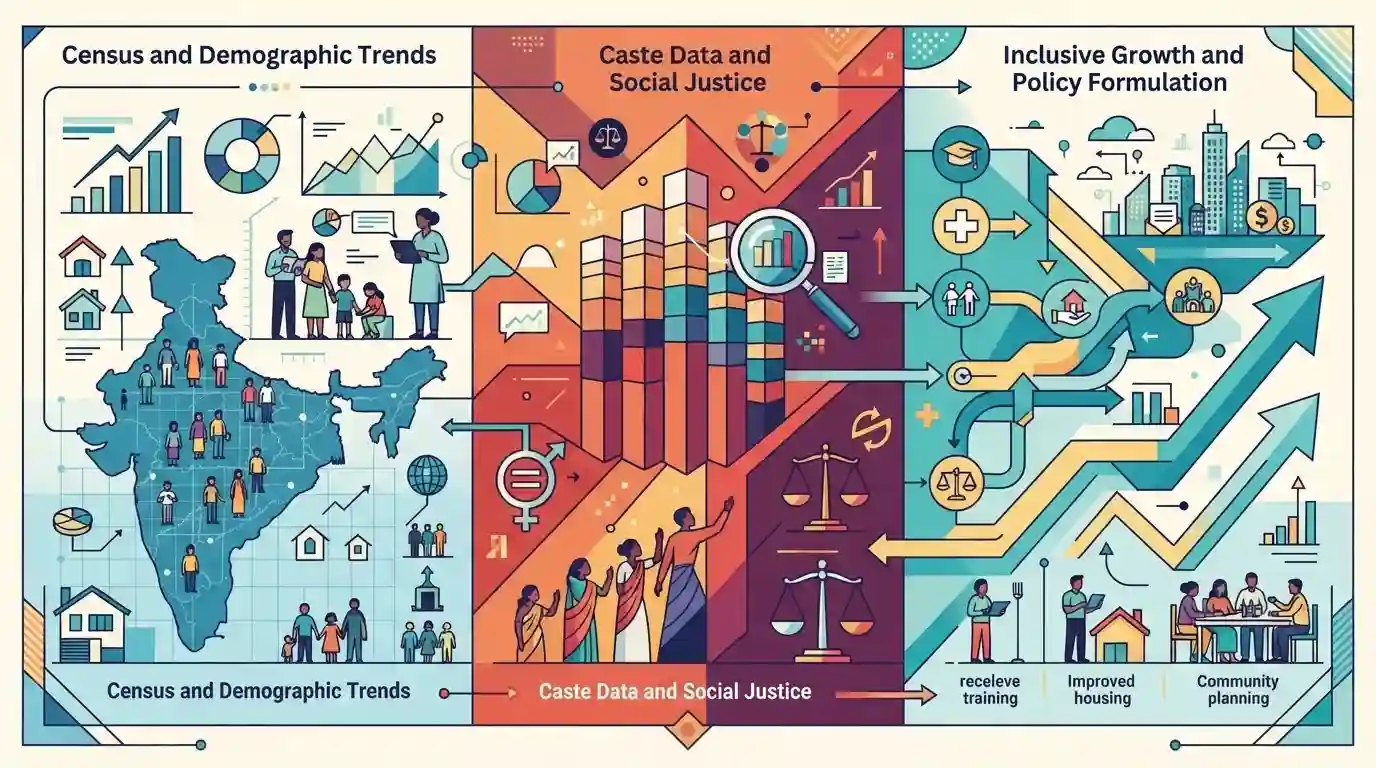
The article discusses the upcoming Census and the inclusion of caste data, analyzing its far-reaching consequences on India's demographic mapping, social justice framework, and political landscape.
मुख्य मुद्दे
- The impending Census, projected around 2027, is expected to incorporate comprehensive caste enumeration alongside traditional demographic metrics.
- Integrating caste data into the national census brings complex administrative, political, and social implications, transforming policy formulation and resource allocation.
- Shifting demographic trends across India require updated baseline data for evidence-based policymaking, federal financial transfers, and targeted welfare distribution.
- The debate touches upon balancing social justice, equity, and the risk of reinforcing rigid social categorizations through state-mandated profiling.
महत्त्वाच्या संज्ञा
Census Act

The central legislation enacted in 1948 that provides the legal framework, powers, and procedures for conducting the decennial population census of India and ensuring data confidentiality.
UPSC context
GS Paper II (Polity & Governance) - Statutory bodies and legal frameworks governing national administration and demographic data collection.
Registrar General and Census Commissioner of India
The statutory authority functioning under the Ministry of Home Affairs responsible for conducting, planning, and managing the decennial population census and vital statistics in India.
UPSC context
GS Paper II (Governance) - Institutional mechanisms, administrative machinery, and execution of national statistical surveys.
संबंधित स्थिर संकल्पना
What are the constitutional provisions governing backward classes and caste lists in India?
- NCBC Status: Article 338B established the National Commission for Backward Classes (NCBC) as a constitutional body via the 102nd Amendment Act, 2018.
- Presidential Notification: Article 342A empowers the President to notify socially and educationally backward classes (SEBCs) in consultation with the Governor, with modifications requiring parliamentary law.
- 105th Amendment: The 105th Constitutional Amendment Act, 2021 restored the power of state governments to identify and maintain their own state lists of SEBCs.
आंतर-विषय नमुने
Caste Census + Finance Commission Devolution
Caste enumeration intersects with federal financial devolution formulas, where population data and socio-economic profiling directly influence Finance Commission resource allocations.
Sub-national Caste Surveys + Federalism
State-level caste surveys run parallel to constitutional provisions under Article 342A, testing the boundaries of federalism and executive competence.

Caste census + Article 342A + constitutional bodies like NCBC will appear as statement-based polity questions.
संबंधित PYQ · 2
संबंधित PYQ · 2
- 2022MainsGS2
Discuss the role of the National Commission for Backward Classes in the wake of its transformation from a statutory body to a constitutional body.
- 2021MainsGS1
Discuss the main objectives of Population Education and point out the measures to achieve them in India in detail.
