Census 2027 and Federal Concerns Over Delimitation and Demography
Source:The Hindu ↗
Why It Matters
The impending delimitation exercise based on post-2026 census data is one of the most critical upcoming constitutional challenges. It touches upon the core of India's asymmetric federalism, balancing the democratic principle of 'one person, one vote' against the need to reward states for demographic stabilization and effective governance.
Summary
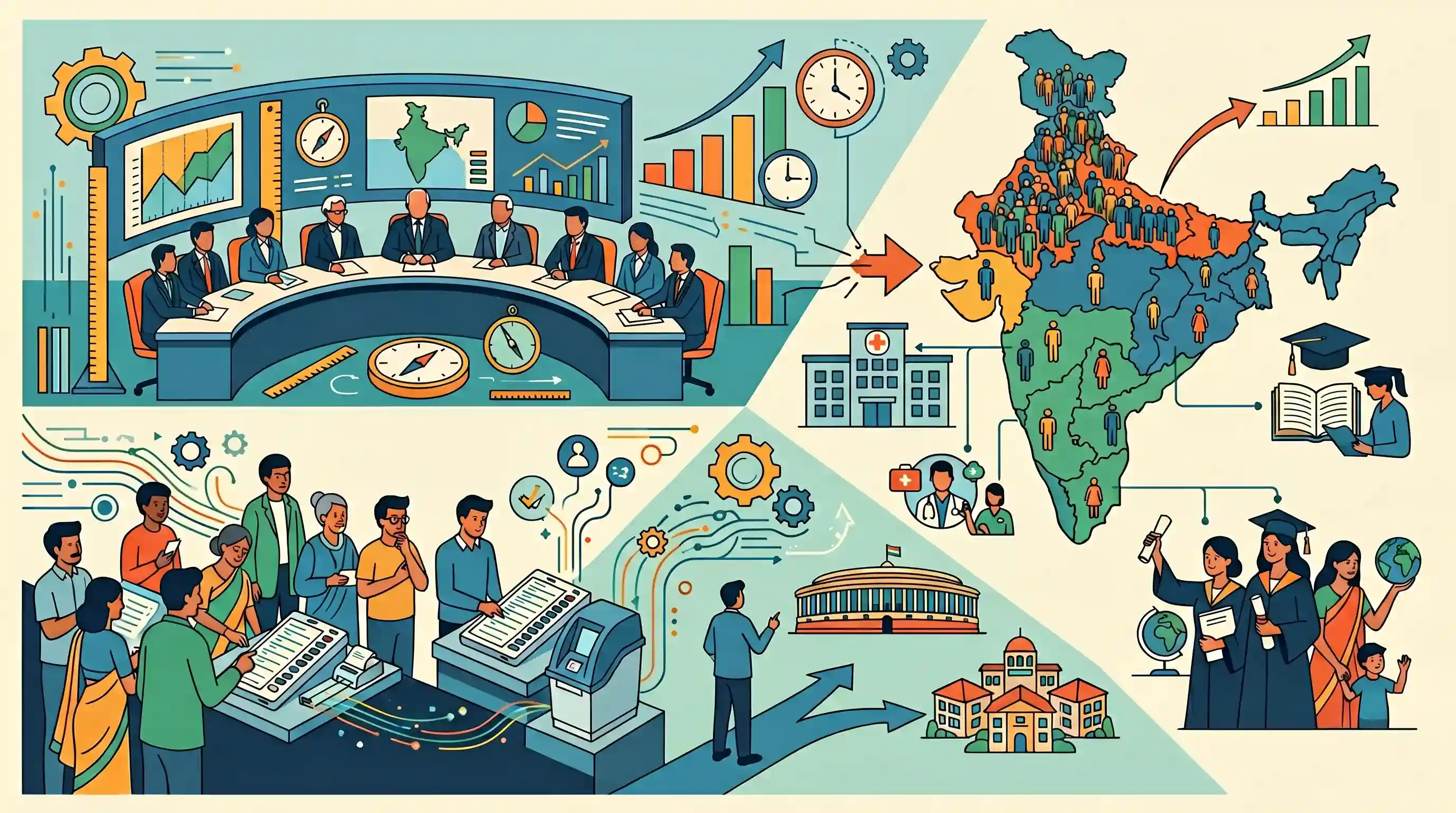
Speaking at a memorial lecture in Chennai, former Chief Election Commissioner S.Y. Quraishi warned that the upcoming Census 2027 and subsequent delimitation exercises could expose demographic fault lines between India's North and South. He highlighted the federal tension where Southern states risk losing parliamentary representation as a consequence of their successful population control—achieved via investments in health, education, and women's empowerment. Quraishi also praised the maturity of the Indian electorate, noting their sophisticated ability to differentiate between national and state elections and their seamless adaptation to EVMs and VVPATs.
Key Points
- Former CEC S.Y. Quraishi highlighted that Census 2027 will count approximately 1.45 billion people and carries immense constitutional weight, potentially reigniting controversies over demographic changes and political representation.
- A purely population-based delimitation exercise threatens to diminish the political influence of Southern states, inadvertently penalizing them for successfully controlling population growth through investments in health, education, and women\'s empowerment.
- Legal experts emphasized that delimitation must be approached with \'constitutional humility and political intelligence\' to maintain federal equilibrium and prevent the alienation of states with stable populations.
- Indian voters demonstrate significant political maturity by distinguishing between national (Lok Sabha) and state (Assembly) elections and have successfully adapted to electoral technologies like EVMs and VVPATs.
Important Terms
Delimitation Commission of India

A high-powered, independent body appointed by the President to redraw the boundaries of Lok Sabha and State Assembly constituencies based on the latest Census data.
UPSC context
GS Paper II: Elections & Constitutional Bodies. Critical for understanding the "One Vote, One Value" principle and regional representation.
Election Commission of India (ECI)
An autonomous constitutional authority established under Article 324, responsible for administering election processes in India at the national and state levels.
UPSC context
GS Paper II: Constitutional Bodies. Core topic for electoral reforms, independence of institutions, and conduct of free/fair elections.
Census of India
The decennial process of counting India's population. The 2027 Census (16th edition) is the first digital census and the legal trigger for upcoming delimitation and women's reservations.
UPSC context
GS Paper I & II: Population issues and Governance. Key for evidence-based policy, resource allocation, and federal representation.
Voter Verifiable Paper Audit Trail (VVPAT)
An independent system attached to EVMs that allows voters to verify their vote via a printed paper slip, ensuring transparency and trust in the electoral process.
UPSC context
GS Paper II: Electoral Reforms. Tests knowledge of technological interventions in democracy and Supreme Court mandates on transparency.
Cooperative Federalism
A structural concept where Centre and States work together to solve national problems; in this context, it refers to the tension over 'penalizing' Southern states for successful population control.
UPSC context
GS Paper II: Centre-State Relations. Vital for discussing fiscal federalism, representational equity, and regional disparities.
Demographic Transition
The shift from high birth/death rates to low rates as a country develops. The "North-South divide" refers to different states being at different stages of this transition.
UPSC context
GS Paper I: Social Issues/Population. Relevant for analyzing the impact of population policies on political power and economic development.
Prelims Trap
"Constituency boundaries and the total number of Lok Sabha seats are both currently frozen based on the 1971 Census."
While the total number of Lok Sabha seats per state is frozen on the 1971 Census, territorial boundaries of constituencies were actually readjusted based on the 2001 Census (87th Amendment).
Static Concepts Connected
What is the Constitutional basis and power of the Delimitation Commission?
- Constitutional Mandate: Under Article 82 and 170, Parliament enacts a Delimitation Act after every census to readjust Lok Sabha and State Legislative Assembly seats.
- Binding Nature: Its orders carry the force of law and cannot be challenged in any court, ensuring electoral boundaries are drawn without judicial delays.
- Composition: Appointed by the President, it is usually headed by a retired Supreme Court judge, and includes the CEC (or an EC) and respective State Election Commissioners.
How did the 15th Finance Commission mitigate North-South federal demographic tensions?
- 2011 Census Shift: It was mandated to use 2011 population data instead of 1971, raising fears in Southern states of reduced tax devolution due to their successful population control.
- Demographic Performance Criterion: To balance this, it introduced a 12.5% weightage for 'Demographic Performance', financially rewarding states that have successfully lowered their Total Fertility Rates (TFR).
Cross-Topic Patterns
ONOE vs. Voter Maturity
The Indian electorate's proven ability to differentiate national and regional issues (split-ticket voting) is a major counter-argument against simultaneous elections, which critics argue might homogenize voter behavior.
Women's Agency as Population Policy
Southern states achieved population stabilization not via coercive two-child policies, but through female literacy, healthcare access, and workforce participation—an essential GS-1/GS-2 blueprint for demographic transition.

Post-2026 delimitation unfreezing + 15th FC demographic criteria is a guaranteed GS-2 Mains question on federalism and representation.
Linked PYQs · 5
Linked PYQs · 5
- 2019MainsGS1
“Empowering women is the key to control population growth.” Discuss.
- 2015MainsGS2
The concept of cooperative federalism has been increasingly emphasized in recent years. Highlight the drawbacks in the existing structure and the extent to which cooperative federalism would answer the shortcomings.
- 2023PrelimsGS1
Consider the following: 1. Demographic performance 2. Forest and ecology 3. Governance reforms 4. Stable government 5. Tax and fiscal efforts For the horizontal tax devolution, the Fifteenth Finance Commission used how many of the above as criteria other than population area and income distance?
- 2024MainsGS2
Examine the need for electoral reforms as suggested by various committees with particular reference to "one nation one election" principle.
- 2018MainsGS2
In the light of recent controversy regarding the use of Electronic Voting Machines (EVM), what are the challenges before the Election Commission of India to ensure the trustworthiness of elections in India?
