Bihar Initiates Groundwork and Digital Mapping for Census
Source:indianmasterminds ↗
Why It Matters
The Census is the bedrock of socio-economic planning and policy formulation in India. For BPSC aspirants, understanding how Bihar's state administration conducts preliminary census operations and secures digital data is critical for topics related to state governance, e-governance, and public administration.
Summary
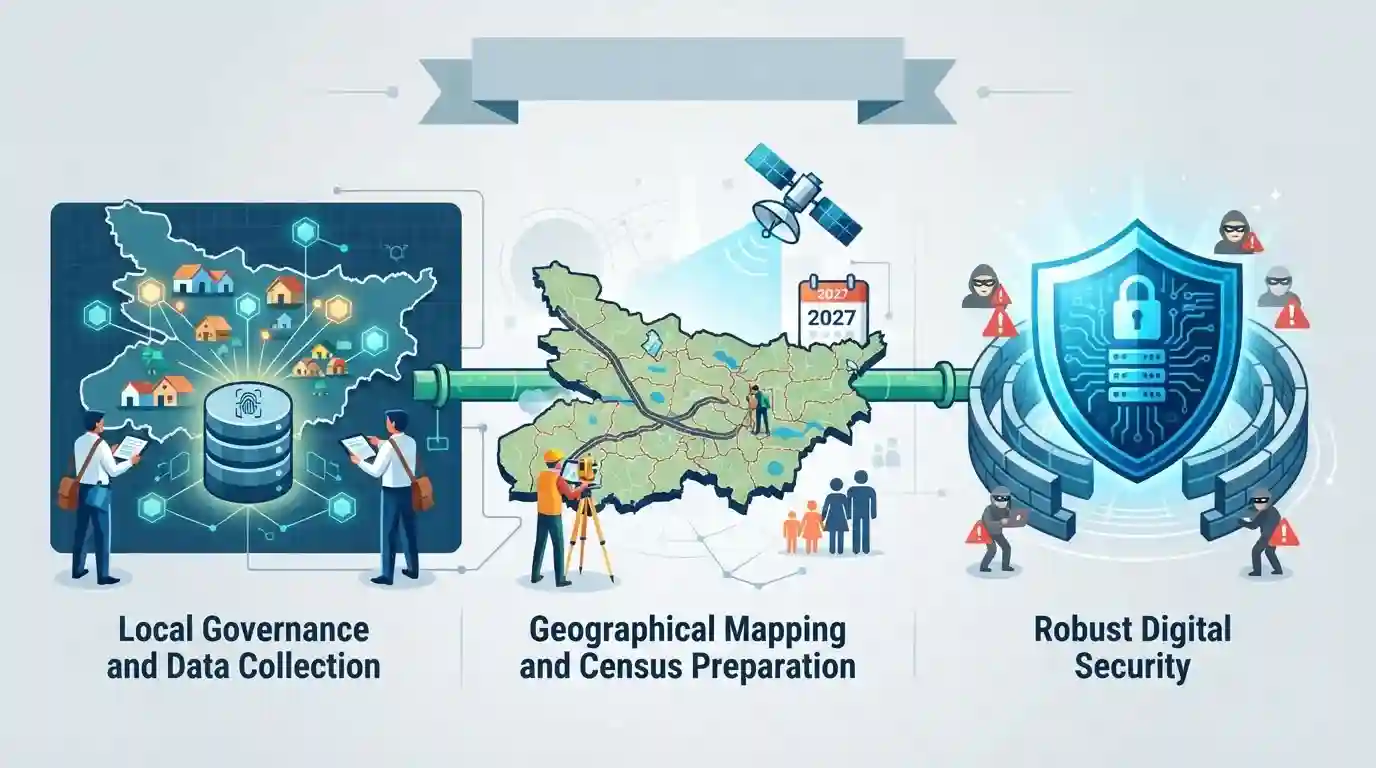
Bihar has initiated the groundwork for Census 2027, focusing on updating geographical and administrative data while ensuring robust digital security protocols for data collection.
Key Points
- Bihar's General Administration Department (GAD) has officially commenced preliminary data collection for Census 2027.
- The first phase involves creating a standardized directory of all villages and towns, defining exact geographical boundaries, and updating local administrative maps.
- This meticulous infrastructure mapping will form the basis of the District Census Handbook, vital for socio-economic planning and grassroots governance.
- The government is enforcing stringent digital security and cybersecurity measures to safeguard the integrity of census data against unauthorized access and manipulation.
Important Terms
Census 2027

India's 16th decadal census and the first fully digital population count, utilizing mobile applications, online self-enumeration portals, and including comprehensive caste data collection.
UPSC context
GS Paper I (Demography) and GS Paper II (Policies); essential for population studies, governance, and delimitation.
District Census Handbook
A key Census of India publication since 1951 containing both census data and non-census village/town directory information regarding civic, educational, healthcare, and economic infrastructure.
UPSC context
GS Paper I & II; vital for local-level developmental planning, rural-urban infrastructure assessment, and decentralized governance.
House Listing Operations (HLO)
The first phase of the census focusing on numbering and listing structures, recording housing conditions, household assets, civic amenities, and digital connectivity prior to the population count.
UPSC context
GS Paper I (Urbanization & Housing); important for analyzing living standards, poverty indices, and basic infrastructure distribution.
Self-Enumeration
A digital feature introduced in Census 2027 allowing citizens to log into a portal and fill in their household details independently before the physical visit of enumerators.
UPSC context
GS Paper II (E-governance); demonstrates the role of technology in enhancing administrative efficiency, data accuracy, and user convenience.
General Administration Department (GAD)
A crucial state-level department responsible for personnel management, public grievances, and implementing key socio-administrative policies, notably acting as the nodal agency for Bihar's 2022 Caste-Based Survey.
UPSC context
GS Paper II (State Administration); tests mechanisms of public administration, state-level policy execution, and governance structures.
Prelims Trap
State governments are legally authorized to conduct a Census under the Census Act, 1948, and access individual data to target welfare beneficiaries.
Only the Union has power over 'Census' (Entry 69). Individual census data is strictly confidential by law, unlike SECC data which is shared to identify beneficiaries.
Static Concepts Connected
What is the legal and constitutional status of the Census in India?
- Union List Entry: Article 246 places 'Population Census' under Entry 69 of the Seventh Schedule, making it an exclusive Union subject.
- Census Act 1948: Provides the statutory framework. Section 15 guarantees absolute confidentiality of individual data, protecting it from disclosure or use in courts.
- Nodal Authority: Conducted by the Office of the Registrar General and Census Commissioner of India, which functions under the Ministry of Home Affairs.
How is Census data linked to local planning and Delimitation?
- Article 243ZD: Mandates District Planning Committees to consolidate plans using local demographic data from the District Census Handbook.
- 84th Amendment: Froze delimitation of Lok Sabha and Assembly seats until the publication of the first census taken after the year 2026.
Cross-Topic Patterns
Census vs. Socio-Economic Surveys
While only the Union conducts a Census (Entry 69), states rely on the Collection of Statistics Act to run local surveys, highlighting federal divisions over demographic data.
Delimitation & Southern State Representation
The post-2026 Census will lift the freeze on constituency delimitation, directly impacting regional seat distribution in Parliament and testing cooperative federalism.

Post-2026 Census, Delimitation (84th Amendment), and District Planning under 243ZD will likely be tested as a unified federalism question.
Linked PYQs · 3
Linked PYQs · 3
- 2022BPSC_PRELIMSGS1
The 'Digital India Award, 2020' was given to the Bihar Government for
- 2022BPSC_PRELIMSGS1
The best index of economic development is provided by
- 2024-EBPSC_PRELIMSGS1
Match List – I with List – II: List I: 1. The Constitution 2. The Fundamental Rights 3. The Directive Principles of State Policy 4. The Citizenship List II: a. Part II of the Constitution of India b. Part I of the Constitution of India c. Part III of the Constitution of India d. Part IV of the Constitution of India
