CeNS Nanotechnology: Indigenous Catalyst for Green Hydrogen
Source:The Hindu ↗
Why It Matters
The transition to a clean energy economy relies heavily on scalable green hydrogen and fuel cells. This indigenous breakthrough reduces dependency on imported, costly precious metals, supporting India's clean energy goals and self-reliance in advanced nanomaterials.
Summary
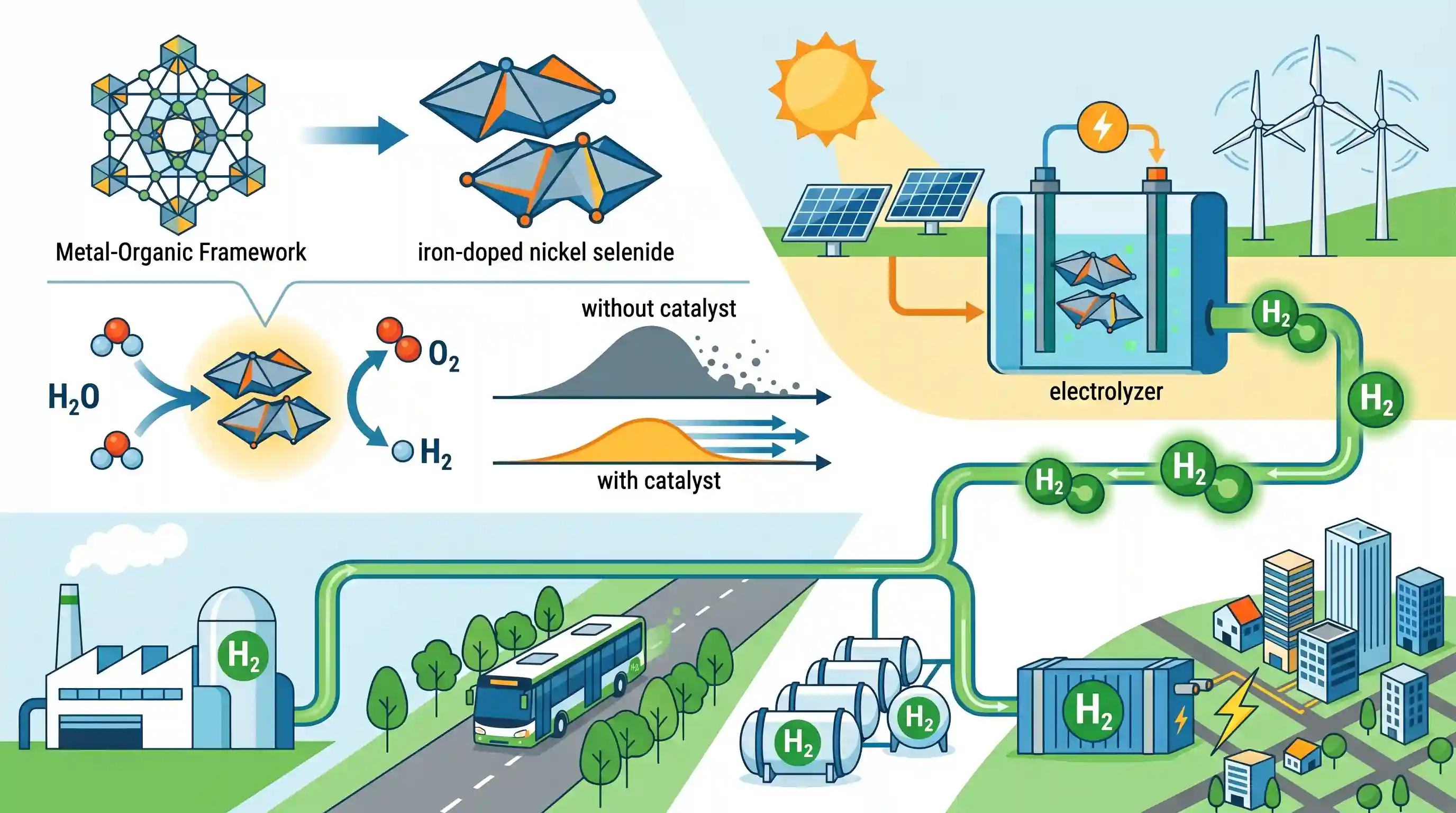
Researchers at the Centre for Nano and Soft Matter Sciences (CeNS), Bengaluru, have developed an affordable and environmentally sustainable catalyst for oxygen electrocatalysis. The novel catalyst utilizes iron-doped nickel selenide derived from a metal-organic framework (MOF), offering a highly efficient alternative to expensive precious metals like platinum and ruthenium. By accelerating the sluggish kinetics of the Oxygen Evolution Reaction (OER) and Oxygen Reduction Reaction (ORR), this nanotechnology innovation paves the way for scalable and cost-effective green hydrogen production and fuel cell commercialization.
Key Points
- Researchers at CeNS have developed a low-cost, environment-friendly catalyst to improve sustainable oxygen electrocatalysis, a critical process for clean energy technologies.
- The innovation replaces expensive precious metals like ruthenium and platinum with an earth-abundant nickel selenide matrix enhanced by iron (Fe) doping.
- The catalyst is synthesized using a metal-organic framework (MOF) modulated with iron and converted into a carbon-rich nanomaterial through pyrolysis.
- It significantly boosts both the Oxygen Evolution Reaction (OER) and Oxygen Reduction Reaction (ORR), making green hydrogen production and fuel cells more efficient and scalable.
Important Terms
Green Hydrogen

Hydrogen produced through water electrolysis powered by renewable energy sources like solar or wind. It releases zero carbon emissions, serving as a critical pillar for global decarbonization.
UPSC context
GS Paper 3: Energy and Environment. Tests understanding of sustainable energy transitions and the path to Net Zero by 2070.
National Green Hydrogen Mission
A flagship Government of India initiative aiming to produce 5 million metric tonnes of green hydrogen annually by 2030, supported by 125 GW of renewable energy capacity.
UPSC context
GS Paper 3: Economy and Environment. Crucial for questions on industrial decarbonization, energy security, and indigenous manufacturing (SIGHT program).
Metal-Organic Frameworks (MOFs)
Highly porous crystalline materials composed of metal ions and organic linkers. Often called 'molecular sponges,' they are used for gas storage, carbon capture, and high-efficiency catalysis.
UPSC context
GS Paper 3: Science & Technology. High relevance due to their 2025 Nobel Prize recognition and transformative applications in clean energy.
Oxygen Evolution Reaction (OER)
The electrochemical process where water is oxidized to release oxygen gas. It is a critical but 'sluggish' bottleneck step in hydrogen production via water splitting.
UPSC context
GS Paper 3: Science & Technology. Essential technical concept for understanding the efficiency of water electrolyzers and green hydrogen production.
Oxygen Reduction Reaction (ORR)
The chemical reaction where oxygen is reduced, typically at the cathode of a fuel cell. Improving its speed is vital for high-performance zero-emission power generation.
UPSC context
GS Paper 3: Science & Technology. Key to understanding the working of fuel cells and metal-air batteries for sustainable mobility.
Centre for Nano and Soft Matter Sciences (CeNS)
An autonomous research institute in Bengaluru under India's Department of Science and Technology (DST), specializing in nanotechnology, soft matter, and advanced energy materials.
UPSC context
GS Paper 3: Science & Technology. Represents the institutional framework of Indian R&D under the Department of Science and Technology.
Fuel Cells
Electrochemical devices that convert chemical energy directly into electricity using hydrogen and oxygen, with water and heat as the only byproducts.
UPSC context
GS Paper 3: Infrastructure and Environment. Focuses on zero-emission transport solutions and energy storage technologies.
Prelims Trap
Fuel cells generate green hydrogen by splitting water utilizing the Oxygen Reduction Reaction.
Fuel cells *consume* hydrogen and oxygen to produce electricity (ORR). Electrolyzers *produce* hydrogen by splitting water (OER). Aspirants often conflate these inverse processes.
Static Concepts Connected
How do Fuel Cells differ from Water Electrolyzers?
- Fuel Cells: Convert chemical energy from hydrogen and oxygen into electrical energy, emitting only pure water as exhaust.
- Electrolyzers: Use electrical energy to split water into Hydrogen and Oxygen, serving as the core technology for producing Green Hydrogen.
- Catalyst Role: Both systems require catalysts to overcome sluggish electrochemical reactions: ORR in fuel cells and OER in electrolyzers.
What are Metal-Organic Frameworks (MOFs) and their applications?
- Structure: Highly porous, crystalline nanomaterials created by linking metal ions or clusters with organic molecules, acting like 'molecular sponges'.
- Key Properties: Possess ultra-high surface areas, tunable pore sizes, and exceptional chemical versatility.
- Applications: Widely used in gas storage (carbon capture, hydrogen), water purification, drug delivery, and as precursors for advanced electrocatalysts.
Cross-Topic Patterns
Green H2 scaling vs PGM dependency
India's National Green Hydrogen Mission targets are constrained by reliance on imported precious group metals (Pt, Ru) for electrolyzers, making indigenous, earth-abundant catalysts crucial for energy security.
Nanotech driving climate mitigation
Nanomaterials like MOFs and transition metal selenides bridge S&T and Environment, offering scalable solutions for heavy-industry decarbonization and clean mobility (Fuel Cell Electric Vehicles).

Expect a 2026 prelims question contrasting Fuel Cells (ORR) and Electrolyzers (OER), testing the role of MOFs and precious metal catalysts.
Linked PYQs · 3
Linked PYQs · 3
- 2023PrelimsGS1
With reference to green hydrogen, consider the following statements: 1. It can be used directly as a fuel for internal combustion. 2. It can be blended with natural gas and used as fuel for heat or power generation. 3. It can be used in the hydrogen fuel cell to run vehicles. How many of the above statements are correct?
- 2024PrelimsGS1
Which one of the following is the exhaust pipe emission from Fuel Cell Electric Vehicles, powered by hydrogen ?
- 2023PrelimsGS1
Consider the following heavy industries: 1. Fertilizer plants 2. Oil refineries 3. Steel plants Green hydrogen is expected to play a significant role in decarbonizing how many of the above industries?
