Celebratory Firing at Muzaffarpur Wedding Leaves Three Injured
Source:shillong-times ↗
Why It Matters
This article highlights the law enforcement challenge surrounding illegal celebratory firing, regulated under the Arms Act, and ties into the historical and geographical context of Muzaffarpur and East Champaran districts in Bihar.
Summary
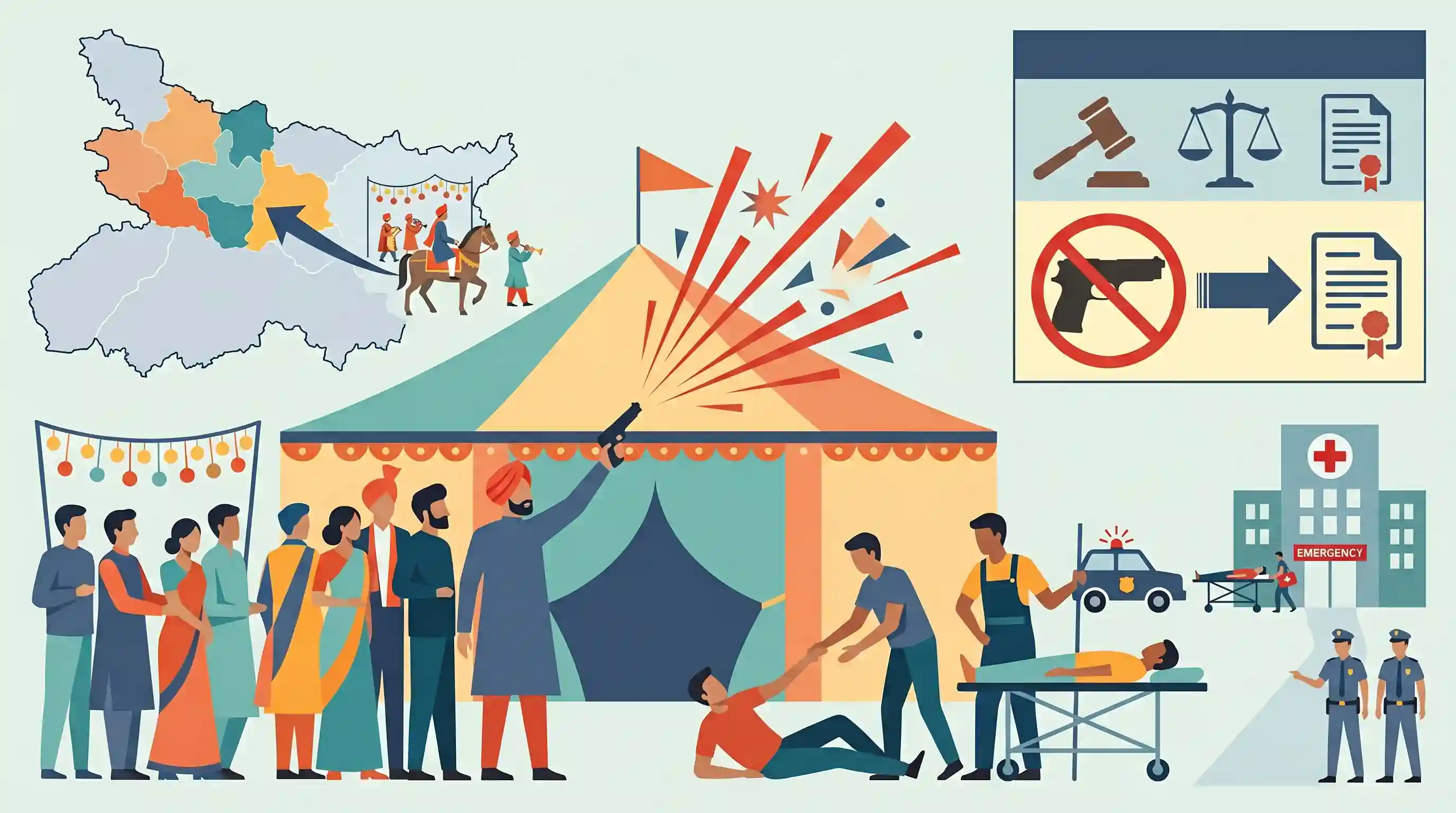
An illegal celebratory firing incident during a wedding in Bihar's Muzaffarpur district left three people injured, including a tent house worker undergoing treatment at SKMCH. The wedding procession had traveled from East Champaran. Celebratory firing is strictly banned under Section 25(9) of the Arms Act, 1959, amended in 2019.
Key Points
- Three people, including a tent house worker named Anil Paswan, were injured during a celebratory firing incident at a wedding in Parsauni Jahangir village, Muzaffarpur district, Bihar.
- The injured worker was admitted to the Shri Krishna Medical College and Hospital (SKMCH) in Muzaffarpur for treatment.
- The groom's procession (baraat) arrived from Jagirha village in East Champaran to the bride's residence in Muzaffarpur.
- Celebratory firing is a punishable offence in India under Section 25(9) of the Arms Act, 1959, which was inserted by the Arms (Amendment) Act, 2019. It carries a penalty of up to 2 years imprisonment, a fine of up to Rs 1 lakh, or both.
- Muzaffarpur district is highly significant in Bihar BPSC context: it is famous for 'Shahi Litchi' (GI tag) and was the location of the famous 1908 Muzaffarpur Conspiracy Case where Khudiram Bose and Prafulla Chaki attempted to assassinate District Judge Kingsford.
Important Terms
Arms (Amendment) Act, 2019

An amendment to the Arms Act, 1959, which reduces permissible firearms per licensee, extends license validity to 5 years, and introduces strict offenses and penalties for illicit trafficking and celebratory firing.
UPSC context
GS Paper II (Polity & Governance) and GS Paper III (Internal Security); tests legislative measures on arms control and public security.
Arms Act, 1959
A parliamentary act regulating the acquisition, possession, manufacture, sale, transport, import, and export of firearms and ammunition in India to preserve public safety and curb illegal weapons.
UPSC context
GS Paper II (Governance and Public Administration); tests statutory bodies and legal frameworks regulating public order and weapon ownership.
Shri Krishna Medical College and Hospital (SKMCH)
A prominent government medical college and tertiary care hospital in Muzaffarpur, Bihar, acting as a key referral centre for North Bihar, especially during seasonal Acute Encephalitis Syndrome (AES) outbreaks.
UPSC context
GS Paper II (Issues relating to Health); provides a critical case study of regional healthcare delivery and crisis health management.
Bihar Police
The state law enforcement agency in Bihar, responsible for maintaining public order, investigating crimes, and implementing laws, including the Arms Act, under state-level home administration.
UPSC context
GS Paper II (State Polity and Governance); relevant for studies on police administration, internal law enforcement, and federal structure.
Prelims Trap
The Arms (Amendment) Act, 2019 reduced license validity to three years while increasing the legal firearm limit per individual.
The Act actually did the reverse: it reduced the legal firearm limit from three to two and extended the license validity from three to five years.
Static Concepts Connected
What are the key regulatory changes introduced by the Arms (Amendment) Act, 2019?
- Firearm Limit: Reduced the maximum number of licensed firearms an individual can legally possess from three to two.
- License Validity: Extended the validity period of firearm licenses from three years to five years.
- Celebratory Gunfire: Explicitly defined and criminalized celebratory gunfire in public gatherings under Section 25(9).
What was the significance of the 1908 Muzaffarpur Conspiracy Case?
- The Objective: Young revolutionaries Khudiram Bose and Prafulla Chaki attempted to assassinate British District Judge Douglas Kingsford.
- The Outcome: The bomb mistakenly killed the wife and daughter of barrister Pringle Kennedy, leading to Chaki's suicide and Bose's execution.
- The Aftermath: The incident triggered the historic Alipore Bomb Conspiracy Case trial, intensifying the revolutionary nationalist movement in India.
Cross-Topic Patterns
Gun culture, local laws, and public safety
Prohibiting celebratory firing bridges central legislation (Arms Act) with state law-and-order machinery, demonstrating how localized customary practices present unique policing and internal security challenges.
Muzaffarpur: From revolutionary cradle to GI hub
Regions key to the Swadeshi movement (like Muzaffarpur) now drive regional economic identity through GI assets (Shahi Litchi), showing a shift from political resistance to economic self-reliance.

UPSC may test the Arms Amendment Act 2019's counter-intuitive dual trend: decreasing personal weapon quotas while increasing license validity.
Linked PYQs · 2
Linked PYQs · 2
- 2008BPSC_PRELIMSGS1
When did the attempt of the murder of Kingsford made at Muzaffarpur?
- 2024-IBPSC_PRELIMSGS1
In which district of Bihar, Lichi production is maximum?
