CEC reviews electoral preparations and highlights poll transparency
Source:The Hindu ↗
Why It Matters
The article is highly relevant for GS2 (Polity and Governance) as it touches upon the institutional role of the Election Commission of India, the mechanisms ensuring electoral transparency, and grassroots administration via Booth Level Officers. It also provides a GS2 IR fact (India chairing International IDEA) which can be used to showcase India's global democratic leadership in Mains answers.
Summary
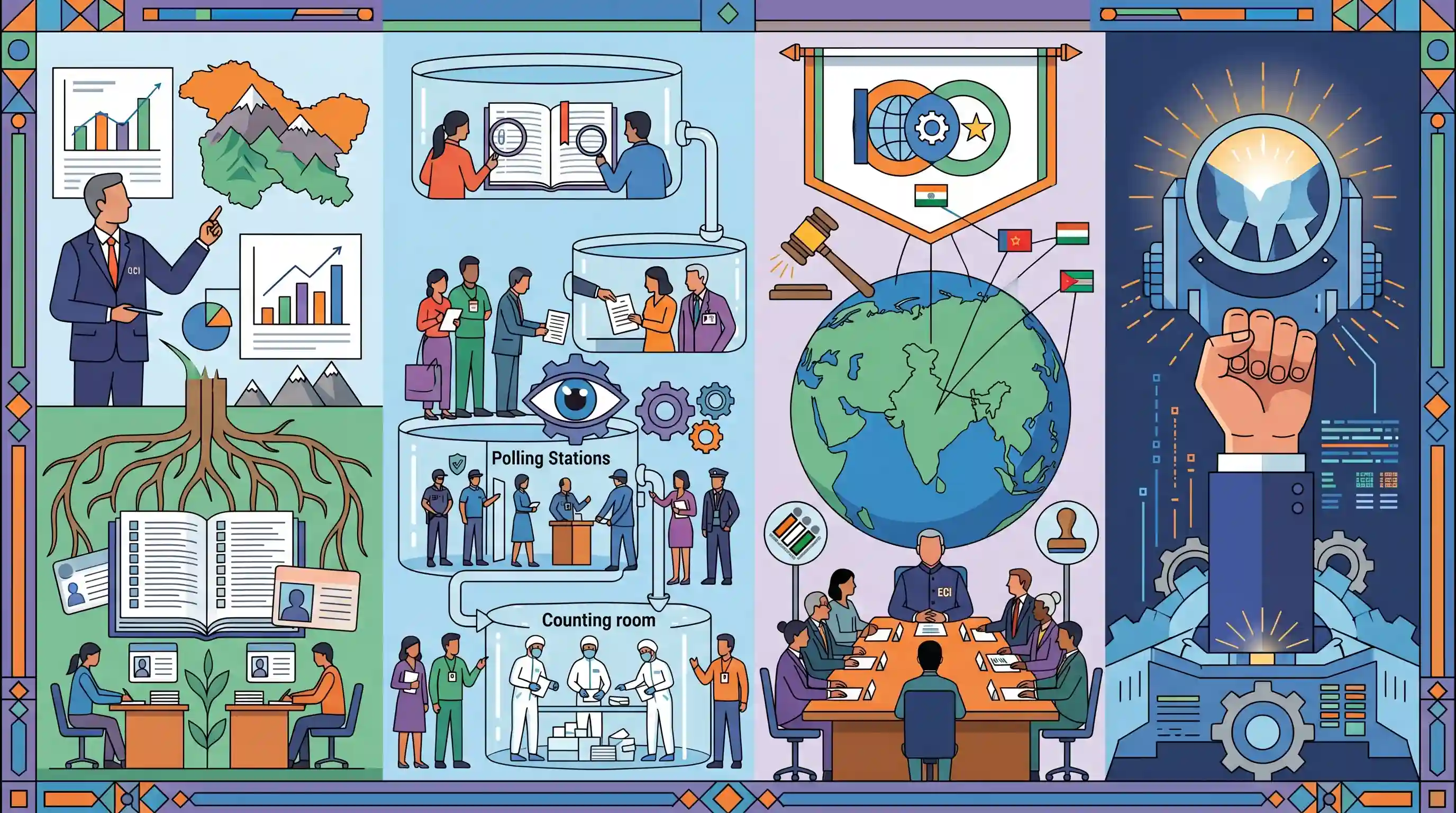
Chief Election Commissioner Gyanesh Kumar reviewed election preparations in Jammu & Kashmir, emphasizing the foundational role of Booth Level Officers (BLOs). He highlighted the unparalleled transparency of India's electoral system, where political parties and candidates audit every stage of the process, from voter list preparation to counting. Furthermore, Kumar noted India's global leadership in democratic processes as the current chair of the International Institute for Democracy and Electoral Assistance (International IDEA).
Key Points
- Chief Election Commissioner (CEC) Gyanesh Kumar reviewed preparations for upcoming elections in Jammu & Kashmir.
- Kumar addressed Booth Level Officers (BLOs), recognizing them as the foundational and crucial link in conducting elections.
- The CEC emphasized the transparency of Indian elections, noting that every stage—from voter list preparation to polling and counting—is audited by political parties and candidates.
- India currently holds the chairmanship of the International Institute for Democracy and Electoral Assistance (International IDEA).
Important Terms
Election Commission of India (ECI)

A permanent constitutional body (Article 324) responsible for administering elections to the Parliament, State Legislatures, and the offices of the President and Vice-President.
UPSC context
GS Paper II: Constitutional Bodies. Tests understanding of its independence, powers of superintendence, and role in free and fair elections.
International Institute for Democracy and Electoral Assistance (International IDEA)
An intergovernmental organization established in 1995 to support global democracy. India is a founding member and holds the 2026 Chairship under CEC Gyanesh Kumar.
UPSC context
GS Paper II: Important International Institutions. Relevant for India’s global leadership in democratic processes and election management.
Representation of the People Act (RPA)
Comprising the 1950 and 1951 Acts, these provide the statutory framework for seat allocation, voter registration, candidate qualifications, and the actual conduct of elections.
UPSC context
GS Paper II: Salient features of the RPA. A core topic for electoral reforms and the legal mechanics of democracy.
Booth Level Officer (BLO)
A grassroots-level official (usually a local government employee) appointed under RPA 1950 to maintain accurate electoral rolls and facilitate voter services at polling booths.
UPSC context
GS Paper II: Electoral Management. Tests knowledge of field-level administration and the "foundational" tier of the ECI's hierarchy.
Delimitation
The act of redrawing boundaries of territorial constituencies for elections to ensure equal representation based on population changes, typically via a high-powered Delimitation Commission.
UPSC context
GS Paper II: Polity and Governance. Critical for understanding representation dynamics, especially in the context of Jammu and Kashmir.
Prelims Trap
"International IDEA is a specialized agency of the United Nations responsible for conducting democratic elections globally."
It is an intergovernmental organization with UN observer status, not a UN specialized agency. It supports sustainable democracy but does not mandate or conduct elections.
Static Concepts Connected
How does the scope of RPA 1950 differ from RPA 1951 in Indian elections?
- RPA 1950 (Preparation): Deals with the delimitation of constituencies, allocation of seats, and preparation of electoral rolls (including the statutory mandate for Booth Level Officers).
- RPA 1951 (Conduct): Governs the actual conduct of elections, qualifications and disqualifications of candidates, corrupt practices, and mechanisms for resolving election disputes.
What are the formal transparency and audit protocols for EVMs and VVPATs?
- Mandatory Mock Polls: Conducted on EVMs and VVPATs in the presence of candidates' polling agents before actual voting commences to demonstrate machine neutrality.
- Microcontroller Verification: In a recent reform, candidates finishing second and third can request a post-election verification of the microcontrollers in 5% of EVMs used in their constituency.
Cross-Topic Patterns
Democracy diplomacy & Global South leadership
India's 2026 chairmanship of International IDEA aligns perfectly with its broader foreign policy strategy of projecting itself as the "Mother of Democracy" and a leading voice of the Global South.
EVM Audits & Supreme Court Judicial Review
The new rule allowing runner-up candidates to verify 5% of EVM microcontrollers stems directly from recent Supreme Court judgments (like the ADR case) balancing electoral integrity with voter privacy.

Expect a multi-statement Prelims question mixing International IDEA's intergovernmental status with the new EVM verification rules.
Linked PYQs · 3
Linked PYQs · 3
- 2017MainsGS2
To enhance the quality of democracy in India the Election Commission of India has proposed electoral reforms in 2016. What are the suggested reforms and how far are they significant to make democracy successful?
- 2024MainsGS2
Examine the need for electoral reforms as suggested by various committees with particular reference to "one nation one election" principle.
- 2017PrelimsGS1
Consider the following statements: 1. The Election Commission of India is a five-member body. 2. Union Ministry of Home Affairs decides the election schedule for the conduct of both general elections and bye-elections. 3. Election Commission resolves the disputes relating to splits/mergers of recognised political parties. Which of the statements given above is/are correct?
