Election Commission special intensive revision of electoral rolls
Source:Indian Express ↗
हे का महत्त्वाचे आहे
It addresses core tenets of Indian democracy—free and fair elections, transparency in voter roll maintenance, and the institutional role of the Election Commission of India under judicial scrutiny.
सारांश
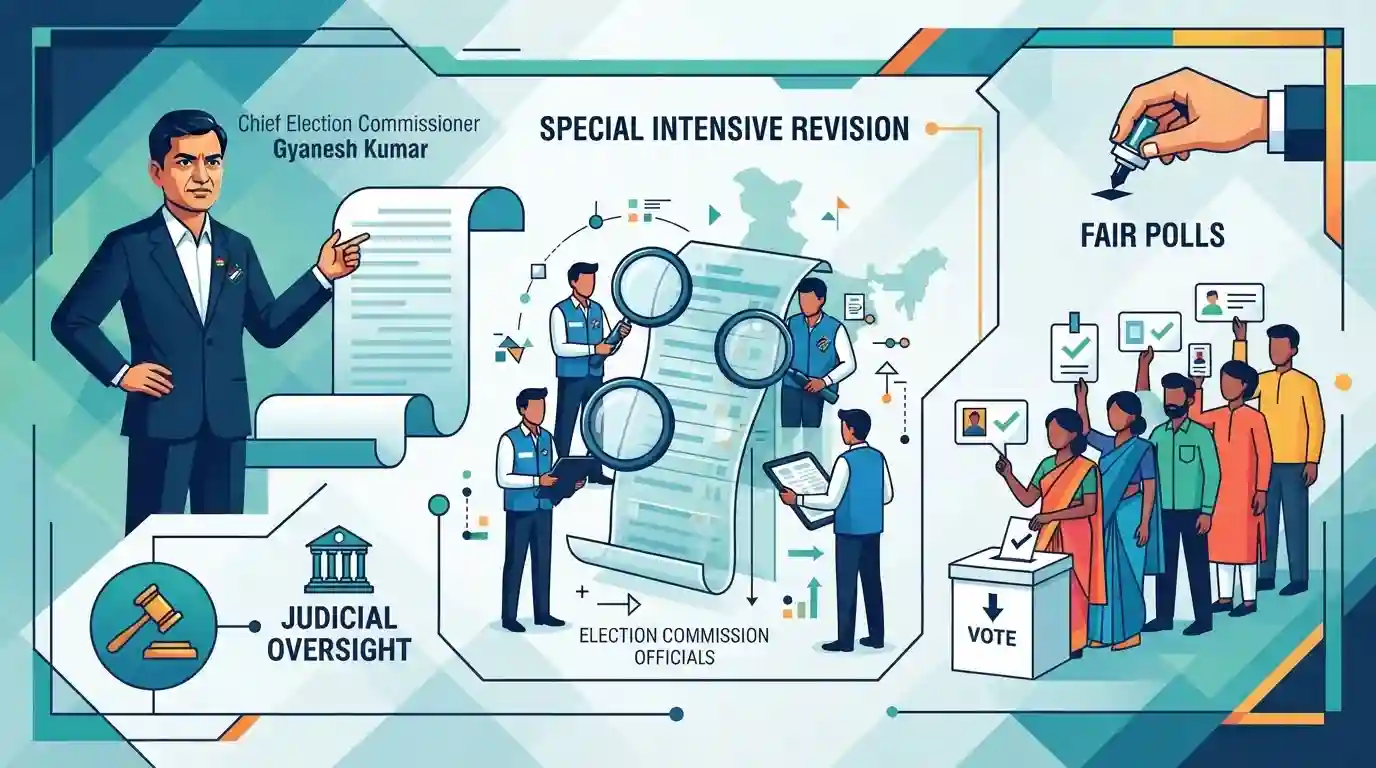
Chief Election Commissioner Gyanesh Kumar underscored the significance of clean electoral rolls through mechanisms like the Special Intensive Revision, highlighting the Election Commission's commitment to fair polls in coordination with judicial oversight.
मुख्य मुद्दे
- Chief Election Commissioner (CEC) Gyanesh Kumar emphasized the critical role of clean electoral rolls for ensuring fair and credible polls.
- The process of Special Intensive Revision of electoral rolls is being highlighted in alignment with judicial oversight and Supreme Court observations.
- Accurate voter lists prevent disenfranchisement and curb electoral malpractices, underscoring the ongoing need for administrative vigilance by the Election Commission.
महत्त्वाच्या संज्ञा
Election Commission of India

An autonomous constitutional body responsible for administering all electoral processes in India, including the Lok Sabha, Rajya Sabha, state legislatures, and the offices of the President and Vice President.
UPSC context
GS Paper II (Polity & Governance) - Essential for questions on constitutional bodies, electoral reforms, and democratic integrity.
Supreme Court of India
The apex judicial authority of India and ultimate interpreter of the Constitution, possessing powers of judicial review and judicial oversight over executive and administrative actions.
UPSC context
GS Paper II (Indian Judiciary) - Tests understanding of constitutional oversight, rule of law, and fair elections.
पूर्वपरीक्षा सापळा
The Special Intensive Revision of electoral rolls is governed under the provisions of the Representation of the People Act, 1951.
Aspirants often confuse the two statutes: RPA 1950 deals with the preparation and revision of electoral rolls and seat allocation, whereas RPA 1951 deals with the actual conduct of elections, corrupt practices, and election disputes.
संबंधित स्थिर संकल्पना
What are the key differences between the Representation of the People Act, 1950 and the RPA, 1951?
- RPA 1950 Scope: Deals with the allocation of seats in the Lok Sabha and State Legislative Assemblies, delimitation of constituencies, and the preparation/revision of electoral rolls.
- RPA 1951 Scope: Deals with the actual conduct of elections, administrative machinery for conducting elections, qualification/disqualification of MPs and MLAs, and corrupt practices.
- Rule-Making Power: Power to make rules under RPA 1950 and 1951 rests with the Central Government in consultation with the Election Commission of India.
आंतर-विषय नमुने
ECI Autonomy vs Judicial Oversight
Electoral roll integrity connects Election Commission administrative powers under Article 324 with the judicial review scope of High Courts and the Supreme Court under Article 32 (Writ jurisdiction).
Grassroots Administration & Booth Level Officers
The grassroots machinery involving Booth Level Officers links administrative decentralization with local governance implementation during electoral revision exercises.

Expect a statement-based question combining Article 324 powers, RPA 1950 roll provisions, and judicial review limits on election schedules.
संबंधित PYQ · 5
संबंधित PYQ · 5
- 2025PrelimsGS1
Consider the following subjects under the Constitution of India : I. List I-Union List, in the Seventh Schedule II. Extent of the executive power of a State III. Conditions of the Governor's office For a constitutional amendment with respect to which of the above, ratification by the Legislatures of not less than one-half of the States is required before presenting the bill to the President of India for assent?
- 2023PrelimsGS1
Consider the following statements in respect of election to the President of India: 1. The members nominated to either House of the Parliament or the Legislative Assemblies of States are also eligible to be included in the Electoral College. 2. Higher the number of elective Assembly seats, higher is the value of vote of each MLA of that State. 3. The value of vote of each MLA of Madhya Pradesh is greater than that of Kerala. 4. The value of vote of each MLA of Puducherry is higher than that of Arunachal Pradesh because the ratio of total population to total number of elective seats in Puducherry is greater as compared to Arunachal Pradesh. How many of the above statements are correct?
- 2020PrelimsGS1
Consider the following statements: 1. According to the Constitution of India, a person who is eligible to vote can be made a minister in a State for six months even if he/she is not a member of the Legislature of that State. 2. According to the Representation of People Act, 1951, a person convicted of a criminal offence and sentenced to imprisonment for five years is permanently disqualified from contesting an election even after his release from prison. Which of the statements given above is/are correct?
- 2017MainsGS2
To enhance the quality of democracy in India the Election Commission of India has proposed electoral reforms in 2016. What are the suggested reforms and how far are they significant to make democracy successful?
- 2022MainsGS2
Discuss the role of the Election Commission of India in the light of the evolution of the Model Code of Conduct.
