Special intensive revision of electoral rolls and election reforms
Source:Indian Express ↗
Why It Matters
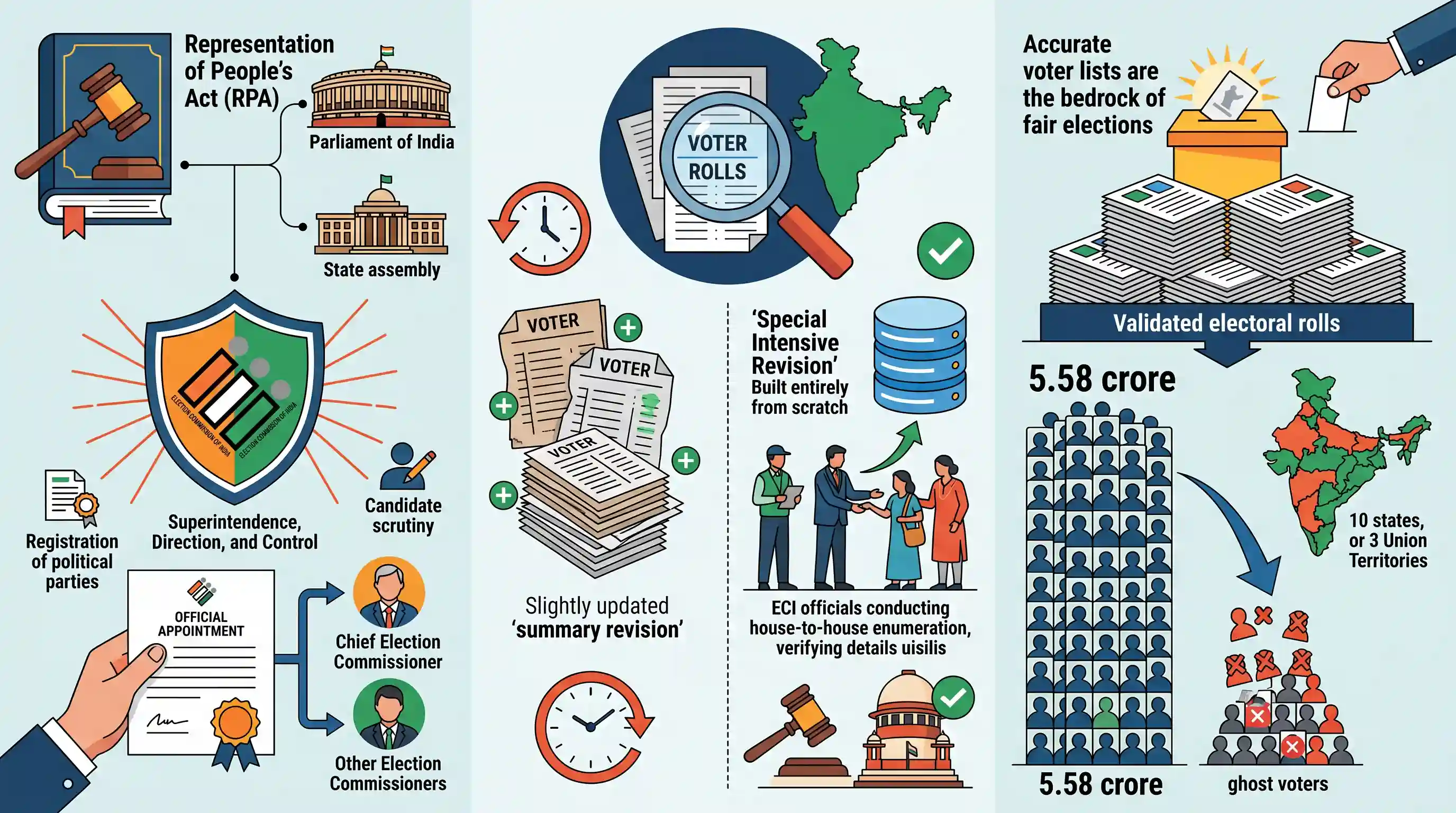
The shift from summary revision to Special Intensive Revision (SIR) marks a critical electoral reform initiated by the Election Commission to sanitize voter lists. The Supreme Court's validation of this move underscores the ECI's broad powers under Article 324. It is highly relevant for GS Paper 2 questions focusing on electoral reforms, the Representation of the People Act, and the functional autonomy of the Election Commission in ensuring free and fair elections.
Summary
Chief Election Commissioner Gyanesh Kumar stressed that accurate voter lists are the bedrock of fair elections, following a Supreme Court ruling that upheld the ECI's Special Intensive Revision (SIR) of electoral rolls. Abandoning the 20-year-old practice of 'summary revisions'—where existing rolls are merely updated—the ECI ordered the preparation of rolls completely afresh. The exercise, which ensures the purity of the electoral process, has already led to the pruning of 5.58 crore voters across 10 states and 3 UTs.
Key Points
- The Election Commission initiated a Special Intensive Revision (SIR) on June 24, breaking a 20-year practice of annual summary revisions.
- In SIR, electoral rolls are prepared entirely afresh, unlike summary revisions which merely update existing lists.
- The Supreme Court upheld the constitutional validity of the Election Commission's decision to conduct this intensive revision.
- The exercise has so far been completed in 10 states and 3 Union Territories, leading to the deletion of 5.58 crore names from the rolls.
Important Terms
Special Intensive Revision (SIR)

A comprehensive house-to-house verification drive by the ECI to overhaul electoral rolls, ensuring accuracy by removing duplicates and ineligible entries while including newly eligible voters.
UPSC context
GS Paper II (Electoral Reforms); tests understanding of administrative measures to maintain roll purity and prevent electoral fraud.
Summary Revision
The routine annual update of existing electoral rolls where additions and deletions are made based on individual applications rather than a full census-style door-to-door verification.
UPSC context
GS Paper II (Elections); tests knowledge of routine administrative processes vs. special reformative measures in the electoral cycle.
Election Commission of India (ECI)
An autonomous constitutional body established under Article 324, responsible for the superintendence, direction, and control of elections to Parliament, State Legislatures, and high offices.
UPSC context
GS Paper II (Constitutional Bodies); central to topics on democratic integrity and Article 324's plenary powers.
India International Institute of Democracy and Election Management (IIIDEM)
The training and research arm of the ECI, established to build capacity among election officials and share democratic best practices with international bodies.
UPSC context
GS Paper II (Institutional Frameworks); relevant for capacity building and India’s global leadership in election management.
Representation of the People Act, 1950
Primary legislation governing the allocation of seats, delimitation of constituencies, and the qualification of voters and preparation of electoral rolls in India.
UPSC context
GS Paper II (Salient features of RPA); tests knowledge of the legal framework for voter registration.
Prelims Trap
"The Special Intensive Revision is mandated by a recent amendment to the Representation of the People Act, 1951."
Preparation of electoral rolls is governed by RPA 1950, not 1951. Furthermore, SIR is a procedural exercise under ECI's existing powers, not a new statutory amendment.
Static Concepts Connected
What is the functional division between the Representation of the People Acts 1950 and 1951?
- RPA 1950: Deals with the allocation of seats, delimitation of constituencies, preparation of electoral rolls, and voter qualifications (the foundational work prior to elections).
- RPA 1951: Governs the actual conduct of elections, qualifications and disqualifications of candidates, corrupt practices, and the resolution of election disputes.
Which constitutional articles govern the preparation and administration of electoral rolls in India?
- Article 324: Vests the absolute power of superintendence, direction, and control over electoral roll preparation exclusively in the Election Commission of India.
- Article 325: Mandates a single general electoral roll for every constituency, explicitly prohibiting discrimination on grounds of religion, race, caste, or sex.
- Article 326: Establishes universal adult suffrage as the baseline for elections to the Lok Sabha and State Legislative Assemblies.
Cross-Topic Patterns
Electoral roll purity & Aadhaar linkage
The ECI's massive pruning via SIR aligns with broader governance efforts to clean voter data, mirroring the Election Laws (Amendment) Act 2021 which permitted the voluntary linking of Aadhaar with electoral rolls.
Article 324 and ECI Plenary Powers
The Supreme Court upholding the ECI's intensive revision reinforces the Commission's plenary powers under Article 324, a theme highly relevant following the recent controversies surrounding the Chief Election Commissioner Act of 2023.

Expect a tricky 2026 Prelims statement swapping the scopes of RPA 1950 (rolls/delimitation) and RPA 1951 (disqualifications/conduct).
Linked PYQs · 4
Linked PYQs · 4
- 2024MainsGS2
Examine the need for electoral reforms as suggested by various committees with particular reference to "one nation one election" principle.
- 2022MainsGS2
Discuss the role of the Election Commission of India in the light of the evolution of the Model Code of Conduct.
- 2017MainsGS2
To enhance the quality of democracy in India the Election Commission of India has proposed electoral reforms in 2016. What are the suggested reforms and how far are they significant to make democracy successful?
- 2020MainsGS2
There is a need for simplification of procedure for disqualification of persons found guilty of corrupt practices under the Representation of Peoples Act". Comment.
