ECI Deploys Anganwadi Workers for Voter Verification in Bihar Polls
Source:The Hindu ↗
Why It Matters
This development illustrates the practical challenges faced by the Election Commission of India in conducting free and fair elections, and the administrative mechanisms (like utilizing frontline workers such as Anganwadi staff) employed to maintain electoral integrity while respecting social customs. It is relevant for understanding electoral procedures and reforms under GS Paper 2.
Summary
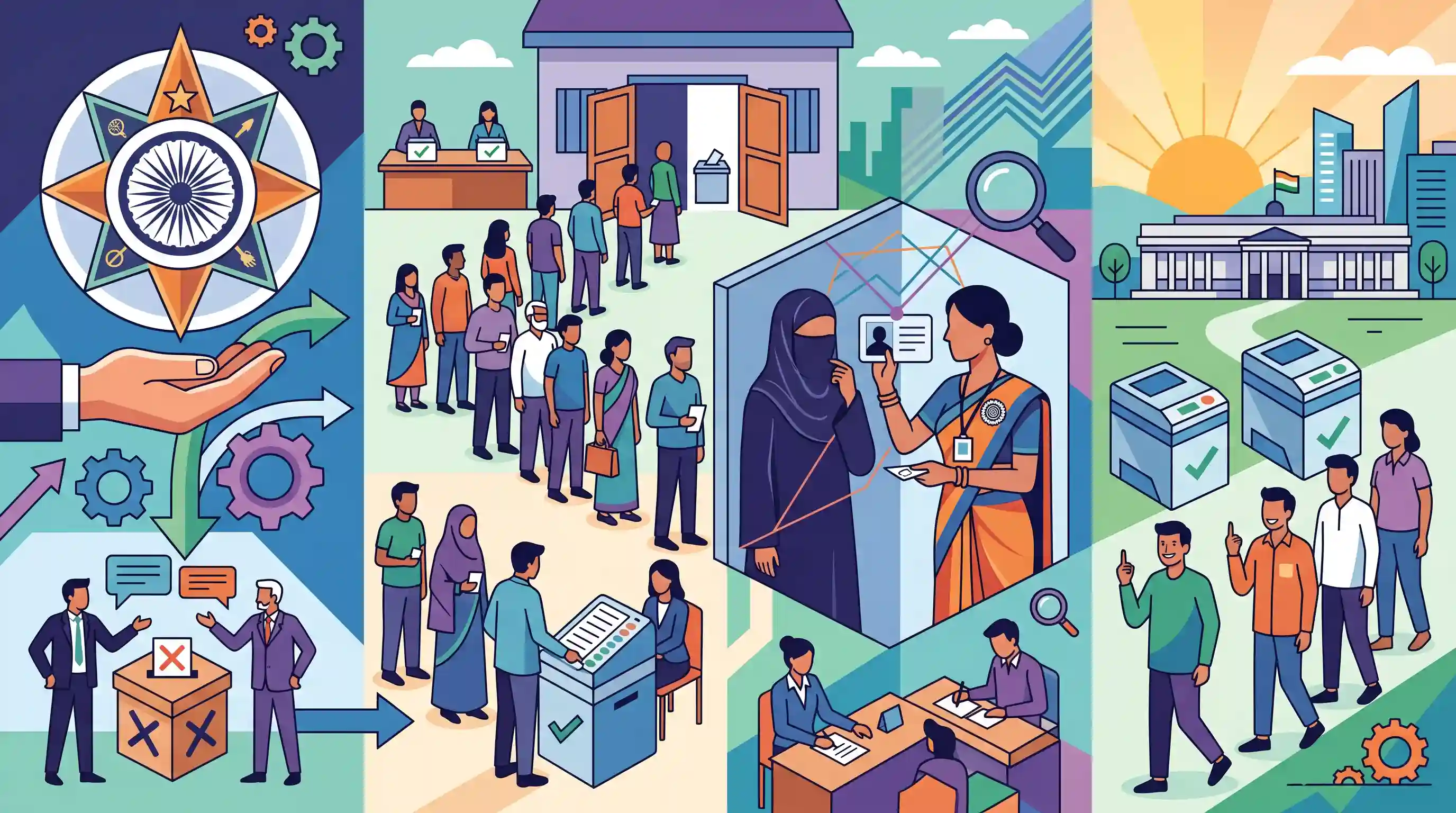
The Election Commission of India (ECI) has announced the deployment of female Anganwadi workers at polling booths for the upcoming Bihar Assembly elections. Their specific role will be to assist in verifying the identities of burqa-clad female voters, ensuring their faces match their voter ID cards. This administrative measure, prompted by concerns over bogus voting raised by state political leaders, reflects the ECI's ongoing efforts to maintain the integrity of the electoral process while respecting cultural sensitivities.
Key Points
- Chief Election Commissioner Gyanesh Kumar announced that Anganwadi workers will be deployed at polling booths during the Bihar Assembly elections.
- Their role will be to assist polling officers in verifying the identity of burqa-clad women voters.
- The move came in response to demands by BJP state leaders to prevent bogus voting by ensuring faces match voter identity cards.
- This measure represents an administrative step by the ECI to ensure free, fair, and transparent elections while accommodating social and cultural sensitivities.
Important Terms
Election Commission of India (ECI)

An independent constitutional body established under Article 324, responsible for administering elections to the Parliament, State Legislatures, and the offices of the President and Vice-President.
UPSC context
GS Paper II (Polity/Governance). Essential for understanding constitutional bodies, their autonomy, and the conduct of democratic processes.
Article 324
The foundational constitutional provision that vests the 'superintendence, direction, and control' of elections in the ECI, granting it plenary powers where the law is otherwise silent.
UPSC context
GS Paper II (Constitution). Core for questions on the constitutional source of electoral authority and institutional independence.
Representation of the People Act, 1951
A parliamentary act that operationalizes the constitutional framework for elections, detailing the conduct of polls, disqualification of candidates, and registration of political parties.
UPSC context
GS Paper II (Polity). A major syllabus topic testing statutory knowledge of candidate eligibility and electoral reforms.
Anganwadi Workers
Community-based frontline workers under the Integrated Child Development Services (ICDS) scheme, often utilized as Booth Level Officers (BLOs) for administrative tasks like voter verification.
UPSC context
GS Paper II (Social Justice/Governance). Tests the intersection of grassroots welfare machinery and administrative roles in governance.
Free and Fair Elections
A core democratic principle and part of the Indian Constitution’s 'basic structure,' ensuring electoral integrity, a level playing field, and the absence of coercion or fraud.
UPSC context
GS Paper II (Polity). Fundamental conceptual pillar for essays and questions on democratic stability and electoral ethics.
Model Code of Conduct (MCC)
A set of guidelines issued by the ECI to regulate the conduct of political parties and candidates during elections to ensure order and fairness.
UPSC context
GS Paper II (Governance). Evaluates knowledge of the regulatory framework and ECI's enforcement capabilities during poll periods.
Prelims Trap
Only regular, salaried state government employees can be deployed by the ECI for voter verification duties.
Rule 35 of the Conduct of Elections Rules, 1961 allows Presiding Officers to employ any "suitable persons" (including scheme workers) to assist in identifying electors; it is not restricted to formal state employees.
Static Concepts Connected
How does the Election Commission requisition staff for poll duties?
- Constitutional Mandate: Article 324(6) obligates the President or Governor to make staff available to the ECI upon request for discharging its functions.
- RPA 1951: Section 159 expands requisition powers to local authorities, universities, and government companies, ensuring sufficient deployment for election conduct.
- Conduct of Elections Rules: Rule 35 empowers Presiding Officers to employ suitable persons locally to assist in verifying the identity of electors at the polling station.
What is the administrative and legal status of Anganwadi workers?
- ICDS Functionaries: They are the foundational, grassroots functionaries of the Integrated Child Development Services (ICDS), launched in 1975 under the Ministry of Women and Child Development.
- Honorarium-based: They are not considered formal government employees with regular pay scales; instead, they receive a monthly honorarium.
- Gratuity Entitlement: A 2022 Supreme Court judgment ruled that they perform statutory duties and are entitled to gratuity under the Payment of Gratuity Act, 1972.
Cross-Topic Patterns
Electoral Integrity vs Cultural Privacy
The ECI's administrative move highlights a classic governance challenge: enforcing statutory mandates to prevent bogus voting while accommodating fundamental rights to privacy and religious/cultural practices (Articles 21 and 25).
State reliance on frontline scheme workers
There is a persistent governance trend of leveraging informally categorized, honorarium-based scheme workers (ASHA, Anganwadi) for critical state functions like COVID tracking, census operations, and now election verification.

Expect a 2026 Prelims statement linking ECI's powers under Conduct of Elections Rules, 1961 with the legal status of Anganwadi workers.
Linked PYQs · 3
Linked PYQs · 3
- 2022MainsGS2
Discuss the role of the Election Commission of India in the light of the evolution of the Model Code of Conduct.
- 2018MainsGS2
In the light of recent controversy regarding the use of Electronic Voting Machines (EVM), what are the challenges before the Election Commission of India to ensure the trustworthiness of elections in India?
- 2017PrelimsGS1
Right to vote and to be elected in India is a
