Chief Election Commissioner praises Bihar historic voter turnout
Source:ani ↗
Why It Matters
The visit of the CEC and his praise for Bihar's electoral achievements highlight both current electoral governance successes and the historical prestige of Bihar's ancient republics (like Vaishali). This is highly relevant for BPSC Prelims, which frequently tests knowledge on constitutional bodies (ECI) and Bihar's ancient history.
Summary
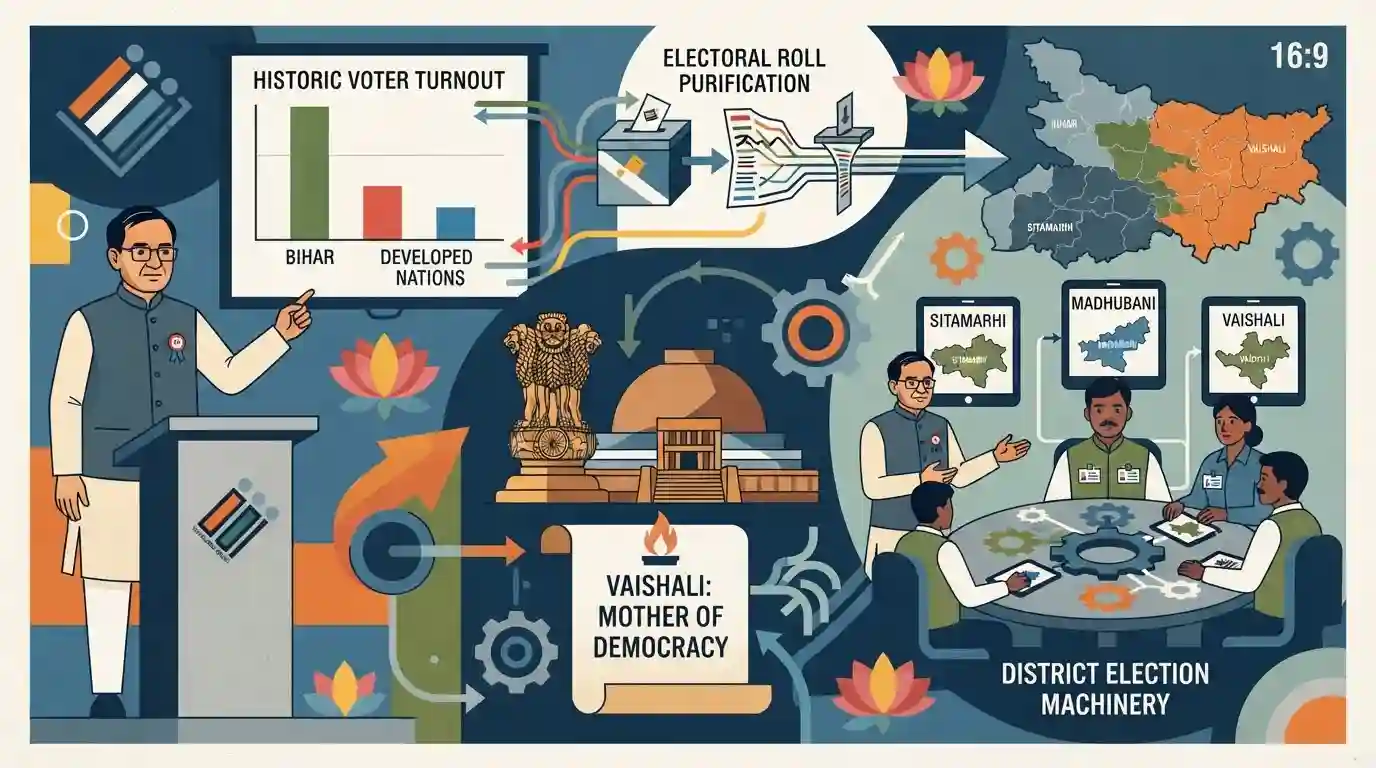
Chief Election Commissioner (CEC) Gyanesh Kumar commenced a two-day tour of Bihar, where he praised the state for its historic voter turnout in the last Assembly elections, which eclipsed several developed nations. He also commended the state's efforts in the purification of electoral rolls. During his visit, the CEC acknowledged the historical importance of Vaishali, referring to it as the 'Mother of Democracy,' and interacted with district election machineries in Sitamarhi, Madhubani, and Vaishali.
Key Points
- Chief Election Commissioner Gyanesh Kumar began a two-day tour of Bihar and lauded the state's record voter turnout in the last Assembly election.
- The CEC praised Bihar's successful implementation of electoral roll purification, which helped in improving the democratic process.
- He highlighted that Bihar's voter turnout surpassed those of developed countries like France, Japan, and Spain.
- He referred to the historical significance of Vaishali by calling it the 'Mother of Democracy' and visited heritage sites in Madhubani and Sitamarhi.
Important Terms
Election Commission of India

The autonomous constitutional authority responsible for administering election processes in India at national, state, and district levels, established under Article 324 of the Constitution.
UPSC context
Vital for BPSC GS Paper 2 (Polity). Tests understanding of constitutional bodies, electoral processes, and democratic governance.
Vaishali
An ancient city in Bihar and capital of the Lichchhavis, historically celebrated as the world's first republic. It represents India's ancient proto-democratic governance systems.
UPSC context
Critical for BPSC Prelims and GS Paper 1 (History of Bihar). Tests knowledge of ancient Mahajanapadas and regional heritage.
Special Intensive Revision (SIR)
A targeted Election Commission initiative to authenticate and purify electoral rolls by removing duplicate and ineligible voters, aiming to ensure free, fair, and credible elections.
UPSC context
Relevant for BPSC GS Paper 2 (Governance). Highlights administrative measures for electoral reform and voter turnout improvement.
Chief Election Commissioner (CEC)
The head of the Election Commission of India, currently Gyanesh Kumar, who leads the constitutional body in conducting free and fair national and state elections.
UPSC context
Important for BPSC Prelims (Current Affairs) and GS Paper 2 (Polity). Tests awareness of key constitutional officeholders.
Prelims Trap
Vaishali was the capital of the Magadha empire and the world's first republic.
Aspirants often confuse ancient capitals. Vaishali was the capital of the Vajji confederation (a Gana-Sangha), not the monarchical Magadha empire.
Static Concepts Connected
What is the historical significance of the ancient Vajji confederation?
- First Republic: Established in the 6th century BCE in present-day Bihar, it operated as a Gana-Sangha (republic) rather than a monarchy.
- Licchavi Clan: Ruled from the capital Vaishali, utilizing an early democratic assembly system known as the Santhagara.
- Ashtakula System: Governance was managed by a confederacy of eight prominent clans, representing a highly decentralized power structure.
What are the core constitutional mandates of the Election Commission of India?
- Article 324: Vests the absolute power of superintendence, direction, and control of all elections in the ECI.
- Electoral Rolls: Mandates the ECI to prepare and revise electoral rolls, ensuring democratic integrity via Special Intensive Revisions (SIR).
Cross-Topic Patterns
Ancient Republics to Modern Elections
BPSC frequently connects ancient Bihar's administrative legacy (Vajji/Licchavis) to modern governance themes like robust voter participation and democratic electoral reforms.
Electoral Integrity and Governance
The successful purification of electoral rolls links directly to GS Paper 2 topics on electoral reforms, the Representation of the People Act, and institutional transparency.

Expect a BPSC question pairing ancient Vaishali's Vajji confederacy (Licchavis) with modern Article 324 electoral mandates.
Linked PYQs · 2
Linked PYQs · 2
- 2019BPSC_PRELIMSGS1
In the Indian Order of Precedence, who amongst the following comes first?
- 2023BPSC_PRELIMSGS1
Which city served as the capital of the ancient kingdom of Magadha during the early Vedic period?
