Chief Election Commissioner Appointment Law and Judicial Scrutiny
Source:Indian Express ↗
ఇది ఎందుకు ముఖ్యం
The independence of the Election Commission is foundational to India's democracy. Analyzing the legislative changes versus judicial directives regarding the appointment process helps aspirants understand the dynamic interplay between the judiciary, legislature, and executive in maintaining checks and balances.
సారాంశం
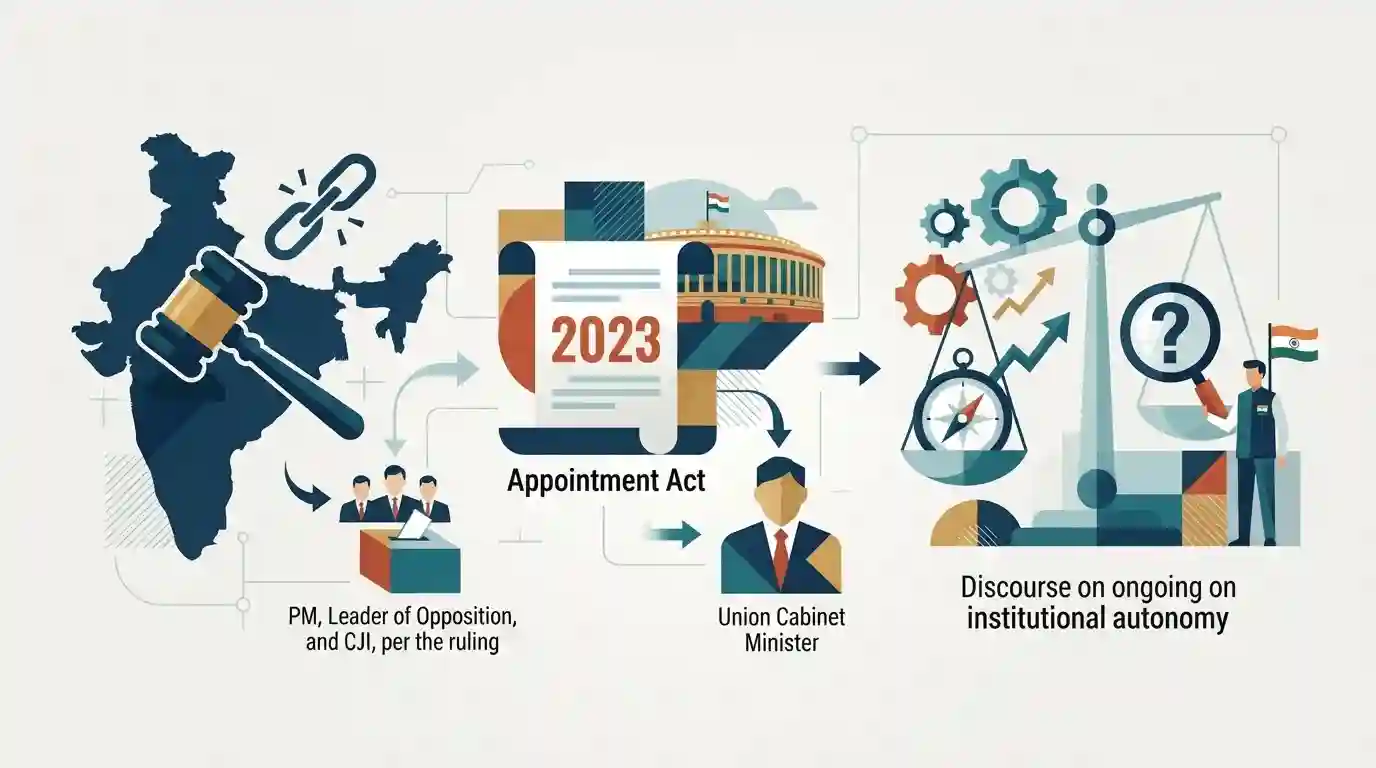
This article explores the legal and political evolution surrounding the appointment of the Chief Election Commissioner (CEC) and Election Commissioners (ECs) in India, tracing it from the landmark Supreme Court Constitution Bench ruling to the enactment of the 2023 Appointment Act and the ongoing discourse on institutional autonomy.
ముఖ్య అంశాలు
- The article discusses the legal and constitutional journey regarding the appointment of the Chief Election Commissioner (CEC) and Election Commissioners (ECs).
- It highlights the Supreme Court Constitution Bench judgment that directed a high-powered committee (Prime Minister, Leader of Opposition, and Chief Justice of India) to select the CEC until Parliament enacted a law.
- Subsequently, Parliament enacted the 2023 Act, replacing the Chief Justice of India with a Union Cabinet Minister on the selection panel, leading to renewed legal scrutiny and debate over the independence of constitutional bodies.
ముఖ్యమైన పదాలు
Chief Election Commissioner and other Election Commissioners (Appointment, Conditions of Service and Term of Office) Act, 2023

A 2023 statute governing the appointment, salary, and service conditions of the CEC and ECs, replacing the 1991 Act and establishing a selection committee comprising the PM, a Union Cabinet Minister, and the Leader of the Opposition.
UPSC context
UPSC GS Paper II (Polity & Governance) — Statutory bodies, executive-legislative oversight, and the ongoing debate over the independence of electoral administration.
Article 324 of the Constitution
The core constitutional provision under Part XV that vests the superintendence, direction, and control of elections in the Election Commission of India.
UPSC context
UPSC GS Paper II (Indian Constitution — Features, Significant Provisions) — Tests understanding of foundational democratic structures and constitutional mandates.
Election Commission of India
An independent constitutional body established under Article 324 responsible for administering election processes in India for Parliament, State Legislatures, and the offices of the President and Vice-President.
UPSC context
UPSC GS Paper II (Constitutional Bodies) — Essential for questions on institutional autonomy, electoral reforms, and free and fair elections.
అనుసంధానమైన స్థిర భావనలు
What are the constitutional provisions regarding the appointment and tenure of Election Commissioners in India?
- Constitutional Basis: Article 324(2) empowers the President to appoint the CEC and ECs, subject to any law made by Parliament.
- Tenure Security: Article 324(5) ensures security of tenure; the CEC can be removed from office only in like manner and on the like grounds as a Judge of the Supreme Court.
- Removal Safeguards: Election Commissioners can be removed by the President only upon the recommendation of the Chief Election Commissioner.
అంతర-అంశ నమూనాలు
CEC Appointment vs. NJAC and Judicial Independence
The executive replacing the CJI on the CEC panel mirrors debates around executive dominance in the NJAC judgment (2015), testing the limits of the basic structure doctrine.
Article 324 and Constitutional Autonomy of Watchdogs
Electoral reforms frequently intersect with Article 324 and the separation of powers, linking statutory body appointments to the broader administrative integrity of constitutional offices.

Expect a statement-based question pairing Article 324 provisions, the Anoop Baranwal interim formula, and the 2023 CEC Act composition.
అనుసంధాన PYQలు · 3
అనుసంధాన PYQలు · 3
- 2024MainsGS2
Examine the need for electoral reforms as suggested by various committees with particular reference to "one nation one election" principle.
- 2022MainsGS2
Discuss the role of the Election Commission of India in the light of the evolution of the Model Code of Conduct.
- 2017PrelimsGS1
Consider the following statements: 1. The Election Commission of India is a five-member body. 2. Union Ministry of Home Affairs decides the election schedule for the conduct of both general elections and bye-elections. 3. Election Commission resolves the disputes relating to splits/mergers of recognised political parties. Which of the statements given above is/are correct?
