Chief Election Commissioner Appointment: Constitutional Bench Review
Source:Indian Express ↗
Why It Matters
It directly impacts the independence of the Election Commission of India, a foundational pillar of Indian democracy, and highlights the evolving jurisprudence around institutional checks and balances between the judiciary and the legislature.
Summary
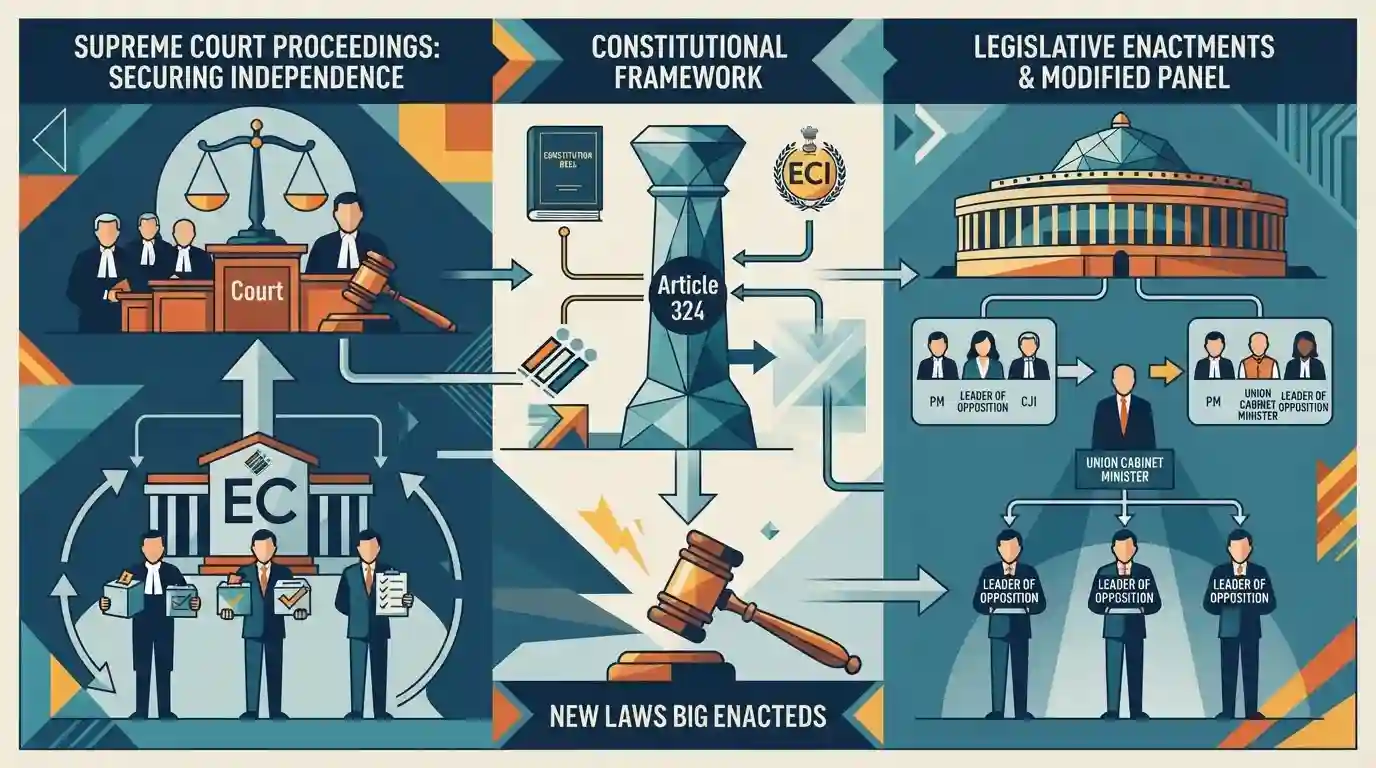
The article explains the legal and constitutional dimensions of the Supreme Court proceedings examining the validity of the law governing the appointment of the Chief Election Commissioner and Election Commissioners. It highlights the tension between judicial interventions to secure the independence of the Election Commission of India under Article 324 and the subsequent legislative enactments by Parliament modifying the composition of the selection panel.
Key Points
- The Supreme Court is examining challenges to the law governing the appointment of the Chief Election Commissioner (CEC) and Election Commissioners (ECs), specifically testing legislative overrides against judicial mandates.
- A previous Constitution Bench ruling in March 2023 had filled a legislative vacuum by mandating a committee comprising the Prime Minister, Leader of Opposition, and the Chief Justice of India (CJI) to pick election commissioners until Parliament enacted a law.
- Parliament subsequently enacted the 2023 Act, replacing the CJI with a Union Cabinet Minister in the selection panel, leading to fresh challenges regarding institutional independence and separation of powers.
- Constitutional questions center around whether a parliamentary law can alter or dilute a judicial framework designed to safeguard the independence of a vital constitutional body like the ECI.
Important Terms
Chief Election Commissioner and other Election Commissioners (Appointment, Conditions of Service and Term of Office) Act, 2023

A 2023 legislation modifying the selection panel for the CEC and Election Commissioners by removing the CJI and replacing them with a Union Cabinet Minister, leaving executive dominance.
UPSC context
UPSC GS Paper II (Polity & Governance - Executive vs Judiciary, Separation of Powers, Statutory Appointments).
Article 324 of the Constitution
Article 324 of the Constitution vests the superintendence, direction, and control of elections in the Election Commission of India, serving as its primary constitutional basis.
UPSC context
UPSC GS Paper II (Constitutional Bodies, Independence of ECI, Separation of Powers).
Election Commission of India (ECI)
A permanent independent constitutional body responsible for administering union and state election processes in India under Article 324.
UPSC context
UPSC GS Paper II (Structure, Organization and Functioning of Constitutional Bodies).
Supreme Court of India
The apex judicial court of India under Part V of the Constitution, vested with the power of judicial review to check legislative and executive actions.
UPSC context
UPSC GS Paper II (Judiciary, Judicial Review, Separation of Powers).
Prelims Trap
Parliament has absolute and unreviewable power under Article 324(2) to determine the composition of the CEC selection panel without judicial scrutiny.
Article 324(2) empowers Parliament to make laws regulating CEC appointments, but this power is not absolute and remains subject to fundamental rights and basic structure norms.
Static Concepts Connected
How are the Chief Election Commissioner and Election Commissioners appointed under the Indian Constitution?
- Constitutional Basis: Article 324(2) states that the President shall appoint the CEC and ECs, subject to the provisions of any law made in that behalf by Parliament.
- Legislative Vacuum: Historically, a legislative vacuum existed for decades, leading the Executive to make appointments directly until the 2023 intervention and enactment.
- 2023 Act Shift: The 2023 Act replaced the Chief Justice of India with a Union Cabinet Minister on the selection committee, altering the executive-dominant balance.
Cross-Topic Patterns
Judicial Review vs Legislative Supremacy
Explores the constitutional friction when Parliament enacts legislation to override judicial stop-gap directions issued under Article 142.
Institutional Autonomy of Watchdog Bodies
Examines how appointments to independent watchdogs impact institutional checks and balances, echoing debates around CBI and CIC selections.

CEC appointment mechanism + Article 324 + separation of powers is prime material for a Mains analytical question.
Linked PYQs · 4
Linked PYQs · 4
- 2024MainsGS2
Examine the need for electoral reforms as suggested by various committees with particular reference to "one nation one election" principle.
- 2022MainsGS2
Discuss the role of the Election Commission of India in the light of the evolution of the Model Code of Conduct.
- 2025MainsGS2
"Constitutional morality is the fulcrum which acts as an essential check upon the high functionaries and citizens alike...." In view of the above observation of the Supreme Court, explain the concept of constitutional morality and its application to ensure balance between judicial independence and judicial accountability in India.
- 2019MainsGS2
Do you think that Constitution of India does not accept principle of strict separation of powers rather it is based on the principle of 'checks and balance'? Explain.
