Middle East Tensions and Strait of Hormuz Risks
Source:Indian Express ↗
Why It Matters
The Middle East is crucial for India's energy security, diaspora, and trade. Understanding the geopolitical dynamics between Iran, Israel, and the US, as well as the strategic importance of chokepoints like the Strait of Hormuz, is essential for analyzing the potential impacts on India's economy and foreign policy.
Summary
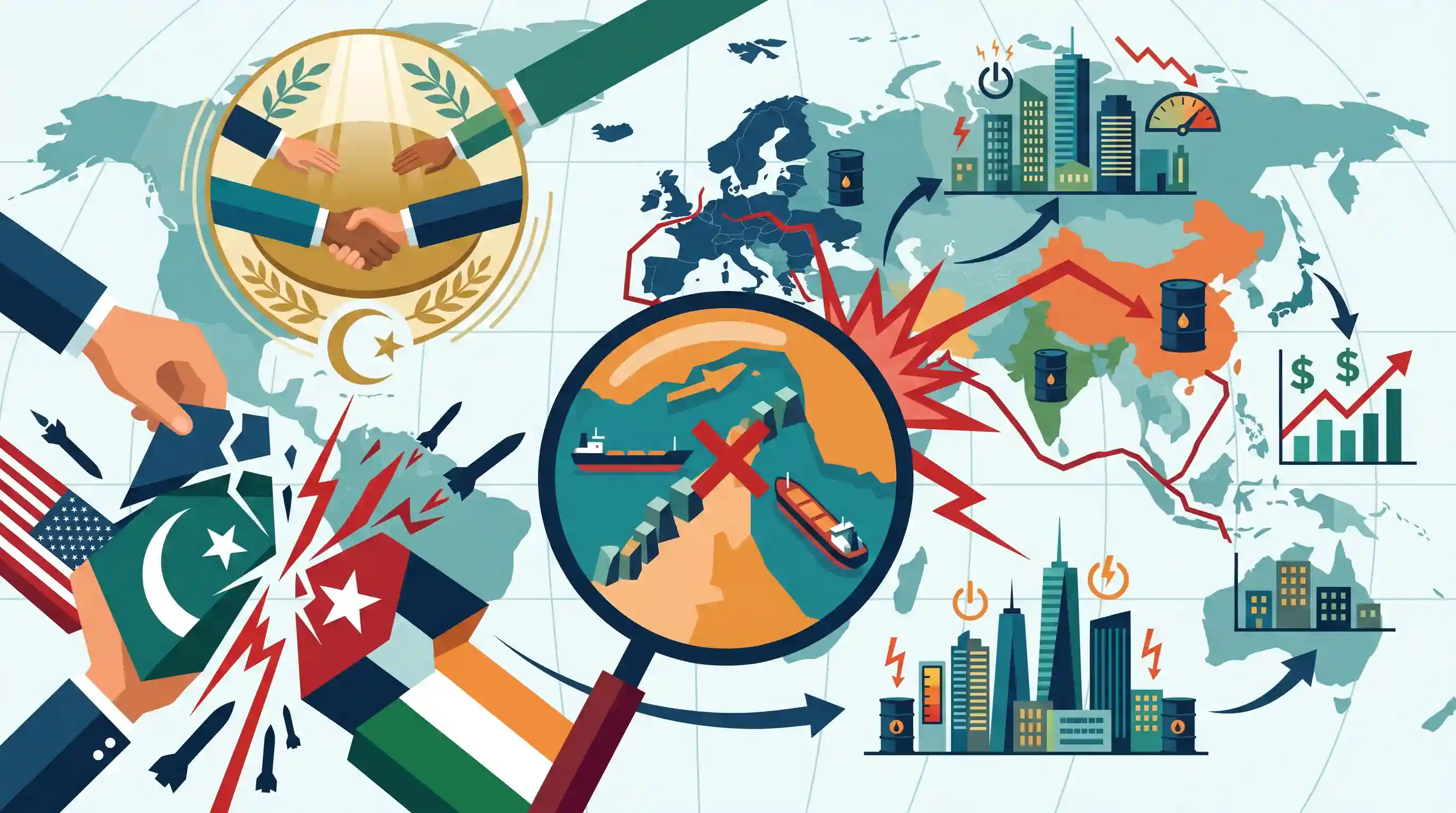
The article discusses the escalating geopolitical crisis in the Middle East, focusing on the heightened tensions between Iran, Israel, and the United States. It highlights the significance of the ongoing 'Islamabad Talks' as a crucial diplomatic effort to broker a ceasefire and prevent a full-scale regional war. A central theme is the strategic vulnerability of the Strait of Hormuz; the article emphasizes that the conflict could lead to the closure of this vital maritime chokepoint, thereby causing massive disruptions to global oil trade and threatening international energy security. Additionally, the involvement of Pakistan as a mediator points to the broader regional implications of the crisis.
Key Points
- Escalating tensions between Iran and Israel, coupled with US involvement, threaten to plunge the Middle East into a wider regional conflict.
- Diplomatic initiatives, particularly the 'Islamabad Talks', are currently underway to mediate a US-Iran ceasefire and prevent the outbreak of total war.
- A major global concern is the potential blockade of the Strait of Hormuz; any disruption at this critical maritime chokepoint would severely compromise global oil supplies and energy security.
- Pakistan's emergence as an intermediary in these negotiations reflects shifting diplomatic dynamics in the region and efforts by neighboring states to contain the conflict's spillover.
Important Terms
Islamabad Talks (2026)

A high-level 2026 diplomatic summit moderated by Pakistan between U.S. and Iranian delegations. The talks aimed to stabilize a fragile ceasefire, resolve the Iran-Israel conflict, and ensure the reopening of the Strait of Hormuz.
UPSC context
GS Paper II: Bilateral agreements and global groupings. Tests understanding of regional mediation and South Asia’s role in Middle Eastern stability.
Strait of Hormuz
A vital maritime chokepoint between the Persian Gulf and the Gulf of Oman. It carries approximately 20% of the world's oil supply, making it a critical strategic focal point during regional conflicts.
UPSC context
GS Paper I/II: Geography and IR. Tests knowledge of global maritime trade routes and geopolitical flashpoints.
Energy Security
The uninterrupted availability of energy sources at an affordable price. In the 2026 context, it refers to India’s vulnerability to supply disruptions from the Gulf, affecting crude and LPG prices.
UPSC context
GS Paper III: Indian Economy and Infrastructure. Tests understanding of resource dependence and economic impacts of global volatility.
Naval Blockade
A military action to prevent vessels from entering or leaving a specific coastal area or port. Announced by the U.S. in April 2026 to pressure Iran following the failure of initial peace talks.
UPSC context
GS Paper II: International Relations. Tests concepts of coercive diplomacy and maritime warfare under international law.
Bridge Diplomacy
A diplomatic strategy where a third party facilitates communication between conflicting nations that lack direct ties. Pakistan used this role in 2026 to mediate between the U.S. and Iran.
UPSC context
GS Paper II: International Relations. Tests understanding of diplomatic mechanisms and neutral mediation in global conflict resolution.
UNCLOS
The 1982 international treaty establishing a legal framework for all marine and maritime activities. It governs rights like "transit passage" through straits used for international navigation.
UPSC context
GS Paper II: Important International institutions and mandates. Tests knowledge of maritime laws and sovereignty issues.
Prelims Trap
"Chabahar Port is located within the Persian Gulf, making it vulnerable to a blockade of the Strait of Hormuz."
Chabahar is strategically located on the Gulf of Oman, outside the Strait of Hormuz. This location provides a resilient bypass route unaffected by Persian Gulf blockades.
Static Concepts Connected
What is the geographical and strategic significance of the Strait of Hormuz?
- Connecting waters: It links the Persian Gulf to the Gulf of Oman and the broader Arabian Sea.
- Bordering nations: It is bounded by Iran to the north, and Oman and the UAE to the south.
- Strategic value: It handles roughly 20% of global petroleum consumption, making it the world's most critical oil transit chokepoint.
How does India mitigate oil supply shocks from Middle East disruptions?
- Import dependency: India relies on the Middle East for 40-45% of its crude imports, primarily shipped through the vulnerable Strait of Hormuz.
- Strategic reserves: The Indian Strategic Petroleum Reserves Limited (ISPRL) maintains emergency crude reserves in underground rock caverns at Visakhapatnam, Mangaluru, and Padur.
- Supplier diversification: India is actively shifting its import reliance toward Russia and the US to hedge against West Asian geopolitical instability.
Cross-Topic Patterns
Maritime chokepoints + Chabahar's resilience
A Hormuz blockade paralyzes Persian Gulf ports, underscoring Chabahar's value on the Gulf of Oman. UPSC often links maritime geography directly to India's energy security and strategic investments.
Pakistan's evolving West Asia role + IMEC
Pakistan mediating US-Iran talks ("Islamabad Talks") marks a diplomatic shift. India must balance this new reality against its own Middle East engagements like I2U2 and the IMEC corridor.

Expect a 2026 map question pairing West Asian straits (Hormuz, Bab-el-Mandeb) with India's strategic ports (Chabahar, Duqm).
Linked PYQs · 4
Linked PYQs · 4
- 2025MainsGS2
"Energy security constitutes the dominant kingpin of India's foreign policy, and is linked with India's overarching influence in Middle Eastern countries.” How would you integrate energy security with India's foreign policy trajectories in the coming years?
- 2017MainsGS2
The question of India's Energy Security constitutes the most important part of India's economic progress. Analyze India's energy policy cooperation with West Asian countries.
- 2018MainsGS2
“India’s relations with Israel have, of late, acquired a depth and diversity, which cannot be rolled back.” Discuss.
- 2024PrelimsGS1
Consider the following statements : Statement-I : Sumed pipeline is a strategic route for Persian Gulf oil and natural gas shipments to Europe. Statement-II : Sumed pipeline connects the Red Sea with the Mediterranean Sea. Which one of the following is correct in respect of the above statements?
