Goods and Services Tax Reforms and Fiscal Federalism
Source:The Hindu ↗
Why It Matters
The article critically evaluates the current state of GST and raises important questions about fiscal federalism and Centre-State relations. The debate over whether to subsume or abolish the GST Compensation Cess directly connects to topics of resource mobilization, cooperative federalism, and structural economic reforms in the GS2 and GS3 syllabi.
Summary
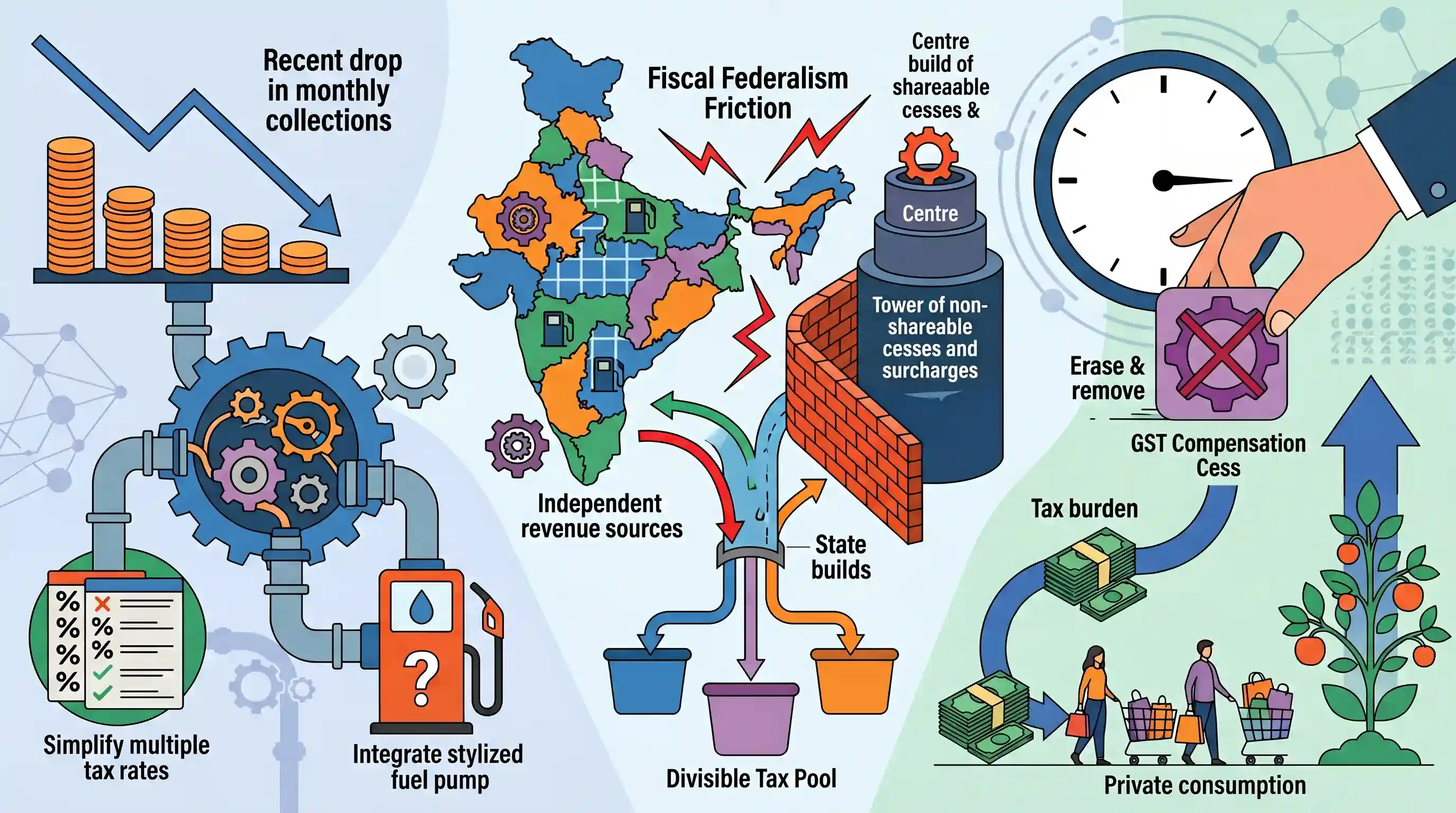
The editorial reviews the Goods and Services Tax (GST) regime on its eighth anniversary, observing that a recent drop in monthly collections underscores the need for deep structural reforms. Key pending reforms include rationalizing tax slabs and bringing fuel into the GST net. However, progress is stalled by friction in fiscal federalism: States are reluctant to surrender their remaining independent revenue sources (like fuel taxes) because the Centre increasingly relies on non-shareable cesses, thereby shrinking the divisible tax pool. The article strongly advocates that the GST Compensation Cess—currently extended to March 2026 to repay pandemic-era loans—must be completely abolished upon expiry rather than subsumed into regular GST rates. Removing this cess is essential to lower the overall tax burden, stimulate private consumption, and revive economic growth.
Key Points
- GST collections in June dropped to ₹1.85 lakh crore, a near-three-year low that signals slowing economic momentum and highlights the need for structural tax reforms.
- There is a pressing need to reduce the number of GST slabs and bring fuel and electricity under the GST framework to make the tax system more efficient.
- States are resisting the inclusion of fuel under GST as they are already unhappy with their shrinking share in the central tax pool, largely due to the Centre's heavy reliance on non-shareable cesses and surcharges.
- The GST Compensation Cess, which was extended to March 2026 to repay COVID-19 pandemic-related borrowings, should ideally be removed entirely rather than being subsumed into new, higher GST rates.
- Removing the Compensation Cess would provide much-needed tax relief to consumers, helping to spur private consumption and economic growth.
Important Terms
Goods and Services Tax (GST)

Comprehensive, destination-based indirect tax replacing multiple central and state levies. Introduced by the 101st Amendment (2017) to create a unified national market and eliminate tax cascading.
UPSC context
GS-III (Indian Economy); tests knowledge of indirect tax reforms and their impact on economic growth and federalism.
GST Compensation Cess
Additional levy on luxury and sin goods to compensate States for revenue losses post-GST. It is extended to March 2026 specifically to repay pandemic-era borrowings.
UPSC context
GS-III (Economy) and GS-II (Federalism); crucial for understanding Centre-State financial disputes and debt management.
GST Council
A constitutional body (Article 279A) chaired by the Union Finance Minister to decide GST rates and laws. It features a weighted voting system representing both Centre and States.
UPSC context
GS-II (Polity/Governance); tests understanding of constitutional bodies and collaborative decision-making in a federal structure.
Fiscal Federalism
The financial relationship and resource allocation between Union and State governments. It aims to balance state financial autonomy with national economic coherence.
UPSC context
GS-II/III; core topic for Centre-State relations, financial devolution, and the role of the Finance Commission.
Divisible Pool
The portion of central tax revenue shared with States as per Finance Commission recommendations. Notably, it excludes revenue from cesses and surcharges under Article 270.
UPSC context
GS-III (Budgeting/Economy); tests understanding of tax devolution mechanisms and fiscal equity between different tiers of government.
Cess
A "tax on tax" earmarked for a specific public purpose, such as education or health. Unlike basic taxes, its proceeds are not shareable with the States.
UPSC context
GS-III (Resource Mobilization); tests awareness of revenue sources and the shrinking share of states in the total tax pool.
Prelims Trap
GST Compensation Cess was extended till 2026 to continue compensating States for ongoing GST revenue shortfalls.
The extension to 2026 is strictly to repay COVID-19 pandemic-era back-to-back borrowings (principal and interest) raised by the Centre, not to provide fresh revenue compensation to States.
Static Concepts Connected
What revenues are excluded from the divisible pool under Article 270?
- Specific Cesses: Levied for dedicated purposes like education or road development, cesses are exclusively retained by the Centre and not shared with States.
- Surcharges: Imposed as a tax on tax under Article 271, surcharges also bypass the divisible pool, remaining entirely with the Union government.
Which major items are currently outside the purview of the GST framework?
- Petroleum Products: Five key items including crude oil, natural gas, petrol, diesel, and ATF are temporarily excluded until the GST Council decides otherwise.
- Alcohol for consumption: Alcoholic liquor for human consumption is constitutionally excluded from GST and remains subject to State excise duties.
- Electricity & Real Estate: State governments continue to levy independent electricity duties and stamp duties on real estate transactions.
Cross-Topic Patterns
16th Finance Commission mandate
The rising share of cesses directly impacts the 16th Finance Commission's deliberations, as States demand higher vertical devolution to offset their shrinking share of actual gross tax revenue.
Indirect taxes and K-shaped recovery
High indirect tax burdens via cesses disproportionately impact lower-income demographics, depressing private consumption and limiting the scope of a broad-based economic recovery.

Expect a 2026 Prelims statement differentiating the original mandate of the GST Compensation Cess from its current debt-servicing extension.
Linked PYQs · 4
Linked PYQs · 4
- 2020MainsGS3
Explain the rationale behind the Goods and Services Tax (Compensation to States) Act of 2017. How has COVID-19 impacted the GST compensation fund and created new federal tensions?
- 2019MainsGS3
Enumerate the indirect taxes which have been subsumed in the Goods and Services Tax (GST) in India. Also, comment on the revenue implications of the GST introduced in India since July 2017.
- 2025MainsGS2
Examine the evolving pattern of Centre-State financial relations in the context of planned development in India. How far have the recent reforms impacted the fiscal federalism in India?
- 2017PrelimsGS1
What is/are the most likely advantages of implementing 'Goods and Services Tax (GST)'? 1. It will replace multiple taxes collected by multiple authorities and will thus create a single market in India. 2. It will drastically reduce the 'Current Account Deficit' of India and will enable it to increase its foreign exchange reserves. 3. It will enormously increase the growth and size of economy of India and will enable it to overtake China in the near future. Select the correct answer using the code given below:
