Indian Economic Growth Resilience Amid US Tariffs
Source:The Hindu ↗
Why It Matters
This article comprehensively links core GS-3 concepts—such as real vs. nominal GDP, GDP deflator, bond yield premiums, and fiscal deficit—with contemporary geopolitical challenges like US trade protectionism and shifting global supply chains. It serves as an excellent case study for Mains answers on how domestic fiscal policies (tax cuts, employment schemes) are utilized to buffer the economy from external shocks.
Summary
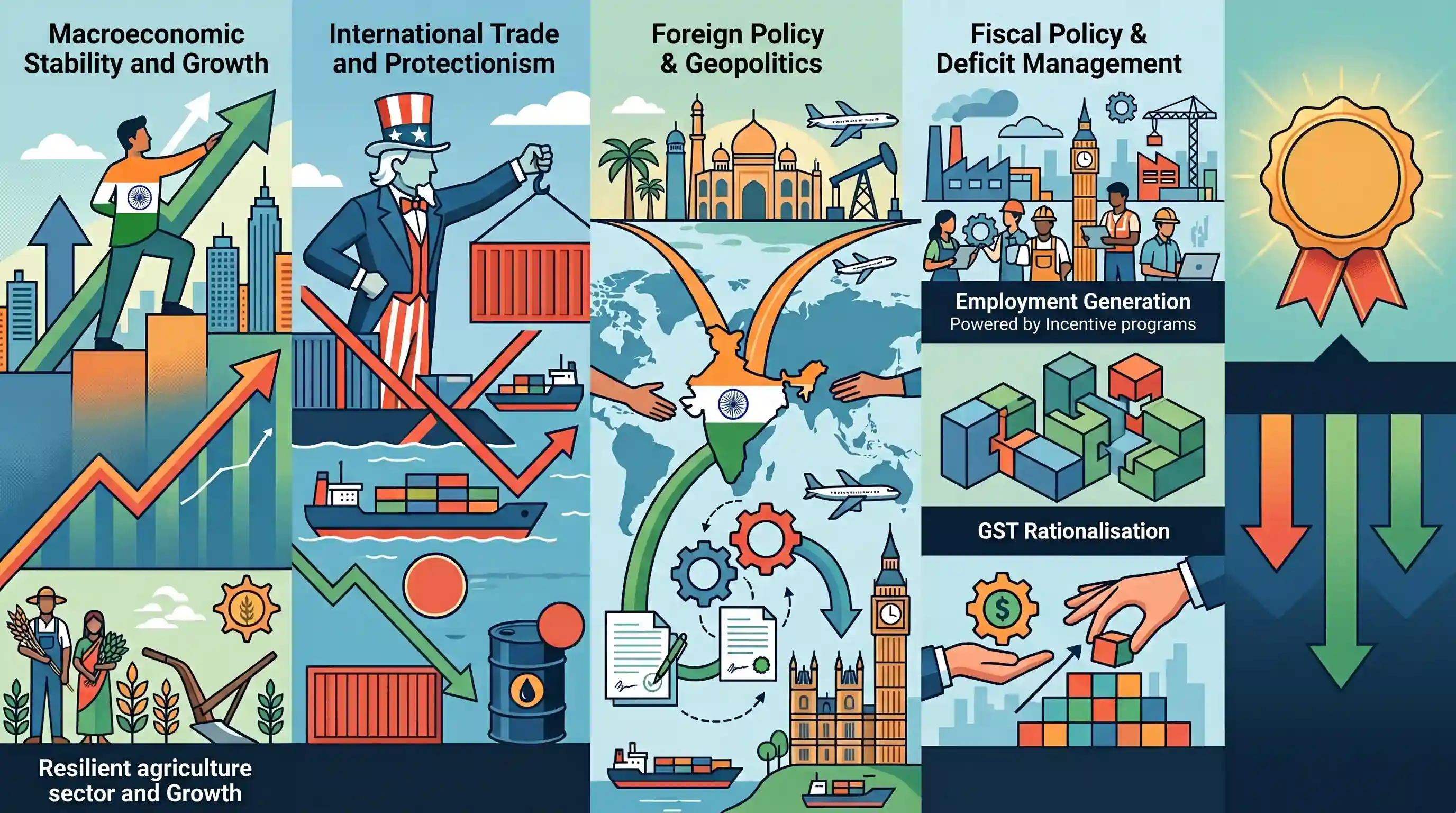
Chief Economic Advisor V. Anantha Nageswaran expressed confidence that the Indian economy will sustain its high growth momentum despite recent punitive tariffs imposed by the United States. While India recorded a robust 7.8% real GDP growth in the first quarter of FY26, aided by a lower GDP deflator and resilient agriculture, the new 50% U.S. tariffs—including a 25% penalty over Russian oil purchases—are expected to impact second-quarter growth. To mitigate this, the government is focusing on trade diversification via Free Trade Agreements (FTAs) with Middle Eastern nations and the UK, while reinforcing the domestic economy through employment-linked incentives, GST rationalisation, and steadfast fiscal consolidation. This fiscal prudence recently earned India a sovereign credit rating upgrade from S&P, significantly reducing borrowing costs.
Key Points
- India's real GDP grew by 7.8% year-on-year in Q1 of FY26, supported by a favorable 'GDP deflator', while agriculture sector output improved to a 3.7% growth.
- The US imposed a steep 50% tariff on Indian goods effective August 27, 2025, which includes a 25% penalty for India's ongoing purchases of Russian crude oil.
- CEA V. Anantha Nageswaran noted that the tariff impact will be mostly contained to Q2 and part of Q3, with the government working to provide 'time' and 'financial' cushions to the export sector.
- Domestic consumption and investment are supported by recent income tax cuts, upcoming GST rationalisations, and the employment-linked incentive scheme introduced in the July 2024 Budget.
- Strict fiscal prudence has cut the fiscal deficit estimate to 4.4% for the year, resulting in India's first sovereign credit rating upgrade by S&P in 30 years and a steep drop in the 10-year bond yield risk premium.
- India is actively pursuing trade diversification through FTAs with nations like the UAE, UK, Oman, and Bahrain to reduce reliance on single markets amid rising global protectionism.
Important Terms
Employment-linked Incentive (ELI) Scheme

A Union Budget 2024-25 initiative providing financial incentives to first-time employees and employers to boost formal job creation and social security coverage via EPFO.
UPSC context
Relevant for GS Paper-3 (Economy, Employment) and Prelims; focuses on formalization and government strategies for job creation.
GDP Deflator
A comprehensive inflation measure calculated as the ratio of Nominal GDP to Real GDP, reflecting price changes in all domestically produced goods and services.
UPSC context
GS Paper-3 topic under Inflation and Growth; tests understanding of real vs. nominal economic indicators.
Fiscal Consolidation
Government strategies aimed at reducing fiscal deficits and public debt through revenue enhancement and expenditure rationalisation to ensure macroeconomic stability.
UPSC context
Core GS Paper-3 topic (Budgeting/Fiscal Policy); tests knowledge of FRBM Act and sustainable debt management.
GST Rationalisation
The process of simplifying the GST structure by reducing or merging multiple tax slabs to improve tax compliance, ease of business, and administrative efficiency.
UPSC context
GS Paper-3 (Indian Economy/Taxation); relevant for mains discussions on indirect tax reforms and cooperative federalism.
Sovereign Credit Rating
An assessment by global agencies (like S&P) of a country's creditworthiness; India’s recent upgrade to 'BBB' reflects improved fiscal discipline and growth prospects.
UPSC context
GS Paper-3 (External Sector/Economy); important for understanding global investor confidence and borrowing costs.
National Statistics Office (NSO)
The premier statistical agency under the Ministry of Statistics and Programme Implementation (MoSPI) responsible for compiling and releasing India's official GDP and inflation data.
UPSC context
GS Paper-3 and Prelims; tests knowledge of institutional frameworks for economic data collection and monitoring.
Prelims Trap
A higher GDP deflator leads to an increase in the Real GDP value for a given Nominal GDP.
Real GDP is calculated by dividing Nominal GDP by the GDP deflator. Therefore, a lower GDP deflator actually leads to a comparatively higher Real GDP figure.
Static Concepts Connected
How does the GDP Deflator differ from CPI and WPI?
- Comprehensive Coverage: It measures price changes for all domestically produced goods and services, not just a fixed basket like CPI or WPI.
- Excludes Imports: It strictly excludes prices of imported goods, whereas CPI includes imported goods if they are consumed domestically.
- Dynamic Weights: Its weights are dynamic and change annually based on current production patterns (Paasche index), unlike the fixed weights of CPI/WPI.
What macroeconomic indicators influence a country's Sovereign Credit Rating?
- Fiscal Discipline: A lower fiscal deficit and strict adherence to fiscal consolidation targets demonstrate better debt sustainability.
- External Balances: Healthy foreign exchange reserves and a manageable Current Account Deficit (CAD) reduce external default risks.
- Policy Stability: Predictable policymaking, institutional strength, and ongoing structural reforms positively impact the qualitative aspect of ratings.
Cross-Topic Patterns
Energy Security vs Western Geopolitics
India's continued purchase of Russian oil despite US penalties highlights the shift toward prioritizing domestic macroeconomic stability and energy security over geopolitical alignment.
Tariffs driving Middle East FTA push
Punitive US tariffs accelerate India’s pivot toward the Middle East (UAE CEPA) and UK to de-risk exports, linking protectionist trade responses directly with the Act West policy.

Sovereign rating upgrades linked to fiscal deficit targets + GDP deflator mechanics are prime targets for a 2026 Prelims economics question.
Linked PYQs · 5
Linked PYQs · 5
- 2019MainsGS3
Do you agree with the view that steady GDP growth and low inflation have left the Indian economy in good shape? Give reasons in support of your arguments.
- 2025MainsGS3
What are the challenges before the Indian economy when the world is moving away from free trade and multilateralism to protectionism and bilateralism? How can these challenges be met?
- 2018PrelimsGS1
Increase in absolute and per capita real GNP do not connote a higher level of economic development, if
- 2022MainsGS3
Economic growth in the recent past has been led by increase in labour productivity." Explain this statement. Suggest the growth pattern that will lead to creation of more jobs without compromising labour productivity.
- 2023MainsGS3
Faster economic growth requires increased share of the manufacturing sector in GDP, particularly of MSMEs. Comment on the present policies of the Government in this regard.
