Wastewater Surveillance Proves Crucial for Disease Outbreak Tracking
Source:The Hindu ↗
Why It Matters
This highlights the intersection of public health governance, technology, and administration. It underscores the value of proactive disease surveillance as critical public health infrastructure and illustrates how political and budgetary decisions directly impact the state's capacity to manage and mitigate health crises.
Summary
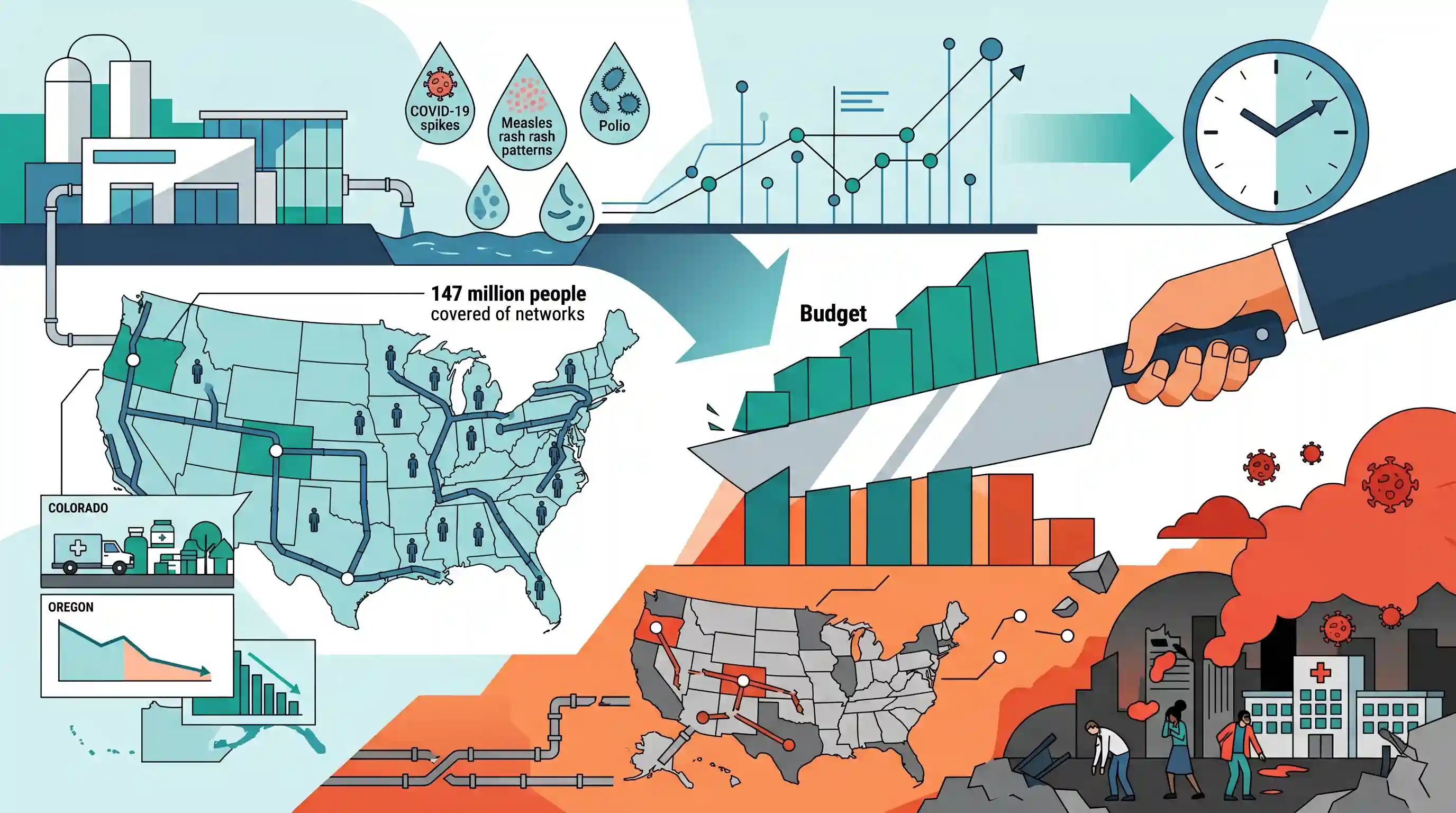
Two recent CDC studies highlight the effectiveness of wastewater surveillance in detecting early signs of communicable diseases like measles, COVID-19, and polio, giving public health officials a critical head start. This nationwide early-warning infrastructure, which covers 147 million people in the U.S., allowed states like Colorado and Oregon to uncover silent transmission and effectively allocate health resources. However, the system's future is jeopardized by a proposed Trump administration budget cut that would slash its funding from $125 million to $25 million annually. Health experts warn that scaling back this vital public health tool could severely compromise outbreak readiness and response capabilities.
Key Points
- Wastewater testing serves as a vital early warning system for communicable diseases, detecting outbreaks of measles, COVID-19, polio, mpox, and bird flu days to months before clinical cases are confirmed.
- Studies from Colorado and Oregon showed that monitoring sewage allowed health departments to trace silent transmission and proactively alert the public and healthcare providers.
- The CDC-run national wastewater surveillance system faces a severe threat due to a proposed funding cut from $125 million to $25 million under a Trump administration budget plan.
- Public health officials deem wastewater surveillance as one of the greatest advancements in disease monitoring in a generation, emphasizing the necessity of sustained federal funding for such infrastructure.
Important Terms
National Wastewater Surveillance System (NWSS)

A CDC-led initiative that monitors infectious diseases like COVID-19 and polio by analyzing community sewage. It acts as an early-warning system for asymptomatic spread.
UPSC context
GS II: Public Health Infrastructure; GS III: Disaster Management. Tests knowledge of non-invasive surveillance technologies for pandemic preparedness.
Centers for Disease Control and Prevention (CDC)
The leading U.S. national public health agency, responsible for disease prevention, environmental health, and emergency response. It often sets global standards for epidemiological surveillance and research.
UPSC context
GS II: International institutions. Important for comparative analysis of health governance and global disease monitoring frameworks.
Wastewater-Based Epidemiology (WBE)
The science of monitoring pathogens, chemicals, or drugs in wastewater to assess the health status and disease prevalence of a community without relying on individual clinical tests.
UPSC context
GS III: Science and Technology. Relevant for innovations in public health and the "One Health" approach to disease tracking.
Integrated Disease Surveillance Programme (IDSP)
A Ministry of Health initiative in India that monitors disease trends to provide early warning signals for outbreaks and coordinates decentralized responses across states.
UPSC context
GS II: Government policies and interventions. The primary Indian framework for disease tracking, comparable to the CDC's surveillance systems.
Genomic Sequencing
The laboratory technique used to determine the entire genetic makeup of a pathogen, enabling health officials to track variants, mutations, and transmission pathways.
UPSC context
GS III: Science and Technology. A high-priority topic regarding biotechnology and its application in managing viral outbreaks and antimicrobial resistance.
Public Health Infrastructure
The foundational physical and organizational structures (labs, data systems, workforce) required to deliver essential health services and respond to public health threats and emergencies.
UPSC context
GS II: Issues relating to health. Evaluates understanding of the systemic requirements for universal health coverage and epidemic resilience.
One Health
An integrated, unifying approach that aims to sustainably balance and optimize the health of people, animals, and ecosystems, often using environmental surveillance as a key tool.
UPSC context
GS II/III: Health and Environment. A major policy framework for preventing zoonotic diseases and managing interconnected biological threats.
Prelims Trap
Wastewater surveillance relies on symptomatic clinical data to confirm the presence of pathogens in a community.
WBE is specifically valuable because it detects pathogens shed by asymptomatic and pre-symptomatic individuals days or weeks before clinical cases peak.
Static Concepts Connected
What is the Integrated Health Information Platform (IHIP)?
- Next-Gen IDSP: It is the web-enabled, near-real-time electronic information system for India's Integrated Disease Surveillance Programme (IDSP).
- Syndromic Mapping: Integrates clinical, laboratory, and syndromic surveillance data on a GIS-enabled platform to track disease outbreaks.
- Integration Capacity: Designed to incorporate diverse public health data streams, making it compatible with future wastewater surveillance inputs.
How does Wastewater-Based Epidemiology support 'One Health'?
- Zoonotic Tracking: Monitors animal-origin pathogens (like Avian Influenza) in municipal environments before major human spillover occurs.
- AMR Mapping: Detects antimicrobial resistance genes in sewage, mapping the cycle of AMR across human, animal, and environmental ecosystems.
Cross-Topic Patterns
WBE + Antimicrobial Resistance (AMR)
Wastewater mapping provides a non-invasive way to track AMR genes across cities, connecting urban sanitation infrastructure directly with national antibiotic resistance policies.
Digital Health + Early Warning Systems
Linking WBE data with India's IHIP shifts public health from reactive management to predictive modeling, merging digital health governance with biological disaster management.

Wastewater-Based Epidemiology and its role in tracking AMR and zoonotic spillovers ('One Health') is a high-probability 2026 Prelims topic.
Linked PYQs · 4
Linked PYQs · 4
- 2021MainsGS2
“Besides being a moral imperative of a Welfare State, primary health structure is a necessary precondition for sustainable development.” Analyze.
- 2024MainsGS2
In a crucial domain like the public healthcare system the Indian State should play a vital role to contain the adverse impact of marketisation of the system. Suggest some measures through which the State can enhance the reach of public healthcare at the grassroots level.
- 2019MainsGS3
Disaster preparedness is the first step in any disaster management process. Explain how hazard zonation mapping will help disaster mitigation in the case of landslides.
- 2023MainsGS3
Introduce the concept of Artificial Intelligence (AI). How does Al help clinical diagnosis? Do you perceive any threat to privacy of the individual in the use of Al in healthcare?
