Parliamentary Affairs Committee Role in Convening Special Sessions
Source:The Hindu ↗
Why It Matters
The article highlights the procedural mechanism for convening Parliament sessions via the CCPA. It also touches upon ongoing security concerns in J&K and the recurrent political discourse surrounding Dr. B.R. Ambedkar and reservation policies, which are central to GS-II (Polity & Social Justice) and GS-III (Internal Security).
Summary
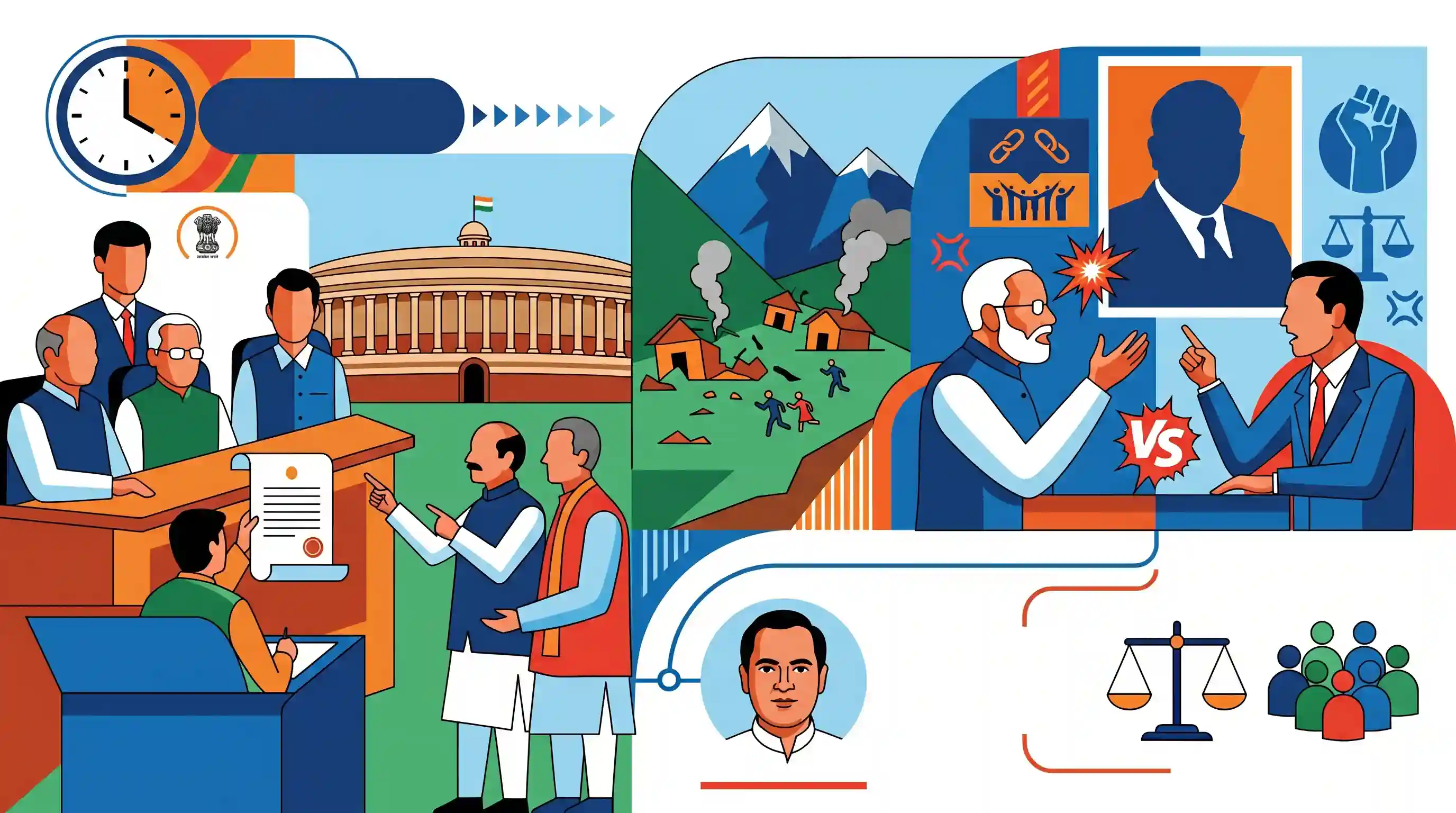
Union Minister Arjun Ram Meghwal stated that the Cabinet Committee on Parliamentary Affairs (CCPA) will consider the Opposition's request for a special parliamentary session. The demand, led by figures like Mallikarjun Kharge and Rahul Gandhi, was triggered by the Pahalgam terror attack that left 26 dead. Additionally, Meghwal engaged in political sparring, criticizing SP leader Akhilesh Yadav for a poster featuring Dr. B.R. Ambedkar and accusing the Congress of historically opposing OBC reservations during Rajiv Gandhi's tenure.
Key Points
- The Cabinet Committee on Parliamentary Affairs (CCPA) will decide on the Opposition's demand for a special session of Parliament.
- The demand follows the Pahalgam terror attack in Jammu and Kashmir, which resulted in 26 fatalities.
- Union Minister Arjun Ram Meghwal criticized Samajwadi Party leader Akhilesh Yadav for a poster equating himself with Dr. B.R. Ambedkar.
- Meghwal additionally attacked the Congress party, claiming it historically opposed OBC reservation under Rajiv Gandhi's leadership.
Important Terms
Cabinet Committee on Parliamentary Affairs (CCPA)

An extra-constitutional standing committee formed under the Rules of Business to manage government business in Parliament, determine session schedules, and scrutinize non-official bills. It ensures coordination between the executive and legislature.
UPSC context
GS Paper II (Polity); tests understanding of executive-legislative coordination and the role of specialized committees in parliamentary governance.
Special Session of Parliament
A unique meeting of Parliament convened by the President under Article 85(1) for specific milestones or urgent matters, occurring outside the traditional Budget, Monsoon, and Winter sessions.
UPSC context
GS Paper II (Polity); relevant for constitutional provisions on summoning the Houses and executive discretion in legislative management.
Cabinet Committees
Specialized, extra-constitutional groups of ministers formed to reduce the Cabinet's workload. They provide in-depth analysis of policy issues and facilitate inter-ministerial coordination for strategic decision-making.
UPSC context
GS Paper II (Polity); tests knowledge of executive structure and the "Inner Cabinet" decision-making process.
OBC Reservations
Affirmative action policy providing a 27% quota in public employment and education for socially and educationally backward classes, implemented following the 1980 Mandal Commission recommendations.
UPSC context
GS Paper II (Social Justice); covers Articles 15(4) and 16(4) and legal evolution post-Indra Sawhney judgment.
Internal Security
The maintenance of peace within national borders by countering domestic threats like terrorism and insurgency. In Jammu & Kashmir, it focuses on neutralizing cross-border infiltration and radicalization networks.
UPSC context
GS Paper III (Security); tests understanding of multifaceted security challenges and state response mechanisms like the UAPA.
Prelims Trap
The Cabinet Committee on Parliamentary Affairs (CCPA) is chaired by the Prime Minister.
While the Prime Minister heads most key Cabinet Committees (like Appointments, Security, Economic Affairs), the CCPA is traditionally chaired by the Defence Minister or Home Minister.
Static Concepts Connected
Who has the constitutional and executive authority to summon Parliament sessions?
- Constitutional Authority: The President summons each House under Article 85(1), ensuring a maximum gap of six months between consecutive sessions.
- Executive Decision: The Cabinet Committee on Parliamentary Affairs (CCPA) determines the actual dates and duration of parliamentary sessions.
- Special Sessions: The term is not explicitly defined in the Constitution; they are convened under the normal summoning powers of Article 85.
What are the key constitutional safeguards and landmarks for OBC reservation?
- Constitutional Provision: Article 340 empowers the President to appoint a commission (e.g., Mandal Commission) to investigate the conditions of socially and educationally backward classes.
- Indra Sawhney Judgement: The 1992 landmark judgement upheld the 27% quota but enforced the 50% ceiling and mandated the exclusion of the 'creamy layer'.
Cross-Topic Patterns
Security crises driving parliamentary oversight
Major terror attacks often prompt demands for 'Special Sessions', highlighting the crucial role of Parliamentary mechanisms in ensuring executive accountability and debate during internal security crises.
Historical debates in contemporary electoral politics
Political sparring over Dr. B.R. Ambedkar's legacy and the Mandal Commission history reflects the ongoing weaponization of post-independence ideological divides for contemporary electoral mobilization.

Expect a tricky prelims statement contrasting the chairmanship of the CCPA with the Cabinet Committee on Security or Economic Affairs.
Linked PYQs · 3
Linked PYQs · 3
- 2020PrelimsGS1
Consider the following statements: 1. The President of India can summon a session of the Parliament at such place as he/she thinks fit. 2. The Constitution of India provides for three sessions of the Parliament in a year, but it is not mandatory to conduct all three sessions. 3. There is no minimum number of days that the Parliament is required to meet in a year. Which of the statements given above is/are correct?
- 2023MainsGS3
Winning of 'Hearts and Minds' in terrorism-affected areas is an essential step in restoring the trust of the population. Discuss the measures adopted by the Government in this respect as part of the conflict resolution in Jammu and Kashmir.
- 2015MainsGS1
Mahatma Gandhi and Dr. B.R. Ambedkar, despite having divergent approaches and strategies, had a common goal of amelioration of the downtrodden. Elucidate.
