CCMB Researchers Find Clues to Darwin Abominable Mystery in Plants
Source:The Hindu ↗
Why It Matters
The article is important for UPSC aspirants as it touches upon fundamental concepts in biology (evolution and plant genetics) relevant for Prelims, while also demonstrating the cutting-edge achievements of Indian research institutions (CSIR-CCMB) relevant for Mains GS3 (Science and Technology).
Summary
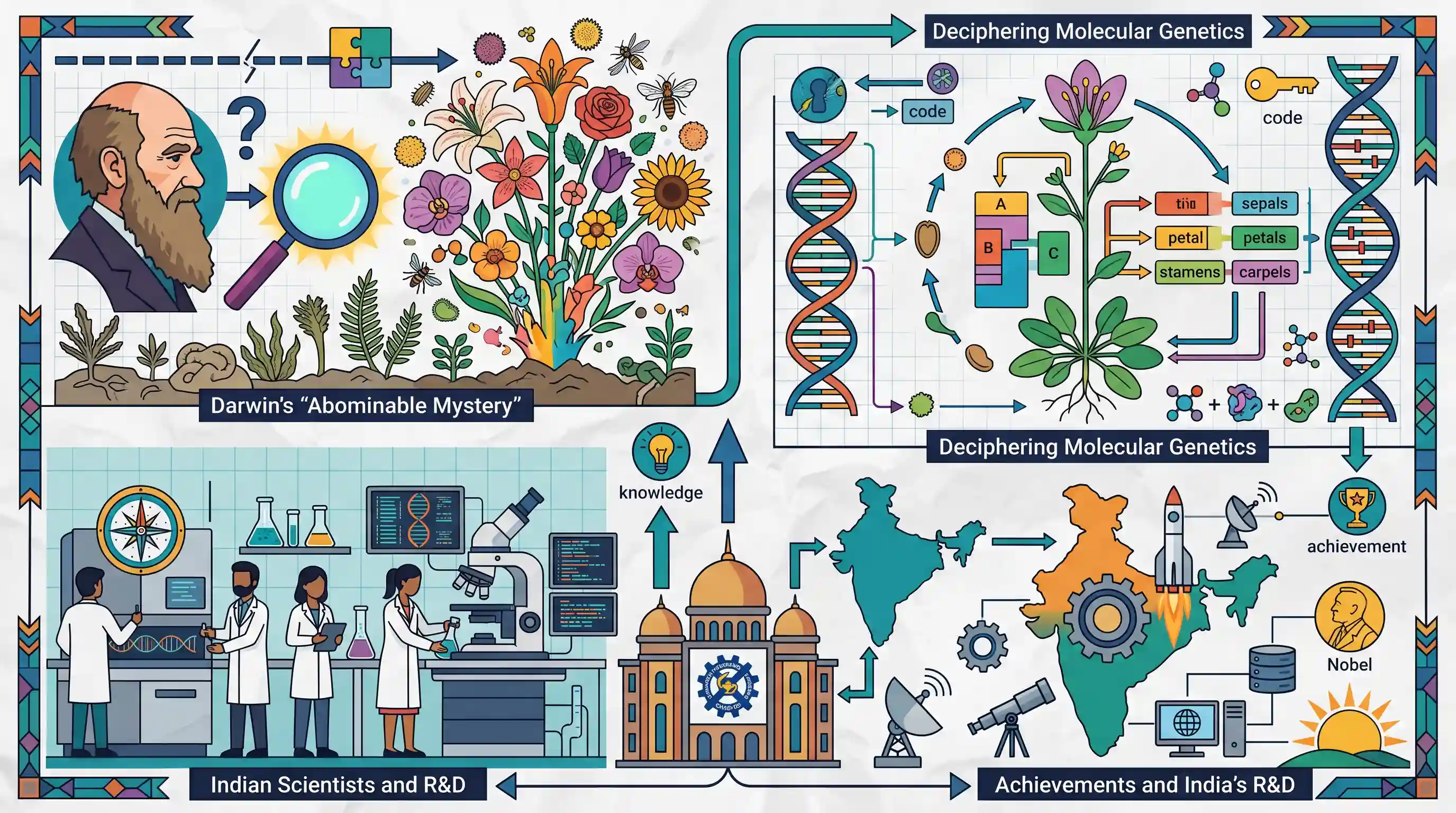
Researchers at the CSIR-Centre for Cellular and Molecular Biology (CCMB) have made significant strides in deciphering Charles Darwin's "abominable mystery"—the evolutionary puzzle regarding the sudden appearance and rapid diversification of flowering plants (angiosperms). By studying the genetic and molecular pathways in a common model plant, the Indian scientists uncovered critical clues about the evolutionary origins of floral development. This research showcases the fundamental research capabilities of Indian scientific institutions in tackling historical biological questions using modern molecular genetics.
Key Points
- Charles Darwin coined the phrase "abominable mystery" to describe the sudden evolutionary appearance and rapid, explosive diversification of angiosperms (flowering plants) in the fossil record.
- Researchers at the CSIR-Centre for Cellular and Molecular Biology (CCMB) have investigated the genetic mechanisms driving this evolutionary leap using a common plant model.
- The study sheds light on the molecular pathways and specific genes responsible for the development of complex floral organs, bridging the evolutionary gap between non-flowering and flowering plants.
- The findings highlight India's growing capacity in fundamental biological research and molecular genetics, answering longstanding questions in evolutionary biology.
Important Terms
Council of Scientific and Industrial Research (CSIR)

India's largest public-funded R&D organization, established in 1942. It operates as an autonomous body under the Ministry of Science and Technology, overseeing a network of 37 national laboratories.
UPSC context
GS Paper 3: Science & Technology; relevant for institutional frameworks and indigenous R&D achievements.
Centre for Cellular and Molecular Biology (CCMB)
A premier CSIR laboratory in Hyderabad specializing in modern biology, genomics, and biotechnology. It is recognized globally as a 'Center of Excellence' by UNESCO for cellular research.
UPSC context
GS Paper 3: Science & Technology; tests knowledge of premier Indian research institutions and their contributions.
Angiosperms
Vascular plants that produce flowers and bear seeds enclosed within a fruit. They comprise approximately 80% of all known green plants and are the most diverse plant group.
UPSC context
GS Paper 3: Biology and Environment; important for biodiversity, agriculture, and evolutionary studies.
Darwin’s ‘Abominable Mystery’
A phrase coined by Charles Darwin in 1879 describing the sudden appearance and rapid diversification of flowering plants in the fossil record, which challenged his theory of gradual evolution.
UPSC context
GS Paper 3: General Science; tests understanding of evolutionary biology and historical scientific puzzles.
SHUKR Gene
A specific gene identified by CCMB researchers that regulates pollen development. Its rapid evolution in eudicots provides a molecular explanation for the fast diversification of flowering plants.
UPSC context
GS Paper 3: Science & Technology; relevant for genetics, biotechnology, and recent Indian scientific breakthroughs.
Molecular Genetics
A sub-field of biology that addresses how differences in the structures or expression of DNA molecules manifest as variation among organisms.
UPSC context
GS Paper 3: Science & Technology; fundamental to understanding biotechnology and genomic research.
Evolutionary Biology
The study of the origins and changes in the diversity of life over time, encompassing natural selection, common descent, and speciation.
UPSC context
GS Paper 3: General Science; critical for understanding ecological shifts and the history of life.
Prelims Trap
"Darwin's 'abominable mystery' describes the missing links in the fossil record regarding early human evolution."
The phrase exclusively describes the sudden geological appearance and rapid, explosive diversification of angiosperms (flowering plants) around 130 million years ago, not human evolution.
Static Concepts Connected
How do Angiosperms differ from Gymnosperms in their reproductive biology?
- Seed enclosure: Angiosperms have seeds enclosed within an ovary (which becomes a fruit). Gymnosperms possess 'naked seeds' exposed on cones.
- Double fertilization: Angiosperms undergo double fertilization (forming a zygote and endosperm). Gymnosperms typically undergo single fertilization without forming a triploid endosperm.
- Reproductive structures: Angiosperms produce complex flowers to attract pollinators, whereas gymnosperms generally rely on wind pollination via cones.
What is the governance structure of the Council of Scientific and Industrial Research (CSIR)?
- Ex-officio Leadership: The Prime Minister of India serves as the ex-officio President of CSIR.
- Autonomous Status: It is an autonomous body registered under the Societies Registration Act, functioning under the Ministry of Science and Technology.
- Laboratory Network: It oversees a pan-India network of 37 national laboratories, including the Centre for Cellular and Molecular Biology (CCMB) in Hyderabad.
Cross-Topic Patterns
Gene discovery & climate-resilient agriculture
The SHUKR gene's role in pollen development under environmental stress connects basic evolutionary biology to applied climate-resilient agriculture, a recurring UPSC mains theme.
Fundamental science and the NRF
CCMB’s work reflects India’s growing push—institutionalized by the Anusandhan National Research Foundation (NRF)—to fund foundational scientific inquiries alongside applied technology.

Expect a Prelims 2026 statement question contrasting angiosperm vs. gymnosperm reproduction (double fertilization) and seed enclosure.
Linked PYQs · 4
Linked PYQs · 4
- 2023PrelimsGS1
'Microsatellite DNA' is used in the case of which one of the following?
- 2021MainsGS3
What are the research and developmental achievements in applied biotechnology? How will these achievements help to uplift the poorer sections of the society?
- 2011PrelimsGS1
Karl Marx explained the process of class struggle with the help of which one of the following theories?
- 2022PrelimsGS1
DNA Barcoding can be a tool to: 1. assess the age of a plant or animal. 2. distinguish among species that look alike. 3. identify undesirable animal or plant materials in processed foods. Which of the statements given above is/are correct?
