CCMB Genetic Discovery and Genome India Project Insights
Source:The Hindu ↗
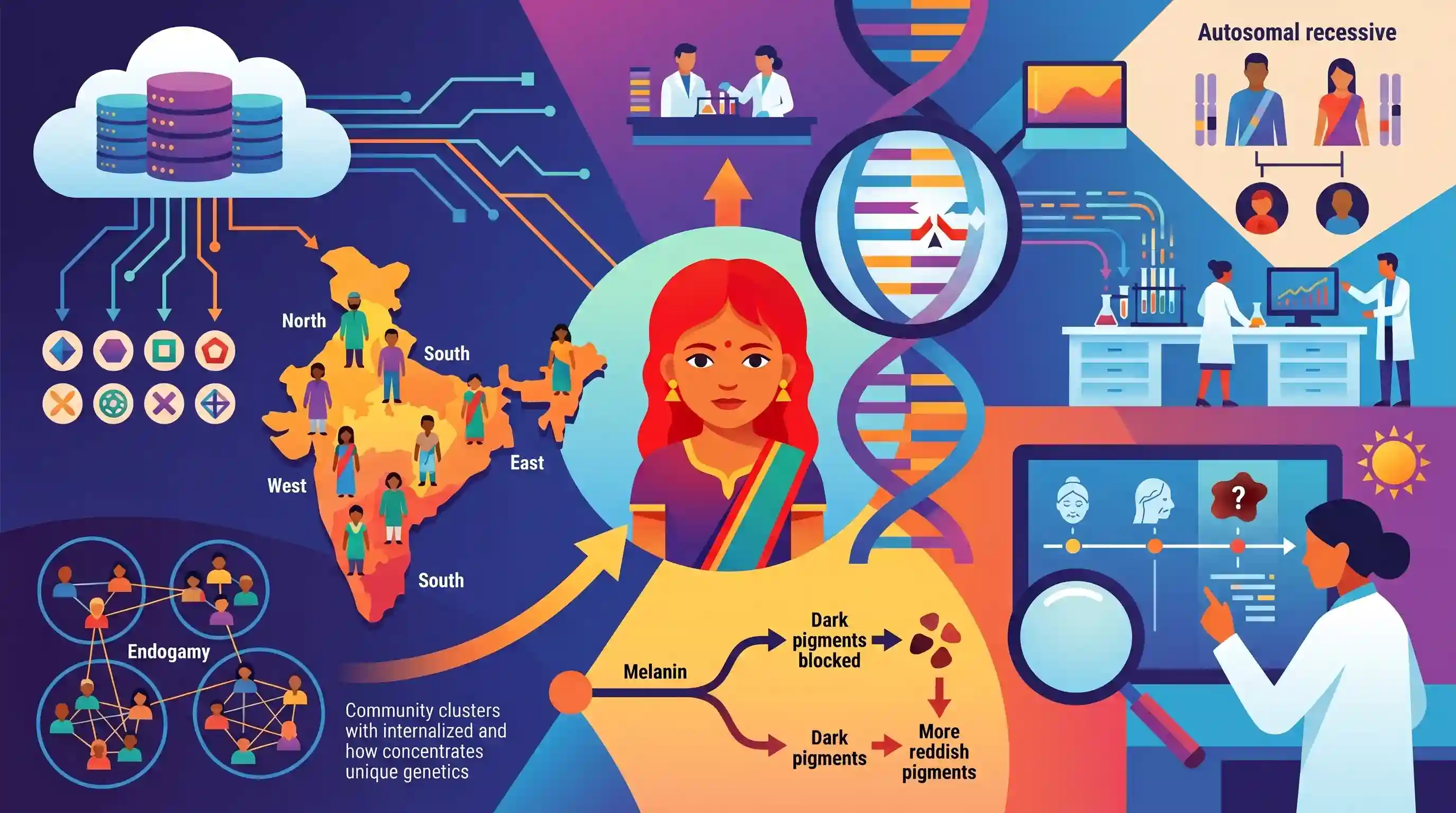
Why It Matters
Illustrates the practical outcomes of the GenomeIndia Project, bridges biological concepts (gene mutation, autosomal recessive traits) with sociological factors (endogamy), and touches upon public health implications (melanoma risks) relevant for GS Paper 3 (Science and Technology) and GS Paper 1 (Society).
Summary
Researchers at CSIR-CCMB have identified a rare autosomal recessive mutation in the MC1R gene responsible for red hair in a young Indian girl. By leveraging extensive genomic data from the GenomeIndia Consortium, scientists mapped 21 novel genetic variants associated with pigmentation across diverse Indian populations. The findings not only demonstrate the biological mechanisms of melanin production but also highlight how social practices like endogamy influence India's unique population genetics. Furthermore, tracking such gene variants is clinically important for predicting susceptibilities to skin conditions, including melanoma.
Key Points
- Scientists at CSIR-CCMB identified a rare mutation (c.872C>A) in the MC1R gene that caused red hair in a five-year-old Indian girl.
- The condition is autosomal recessive, meaning the child inherited one copy of the mutated gene from each parent, who were asymptomatic carriers.
- The MC1R gene regulates pigmentation by determining the balance between eumelanin (brown/black pigment) and pheomelanin (red/yellow pigment).
- Using data from the GenomeIndia Consortium—which sequenced 11,000 individuals across 91 populations—researchers found 21 novel and ultra-rare MC1R variants.
- The study reveals how Indian genetic diversity and social practices like endogamy lead to population-specific genetic variants and differing pigmentation traits across regions.
- Studying MC1R variants holds clinical significance because certain mutations can elevate susceptibility to skin cancers such as melanoma.
Important Terms
GenomeIndia Project

A Department of Biotechnology (DBT) flagship initiative to sequence 10,000 whole genomes from diverse ethnic groups, creating a comprehensive genetic reference database for the Indian population.
UPSC context
GS Paper III (Biotechnology); essential for questions on precision medicine, indigenous genetic mapping, and healthcare policy.
CSIR-Centre for Cellular and Molecular Biology (CCMB)
A premier research laboratory under the Council of Scientific and Industrial Research (CSIR), based in Hyderabad, specializing in genetics, molecular biology, and biotechnology.
UPSC context
GS Paper III (Science & Tech); relevant for institutional roles in Indian biological research and indigenous innovations.
GenomeIndia Consortium
A collaborative network of 20 leading Indian research and academic institutions, including IISc and CCMB, responsible for implementing the GenomeIndia Project.
UPSC context
GS Paper III; tests knowledge of institutional frameworks and public-private-academic partnerships in high-end scientific research.
MC1R Gene
The protein-coding gene responsible for regulating melanin production; mutations in this gene typically determine hair and skin color variations like red hair.
UPSC context
GS Paper III (Genetics); tests understanding of genetic inheritance, mutations, and biological markers in human health.
Endogamy
The social practice of marrying within a specific group, which in the Indian context leads to distinct genetic signatures and increased prevalence of rare recessive traits.
UPSC context
GS Paper I (Society) and III (Genetics); connects social structures with population genetics and health predispositions.
Melanin
A natural pigment responsible for the color of skin, hair, and eyes; its production level is influenced by specific genes like MC1R.
UPSC context
GS Paper III (Biology/Health); basic biological concept often linked to disease susceptibility like melanoma.
Autosomal Recessive Mutation
A genetic condition where an individual must inherit two copies of a mutated gene (one from each parent) to manifest a specific trait or disorder.
UPSC context
GS Paper III (Science); critical for understanding the inheritance patterns of rare diseases and traits in endogamous populations.
MedGenome
A leading private-sector genomics company in India that provides genetic diagnostics and contributes to large-scale population-based genomic studies and databases.
UPSC context
GS Paper III (Biotechnology); relevant for discussions on the role of private enterprises in healthcare and genomic data.
Prelims Trap
The MC1R genetic mutation halts all melanin production entirely, resulting in red hair.
The mutation does not stop melanin synthesis; it alters the balance from eumelanin (black/brown) to pheomelanin (red/yellow). A complete lack of melanin characterizes albinism.
Static Concepts Connected
What defines an autosomal recessive genetic trait?
- Two copies needed: The trait manifests only when an individual inherits two copies of the mutated gene, one from each parent.
- Asymptomatic carriers: Parents carrying just one copy of the mutation do not show symptoms but can pass the altered gene to their offspring.
- Common examples: Sickle cell anemia, cystic fibrosis, and certain pigmentation variations like the MC1R mutation fall under this category.
What is the Genome India Project (GIP)?
- Core objective: A Department of Biotechnology-funded pan-India initiative that successfully sequenced over 10,000 human genomes to map India's immense genetic diversity.
- Reference database: It aims to create a baseline reference genetic database to better understand population-specific diseases, genetic variants, and phenotypic traits.
- Personalized medicine: The resulting data forms the bedrock for predictive health and personalized medicine, aiding in targeted clinical interventions.
Cross-Topic Patterns
Endogamy's impact on genetic diversity
GS1 (Indian Society) intersects with GS3 (Science). The cultural practice of endogamy restricts gene pools, increasing the frequency of homozygous genotypes and rare recessive genetic disorders in specific populations.
Pigmentation genes and skin cancer risks
Connecting basic genetic mapping to clinical health. Tracking MC1R variants goes beyond determining physical traits; it clinically predicts an individual's susceptibility to severe skin conditions like melanoma.

Expect a 2026 Prelims question linking GenomeIndia's sequencing goals with the genetic consequences of endogamy and recessive traits.
Linked PYQs · 3
Linked PYQs · 3
- 2017PrelimsGS1
With reference to agriculture in India, how can the technique of 'genome sequencing', often seen in the news, be used in the immediate future? 1. Genome sequencing can be used to identify genetic markers for disease resistance and drought tolerance in various crop plants. 2. This technique helps in reducing the time required to develop new varieties of crop plants. 3. It can be used to decipher the host-pathogen relationships in crops. Select the correct answer using the code given below:
- 2021PrelimsGS1
In the context of hereditary diseases, consider the following statements : 1. Passing on mitochondrial diseases from parent to child can be prevented by mitochondrial replacement therapy either before or after in vitro fertilization of egg. 2. A child inherits mitochondrial diseases entirely from mother and not from father. Which of the statements given above is/are correct?
- 2023PrelimsGS1
'Microsatellite DNA' is used in the case of which one of the following?
