CCI Dismisses Antitrust Complaint Against Reliance Jio and Others
Source:The Hindu ↗
কেন এটি গুরুত্বপূর্ণ
Highlights the evidentiary threshold required by the CCI to investigate allegations of cartelization and abuse of dominant position, and clarifies the regulatory stance on uniform pricing in oligopolistic markets.
সারসংক্ষেপ
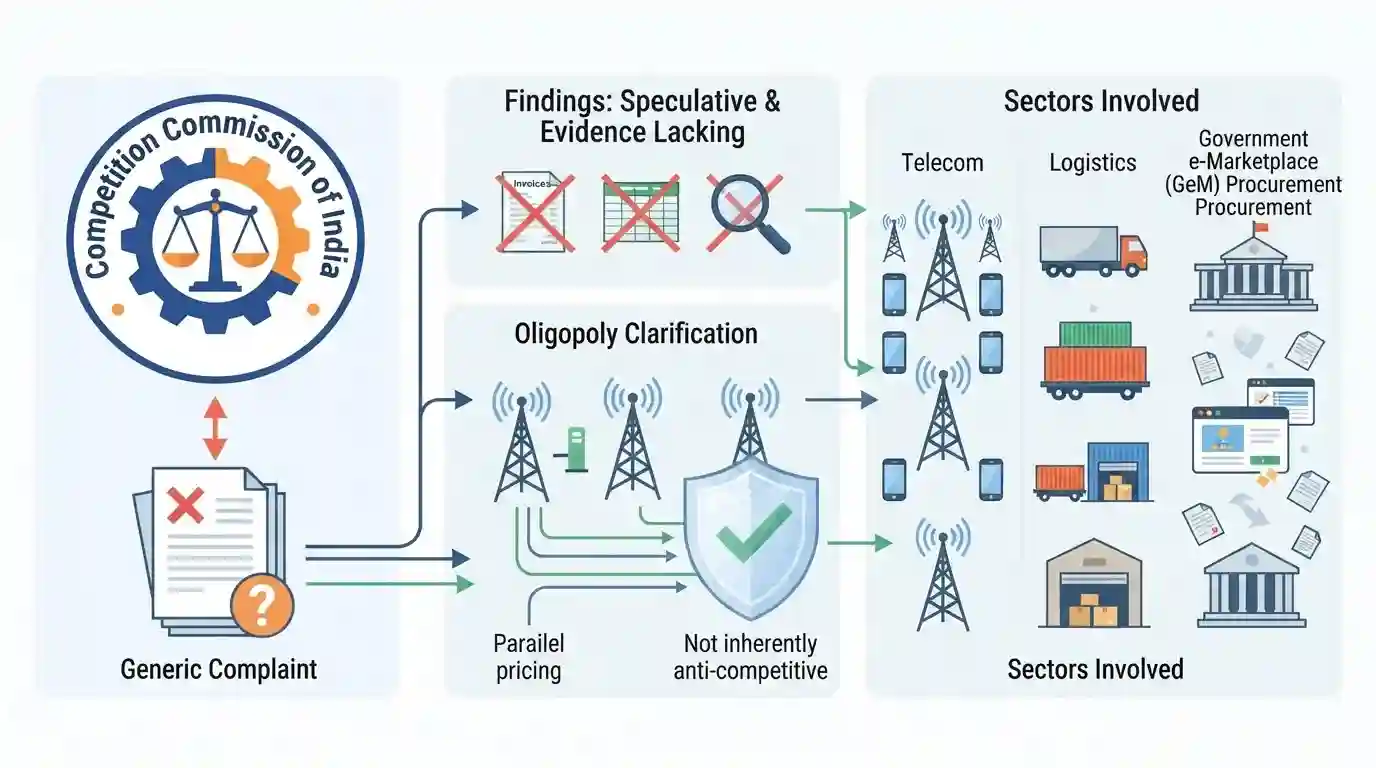
The Competition Commission of India (CCI) has dismissed a generic complaint alleging anti-competitive practices by Reliance Jio and over 4,500 other firms across various sectors, including telecom, logistics, and government e-marketplace (GeM) procurement. The complaint alleged violations of Sections 3 and 4 of the Competition Act—pertaining to anti-competitive agreements and abuse of dominant position. However, the CCI found the allegations to be speculative and devoid of documentary evidence such as invoices or bid documents to substantiate claims of collusion or bid-rigging. Notably, regarding the telecom sector, the regulator clarified that similar tariff plans in an oligopolistic market do not inherently prove the existence of an anti-competitive agreement, emphasizing the need for concrete foundational facts rather than relying on a "roving and fishing inquiry."
মূল বিষয়
- The Competition Commission of India (CCI) dismissed a complaint alleging anti-competitive conduct against Reliance Jio Infocomm and over 4,500 other firms across multiple sectors.
- The complaint alleged violations of Sections 3 and 4 of the Competition Act, which relate to anti-competitive agreements and abuse of dominant position.
- The CCI noted a complete lack of documentary evidence (such as invoices or bid documents) to support claims of collusion, exclusionary practices, or bid-rigging on platforms like the Government e-Marketplace (GeM).
- Regarding the telecom sector, the regulator clarified that mere similarity in prepaid tariff plans in an oligopolistic market cannot independently indicate an anti-competitive agreement.
গুরুত্বপূর্ণ শব্দ
Competition Commission of India (CCI)

A statutory body established under the Competition Act, 2002, responsible for enforcing the law, promoting fair competition, preventing anti-competitive agreements, and protecting consumer interests in Indian markets.
UPSC context
GS Paper II (Statutory Bodies) and GS III (Indian Economy). Tests regulatory governance, antitrust issues, and market fair play.
Competition Act, 2002
The primary Indian legislation promoting market competition, prohibiting anti-competitive agreements and abuse of dominant positions, and regulating mergers. It replaced the Monopolies and Restrictive Trade Practices Act, 1969.
UPSC context
GS Paper III (Indian Economy). Tests economic reforms, domestic trade facilitation, and consumer welfare laws.
Abuse of Dominant Position
Illegal behavior under Section 4 of the Competition Act, 2002, where an enterprise uses its market strength to impose unfair pricing, restrict production, deny market access, or leverage dominance.
UPSC context
GS Paper III (Indian Economy). Tests analysis of corporate monopoly, market regulations, and big-tech dominance in India.
Oligopoly
A market structure dominated by a small number of large sellers or producers, characterized by high entry barriers, pricing interdependence, and a balance between competitive pricing and potential collusion.
UPSC context
GS Paper III (Indian Economy) and Economics Optional. Tests understanding of market structures, pricing strategies, and telecom sector concentration.
Reliance Jio Infocomm Ltd
A major Indian telecommunications company and subsidiary of Jio Platforms, whose entry in 2016 reshaped India's telecom sector into a highly competitive, digital-first oligopoly with massive subscriber share.
UPSC context
GS Paper III (Infrastructure & Industrial Growth). Tests sector-specific disruption, telecommunication growth, and digital economy expansion.
প্রিলিমস ফাঁদ
Possessing a dominant market share or position in a sector is per se illegal under Section 4 of the Competition Act, 2002.
The Act does not prohibit dominance itself, only its abuse. A firm can legally hold a 100% market share as long as it does not engage in abusive practices like predatory pricing.
সংযুক্ত স্থির ধারণা
What is the distinction between Section 3 and 4 of the Competition Act?
- Section 3 focus: Targets collusive anti-competitive agreements (like cartels) that cause or are likely to cause an Appreciable Adverse Effect on Competition (AAEC).
- Section 4 focus: Prohibits the abuse of market dominance. Crucially, holding a dominant position is legal; only its exploitative or exclusionary abuse is penalised.
- Regulatory mechanism: The Competition Commission of India (CCI), under the Ministry of Corporate Affairs, enforces both sections through civil investigations.
What major changes did the Competition (Amendment) Act, 2023 bring to corporate antitrust enforcement?
- Global Turnover Benchmark: Penalties for anti-competitive conduct are now calculated based on global turnover rather than just relevant domestic turnover.
- Leniency Plus Scheme: Encourages cartel whistleblowing by offering additional leniency to an entity already cooperating if they expose another separate cartel.
- Settlement and Commitment: Introduces structured mechanisms to resolve vertical agreement and abuse of dominance disputes quickly without formal, protracted litigation.
আন্তঃবিষয় প্যাটার্ন
Oligopoly markets vs. Consumer welfare
Connects telecom consolidation with consumer rights, illustrating how price parallelism in concentrated markets tests the limits of antitrust enforcement versus capital-intensive sector survival.
GeM digitization vs. Public procurement integrity
Links digital public infrastructure (GeM) with competition law, examining how standardized online bidding platforms balance administrative transparency against the systemic risk of algorithmic bid-rigging.

The 2023 Competition Act amendments, particularly 'global turnover' and 'leniency plus', are highly likely to appear in a multi-statement Prelims question.
সংযুক্ত PYQ · 1
সংযুক্ত PYQ · 1
- 2023MainsGS2
Discuss the role of the Competition Commission of India in containing the abuse of dominant position by the Multi-National Corporations in India. Refer to the recent decisions.
