Samagra Shiksha Abhiyan Extension and Financial Outlay Approval
Source:Indian Express ↗
ఇది ఎందుకు ముఖ్యం
Understanding the financial mechanisms and policy realignments of major centrally sponsored educational schemes like Samagra Shiksha Abhiyan under NEP 2020 is vital for aspirants tracking social sector development, inclusive growth, and federal governance in India.
సారాంశం
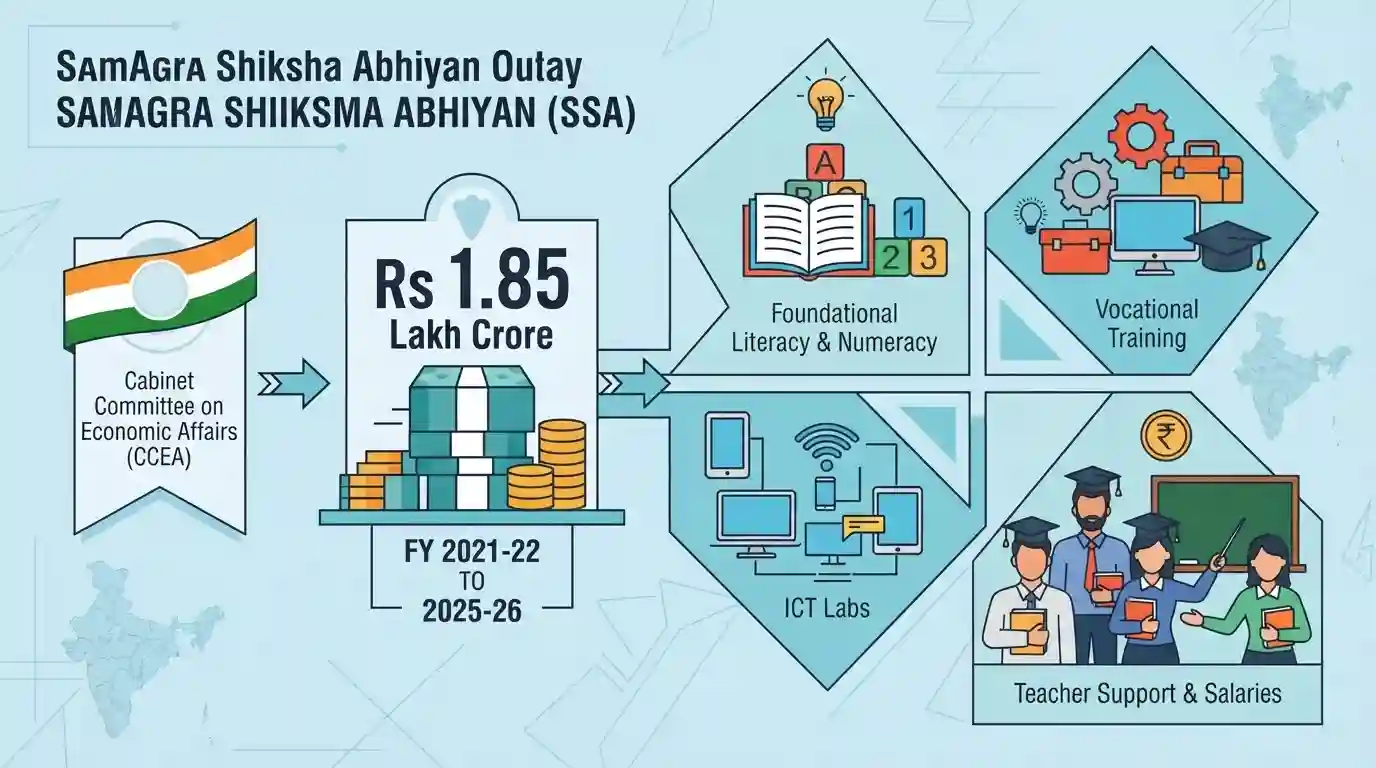
The Cabinet Committee on Economic Affairs (CCEA) approved the continuation of the Samagra Shiksha Abhiyan (SSA) scheme for school education up to the financial year 2025-26, with a total financial outlay of Rs 1.85 lakh crore. The extension aligns the Centrally Sponsored Scheme with the objectives of the National Education Policy (NEP) 2020, providing financial support for foundational literacy, vocational training, ICT labs, and teachers' salaries across states and union territories.
ముఖ్య అంశాలు
- The Cabinet Committee on Economic Affairs (CCEA) approved the continuation and extension of the Samagra Shiksha Abhiyan (SSA) scheme for school education up to March 31, 2026.
- The financial outlay for this extension is set at Rs 1.85 lakh crore, which includes a central share of Rs 1,29,347.49 crore.
- The revamped scheme incorporates key recommendations of the National Education Policy (NEP) 2020, focusing on foundational literacy and numeracy, vocational education, digital initiatives, and inclusive education.
- It aims to support around 1.16 million schools, over 156 million students, and 5.7 million teachers across government and aided schools in India.
ముఖ్యమైన పదాలు
Samagra Shiksha Abhiyan (SSA)

An integrated centrally sponsored scheme for school education from pre-primary to Class 12, subsuming Sarva Shiksha Abhiyan, RMSA, and Teacher Education to ensure inclusive and equitable quality education.
UPSC context
GS Paper II (Social Sector - Education). Tests understanding of government interventions and flagship schemes in school education.
National Education Policy (NEP) 2020
India's comprehensive education roadmap aiming to restructure the 10+2 system into a 5+3+3+4 framework, prioritize foundational literacy and numeracy, and foster holistic skill development.
UPSC context
GS Paper II (Social Sector - Education, Human Resources). Tests knowledge of major policy overhauls in India's education ecosystem.
Cabinet Committee on Economic Affairs (CCEA)
A high-level standing committee of the Union Cabinet, chaired by the Prime Minister, responsible for economic policy decisions, financial approvals, and coordinating economic initiatives.
UPSC context
GS Paper II (Polity - Executive, Governance). Tests awareness of cabinet committees and administrative decision-making bodies.
అనుసంధానమైన స్థిర భావనలు
What are the structural components and funding patterns of the Samagra Shiksha Abhiyan (SSA)?
- Scheme Integration: Merger background, It integrates Sarva Shiksha Abhiyan (SSA), Rashtriya Madhyamik Shiksha Abhiyan (RMSA), and Teacher Education (TE) into a unified pre-primary to Class 12 framework.
- Funding Ratio: Funding formula, Operates as a Centrally Sponsored Scheme with 60:40 for general states/UTs with legislature, 90:10 for NE/Himalayan states, and 100% for UTs without legislature.
- NEP Alignment: Policy alignment, Incorporates key NEP 2020 frameworks like NIPUN Bharat for FLN and NISHTHA for teacher training, aligning with SDG-4.
అంతర-అంశ నమూనాలు
Social Sector Schemes + Fiscal Federalism
Samagra Shiksha funding ratios mirror broader Centrally Sponsored Scheme architectures, testing fiscal federalism dynamics between the Union and states on social sector outlays.

Centrally Sponsored Schemes like SSA, their funding ratios, and merger history are prime material for matching or statement-based prelims questions.
అనుసంధాన PYQలు · 1
అనుసంధాన PYQలు · 1
- 2020MainsGS2
National Education Policy 2020 is in conformity with the Sustainable Development Goal-4 (2030). It intends to restructure and reorient education system in India. Critically examine the statement.
