Multilingual Education Policy Implementation and Legal Challenges
Source:Indian Express ↗
Why It Matters
This issue reflects the classic constitutional and administrative tension between preserving native linguistic diversity (Bhartiya Bhashas) and managing students' aspirations for global language acquisition. It highlights critical challenges in the ground-level implementation of national education reforms (NEP 2020), including infrastructural bottlenecks, teacher recruitment deficits, and the legal limits of executive policy enforcement under the Right to Education framework.
Summary
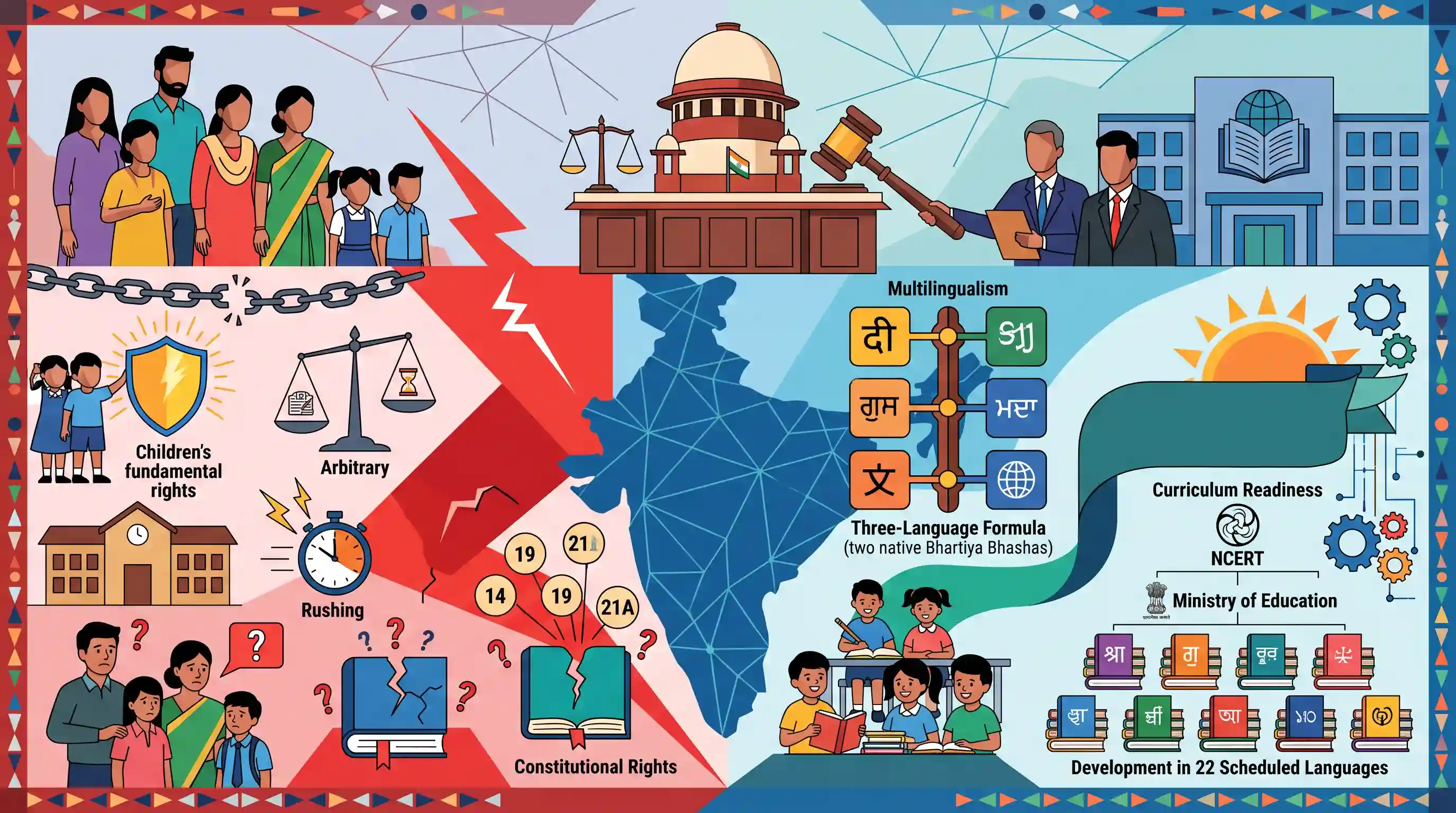
The Central Board of Secondary Education (CBSE) has defended its mandatory three-language policy in the Supreme Court against a petition filed by parents and teachers challenging its implementation in Class 9 from July 1, 2026. The petitioners argue that the policy is arbitrary, violates fundamental rights, and is being rushed without adequate teachers or textbooks. CBSE countered that nearly half of its affiliated schools already offer multiple native Indian languages and are fully compliant. Under the current rule, aligning with the National Education Policy (NEP) 2020, students must study three languages, of which at least two must be Bhartiya Bhashas (Indian languages), while foreign languages can still be studied under flexible provisions. NCERT and the Ministry of Education are actively addressing curriculum readiness through textbook development in 22 Scheduled Languages.
Key Points
- A petition filed in the Supreme Court by parents and foreign-language teachers from multiple cities challenges CBSE's May 15 circular, which mandates the three-language policy in Class 9 starting from July 1, 2026.
- Petitioners argue that the mandatory policy is arbitrary, unconstitutional, and violates Articles 14, 19, 21, and 21A of the Constitution. They highlight that CBSE abruptly reversed an earlier notification that had deferred the policy's implementation to the 2029-30 academic year.
- The legal challenge raises concerns about a severe lack of preparation, pointing out that schools lack proper textbooks, board assessment frameworks, and qualified language teachers—often forcing students to use Class 6 level materials.
- Defending the policy, CBSE submitted that 47.3% of its 28,848 affiliated schools already offer two or more Indian (Bhartiya) languages at the Class 9 level, thereby requiring no additional teachers, and 99.19% of schools have at least one Indian-language teacher.
- Under the current framework, Class 9 students must study three languages, with at least two being Bhartiya Bhashas (indigenous Indian languages). CBSE clarified that foreign languages are not being eliminated but can be pursued either as one of the three languages (alongside two Bhartiya Bhashas) or as an optional fourth language.
- To ease the transition, the NCERT has developed textbooks in all 22 Scheduled Languages, and the Ministry of Education has set up a High-Powered Task Force with CBSE and NIOS to fast-track curriculum and book development.
Important Terms
Three-Language Formula

An educational framework designed to promote multilingualism and national unity, requiring school students to learn three languages: their regional language, Hindi (or English in Hindi-speaking states), and an additional modern Indian or foreign language.
UPSC context
GS Paper II: Government Policies/Education. Tests federal-linguistic relations, curriculum reforms, and regional challenges in educational policy implementation.
National Education Policy 2020
A comprehensive framework aimed at restructuring India's school and higher education systems, promoting holistic, flexible, multilingual learning, and alignment with global standards of 21st-century education.
UPSC context
GS Paper II: Issues Relating to Education. Tests knowledge of national educational reforms, center-state coordination, and modern curriculum standards.
Eighth Schedule of the Constitution
A constitutional list (Articles 344(1) and 351) enumerating 22 officially recognized languages of India, serving as a tool for linguistic accommodation, official communication, and cultural preservation.
UPSC context
GS Paper II: Indian Constitution. Tests understanding of linguistic federalism, constitutional amendments (21st, 71st, 92nd), and official language status.
Article 21A of the Constitution
A Fundamental Right inserted by the 86th Constitutional Amendment Act of 2002, guaranteeing free and compulsory education to all children aged six to fourteen years.
UPSC context
GS Paper II: Fundamental Rights. Tests knowledge of the constitutional basis of education, judicial interpretations, and statutory frameworks like the RTE Act.
Article 14 of the Constitution
A Fundamental Right that guarantees equality before the law and equal protection of the laws to all persons within India, preventing arbitrary state action.
UPSC context
GS Paper II: Fundamental Rights. Tests the rule of law, reasonable classification, judicial review, and challenges to administrative policies.
Central Board of Secondary Education
A national-level board of education in India for public and private schools, functioning under the Union Ministry of Education to standardize school curricula.
UPSC context
GS Paper II: Governance/Education. Tests administrative alignment, standardizing national curriculum frameworks, and school board governance issues.
Prelims Trap
The Three-Language Formula is a constitutionally mandated scheme under Article 350A of the Constitution.
The formula is a policy recommendation originating from the Kothari Commission, not a direct constitutional mandate, though Articles 350A and 351 direct language promotion.
Static Concepts Connected
What are the key constitutional provisions governing language instruction and promotion in India?
- Article 350A: Directs states to provide adequate facilities for instruction in the mother-tongue at the primary stage to children belonging to linguistic minority groups.
- Article 351: Mandates the Union to promote the spread and development of the Hindi language as a medium of expression for India's composite culture.
- Eighth Schedule: Lists 22 official languages, expanded from 14 via the 21st (Sindhi), 71st (Konkani, Manipuri, Nepali), and 92nd (Bodo, Dogri, Maithili, Santhali) Amendments.
How did the Three-Language Formula (TLF) originate and evolve in India's education policy?
- Kothari Commission (1964-66): Recommended the TLF to promote multilingualism and national integration, especially bridging the linguistic gap between Hindi and non-Hindi speaking states.
- NPE 1968 Formulation: Formally adopted the TLF, recommending Hindi, English, and a regional language in Hindi-speaking states, and regional language, Hindi, and English in non-Hindi states.
- NEP 2020 Flexibilities: Introduced flexibility, stating no language will be imposed, but at least two of the three languages studied must be native Indian languages ('Bhartiya Bhashas').
Cross-Topic Patterns
Federalism vs. Centralized Education Policy
The implementation of NEP's language guidelines highlights the ongoing friction between the Union's centralized policy-making and the States' concurrent jurisdiction over school education systems.
Linguistic Rights vs. Right to Education
Balancing mandatory native language policies under Article 21A with linguistic rights of minorities under Article 30 and individual freedom of choice under Article 19.

Supreme Court scrutiny of the Three-Language Formula will likely frame 2026 questions on Eighth Schedule amendments and Article 350A.
Linked PYQs · 3
Linked PYQs · 3
- 2022MainsGS2
The Right of Children to Free and Compulsory Education Act, 2009 remains inadequate in promoting incentive-based system for children's education without generating awareness about the importance of schooling. Analyse.
- 2020MainsGS2
National Education Policy 2020 is in conformity with the Sustainable Development Goal-4 (2030). It intends to restructure and reorient education system in India. Critically examine the statement.
- 2024PrelimsGS1
The Constitution (71st Amendment) Act, 1992 amends the Eighth Schedule to the Constitution to include which of the following languages? 1. Konkani 2. Manipuri 3. Nepali 4. Maithili Select the correct answer using the code given below:
