Himachal Govt Schools Affiliated to CBSE Aim High
Source:tribuneindia ↗
Why It Matters
State-level educational reforms (such as introducing English-medium education and CBSE affiliation) and their impact on national assessment indices (ASER, PARAKH, PGI) are highly relevant for Prelims. The literacy statistics of Himachal Pradesh frequently appear in state-specific questions.
Summary
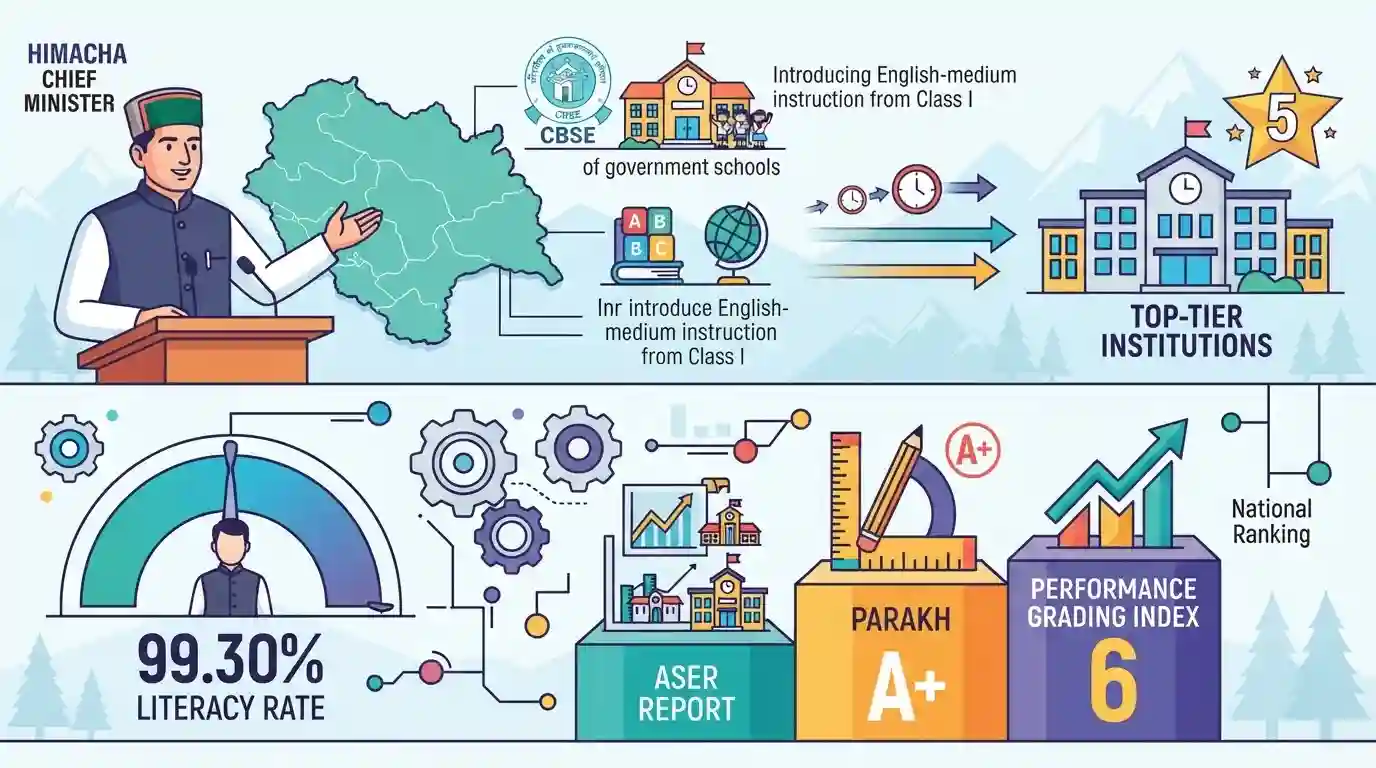
Himachal Pradesh Chief Minister Sukhvinder Singh Sukhu announced that the state's government schools, recently affiliated with the CBSE, will become top-tier educational institutions within five years. Highlighting recent educational reforms, the CM noted the introduction of English-medium instruction from Class I and the affiliation of 156 government schools with CBSE. The state has reached a milestone literacy rate of 99.30% and has significantly improved its standing in national educational assessments, including the ASER report, PARAKH, and the Performance Grading Index, where it now ranks sixth nationally.
Key Points
- Himachal Pradesh Chief Minister Sukhvinder Singh Sukhu stated that newly introduced CBSE-affiliated government schools will rank among the finest in five years.
- The state has commenced English-medium education from Class I in government schools, and 156 government schools have already been affiliated with the CBSE.
- Himachal Pradesh has achieved a historic literacy rate of 99.30%, declaring itself a fully literate state.
- The state has shown marked improvement in education indices, including the highest reading proficiency in the ASER report and a rise to 6th position in the Ministry of Education's Performance Grading Index.
Important Terms
ASER (Annual Status of Education Report)

A nationwide, household-based survey conducted annually by the NGO Pratham. It assesses children's enrollment status and foundational learning capabilities, particularly basic reading and arithmetic skills, across rural India.
UPSC context
Essential for GS Paper 2 (Social Sector/Education) and Essays to highlight learning deficits, foundational literacy, and NEP 2020 outcomes.
PARAKH
Performance Assessment, Review, and Analysis of Knowledge for Holistic Development. It is India’s first national assessment regulator under NCERT, introduced by NEP 2020 to standardize evaluation norms across all school boards.
UPSC context
Important for GS Paper 2 (Education/Governance) to discuss NEP 2020 implementation, ending rote learning, and standardizing national education quality.
Performance Grading Index (PGI)
A comprehensive framework developed by the Ministry of Education. It evaluates and grades the school education performance of States, UTs, and districts using data-driven indicators like learning outcomes, infrastructure, and equity.
UPSC context
Crucial for GS Paper 2 (Governance/Education) as an example of evidence-based policymaking, identifying educational gaps, and promoting cooperative federalism.
CBSE (Central Board of Secondary Education)
A prominent national-level board of education in India managed by the Union Government. It sets curriculum standards, conducts board examinations, and regulates public and private affiliated schools across the country.
UPSC context
Relevant in GS Paper 2 (Education Policy) regarding national curriculum standardization, state school affiliations, and integrating broader educational frameworks.
Prelims Trap
The ULLAS scheme targets foundational literacy and numeracy for children aged 6 to 14 years.
ULLAS (Nav Bharat Saksharta Karyakram) targets non-literates aged 15 years and above. Foundational literacy for early school-going children (ages 3-9) falls under NIPUN Bharat.
Static Concepts Connected
What is the mandate and structure of PARAKH under NEP 2020?
- National Regulator: Sets norms, standards, and guidelines for student assessment and evaluation across all recognized school boards in India.
- NCERT Unit: Constituted as an independent constituent unit within the NCERT, not as a separate statutory body by an Act of Parliament.
- Assessment Shift: Aims to shift the educational focus from rote memorization to formative, competency-based holistic assessments.
How does the Performance Grading Index (PGI) 2.0 evaluate states?
- Domains & Indicators: Evaluates states via 73 indicators across 6 domains, including Learning Outcomes, Access, Infrastructure, Equity, and Governance.
- Grading System: Classifies states into 10 grades (from 'Daksh' at the top to 'Akanshi-3' at the bottom). No state has achieved 'Daksh' yet.
- Objective: Promotes evidence-based policy making by highlighting specific intervention areas at the state and district levels.
Cross-Topic Patterns
NGO vs Government Education Assessments
UPSC often contrasts citizen-led surveys (Pratham's ASER) focusing on foundational reading/math with government-led systemic evaluations (NAS/PARAKH) measuring comprehensive curriculum outcomes.
Demographic Dividend and Lifelong Learning
Adult literacy drives like ULLAS directly link to India's capacity to harness its demographic dividend, shifting policy focus from just primary school enrollment to adult upskilling and lifelong learning.

Expect a multi-statement Prelims question comparing the target groups of ULLAS (15+) vs NIPUN Bharat (3-9 years) alongside PARAKH's role.
Linked PYQs · 3
Linked PYQs · 3
- 2016HPAS_PRELIMSGS1
As per Census 2011, literacy rate in Himachal Pradesh for male and female respectively is :
- 2017HPAS_PRELIMSGS1
To improve the Gross Enrolment Ratio (GER) in Higher Education the Government of H.P. has adopted 'Rashtriya Uchtar Shikha Abhiyan' the centrally sponsored scheme in the year :
- 2022HPAS_PRELIMSGS1
Select the incorrect statements from the following : (i) H.P. has been assessed second top performer in terms of Human Resource Development and Public Infrastructure among Hill States during 2020-21. (ii) Bilaspur district has been ranked at number one on the basis of District Good Governance Index (DGGI)-2020. (iii) Shimla district ranked fifth in DGGI-2020. (iv) Hamirpur has improved its position to the fourth in terms of Transparency and Accountability Index.
