CBSE portal cyber defense against denial of service attack
Source:Indian Express ↗
Why It Matters
This incident acts as a vital real-world case study for UPSC aspirants on the vulnerabilities of critical digital infrastructure and e-governance portals. It highlights specific defensive measures—like penetration testing, DDoS mitigation, and WAF—essential for protecting public service delivery platforms against modern cyber threats.
Summary
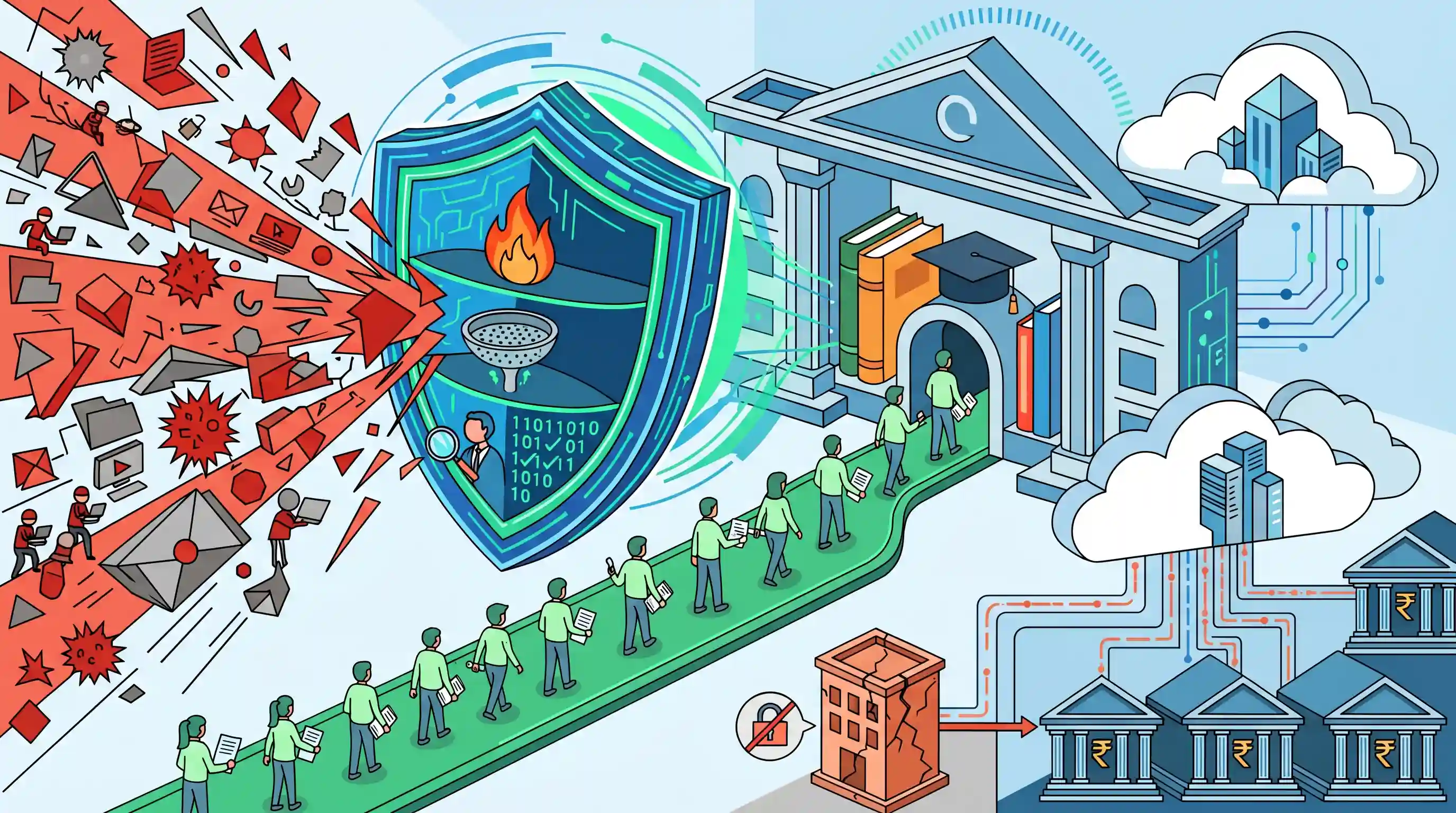
The Central Board of Secondary Education (CBSE) successfully defended its post-result grievance redressal portal against a massive Denial-of-Service (DoS) attack of 3.8 million packets. Despite facing over 1 lakh unauthorised access attempts within two minutes of going live, the portal processed over 70,000 student applications securely. This resilience was attributed to rigorous pre-launch security audits, including penetration testing and the deployment of Web Application Firewalls (WAF) and DDoS mitigation tools. The system overhaul—which included migrating to Amazon Web Services (AWS) and integrating multiple public sector banks—was necessitated by a prior payment gateway vulnerability, highlighting the critical importance of robust cybersecurity infrastructure in national e-governance platforms.
Key Points
- The CBSE's post-result grievance redressal portal successfully thwarted a Denial-of-Service (DoS) attack consisting of nearly 3.8 million malicious packets on June 3, 2026.
- Within two minutes of its launch, the portal handled 1.5 million access requests and blocked over 1,00,000 unauthorised access attempts bearing DDoS-type patterns.
- Before activation, the portal underwent an emergency security hardening process involving penetration testing, load testing, and vulnerability assessments by cybersecurity experts.
- The security architecture was reinforced using Web Application Firewalls (WAF), DDoS mitigation tools, secure authentication controls, and continuous audit logging.
- Prior to this, the system faced vulnerabilities including a payment gateway hack linked to HDFC, which led the government to consult IIT Madras and IIT Kanpur, integrate four public sector banks, and migrate to AWS.
- Over 70,000 successful grievance applications (re-evaluation and verification of marks) were processed, underscoring the critical need for secure and resilient e-governance public service delivery platforms.
Important Terms
Denial-of-Service (DoS) Attack

A cyberattack where malicious actors overwhelm a server with massive traffic (e.g., 3.8 million packets) to make a service unavailable to legitimate users.
UPSC context
GS Paper 3: Cyber Security. Tested as a fundamental threat to e-governance and critical digital services.
On-Screen Marking (OSM)
A digital evaluation method where physical answer scripts are scanned and marked by examiners on-screen, intended to eliminate manual totaling errors and speed up results.
UPSC context
GS Paper 2: Governance and Education. Represents ICT-led reforms in the examination system and associated implementation challenges.
Critical Information Infrastructure (CII)
The computer resource whose destruction would have a debilitating impact on national security, economy, or public safety; protected under the IT Act, 2000.
UPSC context
GS Paper 3: Internal Security. Crucial for understanding the protection of vital national digital assets from sophisticated cyber threats.
CERT-In
The national nodal agency for responding to computer security incidents, operating under the Ministry of Electronics and Information Technology (MeitY).
UPSC context
GS Paper 3: Security. Frequently tested in Prelims and Mains as India's primary cybersecurity watchdog.
CBSE
A national-level statutory board in India, under the Ministry of Education, responsible for conducting board examinations and regulating secondary education.
UPSC context
GS Paper 2: Statutory Bodies. Relevant for education policy, governance, and institutional accountability.
Public Sector Banks (PSBs)
Banks in which the Government of India holds a majority stake; used in this context as reliable, sovereign-backed alternatives for digital payment gateways.
UPSC context
GS Paper 3: Indian Economy. Key to financial inclusion and the secure delivery of government-to-citizen digital services.
Prelims Trap
Education sector portals like CBSE are classified as Critical Information Infrastructure (CII) protected by NCIIPC.
Under the IT Act, CII covers sectors where incapacitation impacts national security or economy (e.g., banking, telecom, power, transport). Education portals are generally not notified as CII.
Static Concepts Connected
What is the role of a Web Application Firewall (WAF) in cybersecurity?
- OSI Layer 7: Filters and monitors HTTP/HTTPS traffic specifically at the application layer, unlike traditional network firewalls that operate at lower layers.
- Specific Threats: Designed to block application-specific vulnerabilities like SQL injections, cross-site scripting (XSS), and zero-day web exploits.
How does a Distributed Denial-of-Service (DDoS) attack function?
- Botnet Infrastructure: Utilizes a distributed network of malware-infected devices (botnets), such as compromised IoT devices, to generate an overwhelming flood of traffic.
- Primary Objective: Aims to exhaust server resources or network bandwidth, rendering the targeted digital service or website unavailable to legitimate users.
Cross-Topic Patterns
E-Governance and Cloud Sovereignty
Moving government portals to private cloud architectures like AWS highlights the tension between system scalability (MeghRaj initiative) and strict data localization mandates under the DPDP Act.
Systemic Risk in Payment Gateways
Integrating multiple PSBs to prevent gateway hacking parallels RBI's regulatory push against single-point-of-failure risks in Payment Aggregators and UPI infrastructure.

Expect a Prelims match-the-following on cyber threats (DDoS, SQL Injection) paired with their defense mechanisms (WAF, Botnet filtering).
Linked PYQs · 4
Linked PYQs · 4
- 2017MainsGS3
Discuss the potential threats of Cyber attack and the security framework to prevent it.
- 2020MainsGS3
Discuss different types of cyber crimes and measures required to be taken to fight the menace.
- 2021MainsGS3
Keeping in view India's internal security, analyse the impact of cross-border cyber attacks. Also discuss defensive measures against these sophisticated attacks.
- 2023MainsGS2
e-governance, as a critical tool of governance, has ushered in effectiveness, transparency and accountability in governments. What inadequacies hamper the enhancement of these features ?
