CBSE Digital Evaluation Rollout Faces Technical Glitches
Source:Indian Express ↗
Why It Matters
It underscores a critical governance issue: the rapid deployment of digital technologies in public services without adequate pilot testing or user-centric design can cause systemic failures. This is highly relevant for UPSC aspirants studying e-governance limitations, accountability, and the socio-economic impacts of educational reforms under GS2.
Summary
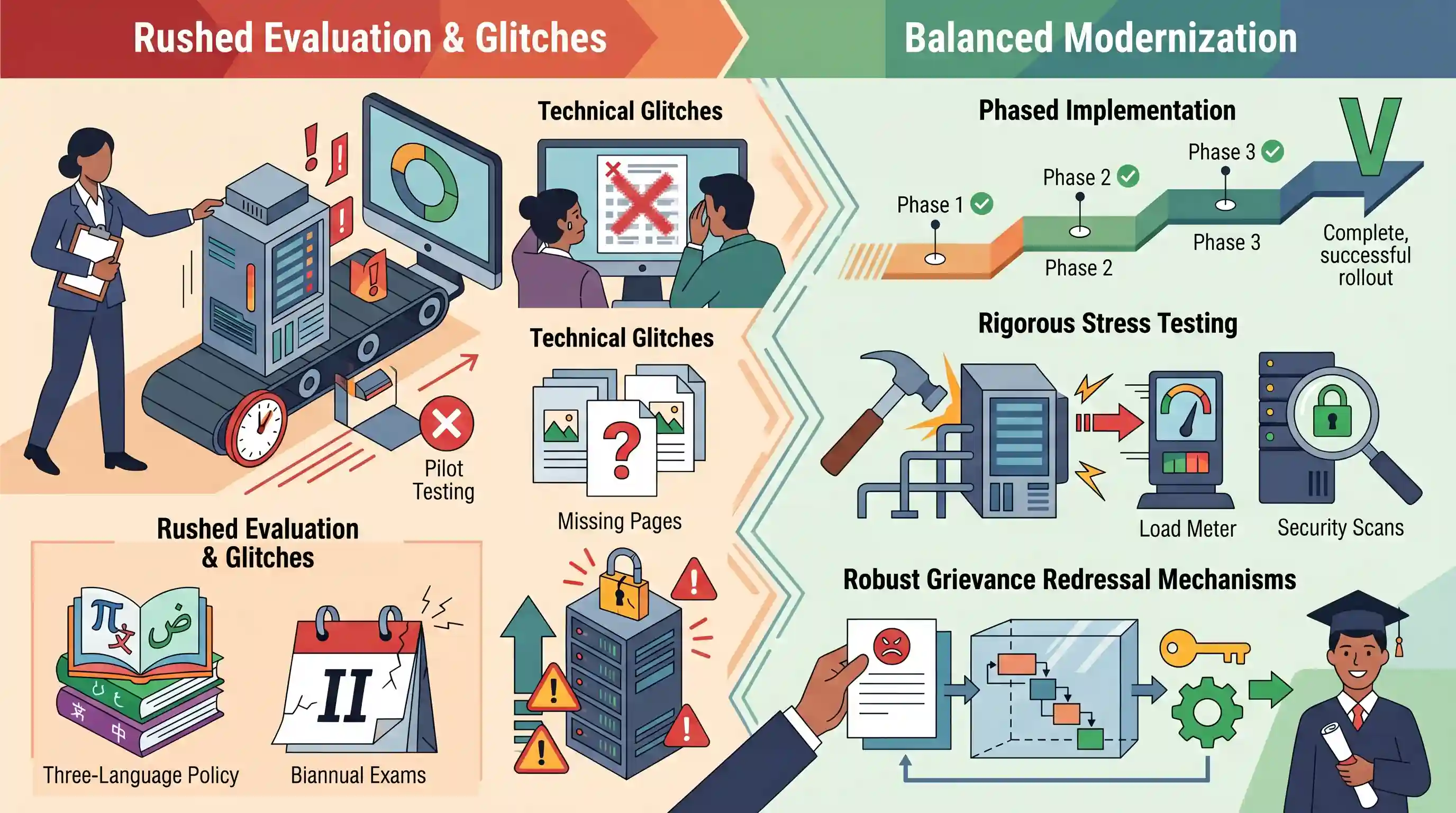
The Central Board of Secondary Education's (CBSE) hurried rollout of the On-Screen Marking (OSM) system for Class XII exams exposes severe administrative shortsightedness. Undertaken without sufficient pilot testing, the sudden shift to a fully digital evaluation framework resulted in multiple technical glitches, including blurred scans, missing pages, and cybersecurity vulnerabilities. This debacle reflects a broader trend of ambitious but hastily implemented reforms in the education sector, such as the introduction of a three-language policy and biannual board exams. The editorial argues that while modernisation is necessary, high-stakes public systems require phased implementation, rigorous stress testing, and robust grievance redressal mechanisms to ensure technological failures do not harm students' futures.
Key Points
- The CBSE rapidly rolled out the On-Screen Marking (OSM) system for Class XII exams shortly before they commenced, transitioning suddenly to a fully digital evaluation framework.
- The hasty implementation led to significant technical failures, including blurred scans, missing pages, and cybersecurity concerns, primarily due to inadequate pilot testing across regional offices.
- This incident highlights an administrative flaw where digitization is blindly equated with progress, neglecting the necessity of phased rollout, stress testing, and teacher training.
- The OSM failure is indicative of a wider pattern of simultaneously introducing un-tested reforms, such as the three-language policy and biannual board exams.
- A parliamentary panel has intervened, summoning officials from the Education Ministry and CBSE to fix accountability and address the systemic glitches in these high-stakes exams.
Important Terms
On-Screen Marking (OSM) system

A digital evaluation system where physical answer scripts are scanned and marked by examiners on a computer portal. It aims to reduce manual errors and improve speed but requires robust IT infrastructure.
UPSC context
GS Paper II (E-Governance/Education); tests challenges in digital public service delivery and administrative preparedness.
Three-language policy
An educational framework requiring the study of three languages. NEP 2020 provides flexibility by allowing states to choose, provided at least two of the three languages are native to India.
UPSC context
GS Paper II (Social Justice/Education); tests understanding of federalism and linguistic diversity in national policy.
Central Board of Secondary Education (CBSE)
A national-level educational board in India under the Ministry of Education. It standardizes curriculum and conducts Class X and XII examinations for over 28,000 affiliated schools globally.
UPSC context
GS Paper II (Governance); tests knowledge of regulatory bodies and their role in setting national educational standards.
Parliamentary Standing Committee
Permanent committees of Parliament that provide detailed scrutiny of ministry policies, bills, and expenditures. They act as a vital check on executive actions and ensure administrative accountability.
UPSC context
GS Paper II (Polity); tests understanding of the tools for legislative oversight of the executive.
National Education Policy (NEP) 2020
India's comprehensive reform policy aiming to transform school and higher education. It advocates for multilingualism, flexible board exams, and technology-driven assessments like the OSM system.
UPSC context
GS Paper II (Government Policies); a cornerstone for questions on modernizing the Indian education system.
IIT Madras & IIT Kanpur (Technical Oversight)
Premier technical institutes engaged by the Ministry of Education to review and oversee the implementation of digital evaluation systems to ensure accuracy, security, and technical stability.
UPSC context
GS Paper III (S&T/Governance); tests the role of technical expertise in public institution reforms.
Prelims Trap
The Central Board of Secondary Education (CBSE) is a statutory body established by an Act of Parliament.
Aspirants often confuse exam bodies with statutory bodies. CBSE is a registered society and an autonomous organization under the Ministry of Education, not a statutory body.
Static Concepts Connected
How do Parliamentary Committees enforce executive accountability in administrative matters?
- Standing Committees: Scrutinize demands for grants, bills, and long-term policies of specific ministries.
- Summoning Officials: Can summon secretaries and heads of autonomous bodies (e.g., CBSE) to depose on administrative failures and public grievances.
- Recommendatory Pressure: Their reports, while persuasive rather than legally binding, often force the executive to pause, review, or modify flawed implementations.
What are the key assessment and structural reforms proposed under NEP 2020?
- Biannual Board Exams: To reduce high-stakes pressure, the policy allows students to take board exams twice a year.
- Formative Assessment: Transitioning from summative to regular, formative, competency-based assessments via standard-setting bodies like PARAKH.
- Multilingualism: Continued emphasis on the three-language formula to promote multilingualism and regional languages.
Cross-Topic Patterns
E-Governance scaling vs. State Capacity
The OSM failure mirrors early Aadhaar/CoWIN hurdles, highlighting that tech deployment without grassroots capacity (teacher training, digital infra) compromises public service delivery.
NEP 2020 and Federal Friction
Rushed educational reforms like the three-language policy often trigger federal friction, linking concurrent-list mandates to Center-State tensions over regional linguistic autonomy.

Expect a GS-2 Mains question linking e-governance failures (tech-bias without capacity) to the oversight role of Parliamentary panels.
Linked PYQs · 3
Linked PYQs · 3
- 2023MainsGS2
e-governance, as a critical tool of governance, has ushered in effectiveness, transparency and accountability in governments. What inadequacies hamper the enhancement of these features ?
- 2025MainsGS2
e-governance projects have a built-in bias towards technology and back-end integration than user-centric designs. Examine.
- 2020MainsGS2
National Education Policy 2020 is in conformity with the Sustainable Development Goal-4 (2030). It intends to restructure and reorient education system in India. Critically examine the statement.
