CBSE Mandates Mental Health and Social Emotional Learning in Schools
Source:Indian Express ↗
Why It Matters
Addressing the youth mental health crisis and student suicides is a pressing governance and social issue in India. This institutional directive by CBSE introduces psychological wellness and Emotional Intelligence (via SEL) directly into the formal education framework, making it highly relevant for questions on education policy (GS2) and applications of Emotional Intelligence (GS4).
Summary
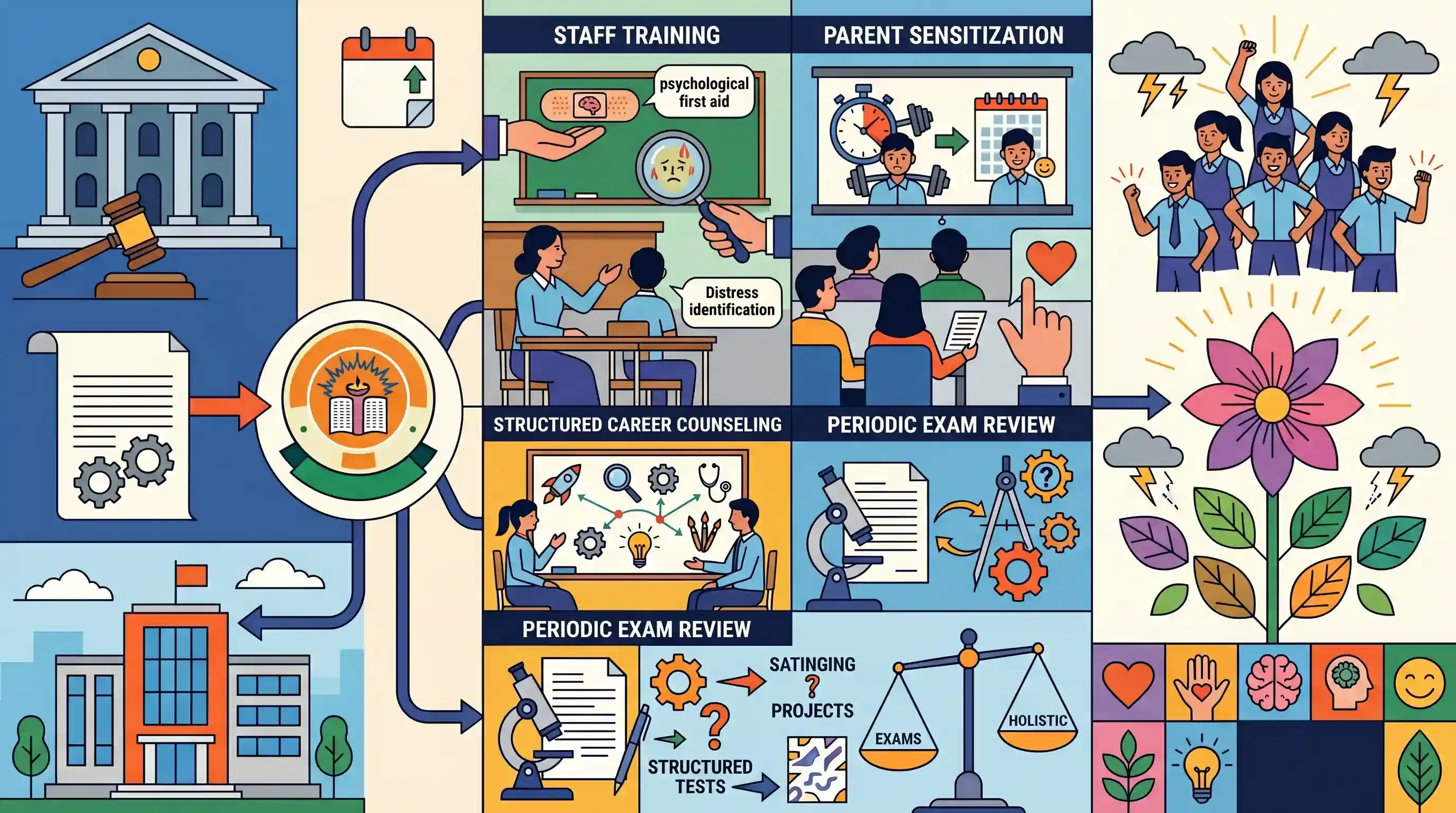
The Central Board of Secondary Education (CBSE) has directed all affiliated schools to mandate comprehensive measures focusing on 'Mental Health and Wellness' and 'Social Emotional Learning' (SEL). Arising from a July 2025 Supreme Court directive, these rules obligate schools to provide staff training in psychological first aid and distress identification twice a year. The guidelines also emphasize structural changes like mandatory parent sensitisation against academic pressure, structured career counseling, and periodic review of exam patterns to foster holistic student development and mitigate severe academic stress.
Key Points
- CBSE mandated all affiliated schools to adopt comprehensive measures for 'Mental Health and Wellness' and 'Social Emotional Learning (SEL)' following a July 2025 Supreme Court judgment.
- Schools are required to provide bi-annual training for all staff on psychological first aid, identifying warning signs of distress, and protocols for managing self-harm.
- Mandatory sensitisation programmes for parents must be conducted to prevent undue academic pressure and recognize signs of student distress.
- Schools must provide structured career counseling and are advised to periodically review exam patterns to help students build identities beyond just academic scores and ranks.
Important Terms
Social Emotional Learning (SEL)

Process of acquiring skills for self-awareness, emotional regulation, and empathy. It focuses on intrapersonal and interpersonal competencies to foster healthy identities and responsible decision-making in students.
UPSC context
GS II (Education), GS IV (Emotional Intelligence). Tests holistic pedagogy and psychological well-being in educational reforms.
Central Board of Secondary Education (CBSE)
A national-level education board under India’s Ministry of Education. It standardizes curriculum, conducts Class 10 and 12 examinations, and grants affiliation to schools nationwide and abroad.
UPSC context
GS II (Governance/Statutory Bodies). Tests knowledge of regulatory frameworks governing India's school education system.
Article 21
Constitutional provision guaranteeing the "Right to Life and Personal Liberty." In 2025, the Supreme Court expanded its scope to include student mental health as integral to a dignified life.
UPSC context
GS II (Fundamental Rights). Tests judicial activism and the evolving legal interpretation of mental health as a human right.
Psychological First Aid (PFA)
An evidence-informed, non-professional approach providing immediate emotional support to individuals in distress. It focuses on safety, stabilization, and connection to services rather than clinical treatment.
UPSC context
GS II (Social Justice/Health). Tests awareness of non-clinical crisis intervention strategies within institutional safety protocols.
UMMEED Guidelines
Ministry of Education framework ("Understand, Motivate, Manage, Empathize, Empower, Develop") providing protocols for schools to prevent student suicides and promote proactive mental well-being.
UPSC context
GS II (Social Sector-Education). Tests specific policy interventions designed to mitigate academic stress and student suicides.
MANODARPAN Initiative
A Ministry of Education initiative providing psychosocial support to students and teachers through helplines and resources, specifically cited in judicial mandates for school wellness.
UPSC context
GS II (Government Schemes/Health). Tests familiarity with national support systems for mental health and emotional well-being.
Prelims Trap
Student mental health is an explicitly enumerated fundamental right under Article 21 of the Constitution.
Mental health is an inferred right. The Supreme Court interprets it as an integral component of the Right to Life; it is not explicitly written in the Constitution.
Static Concepts Connected
How has Article 21 been judicially expanded regarding health?
- Inferred Rights: The Supreme Court has progressively broadened Article 21 to include the right to health and emergency medical care (e.g., Parmanand Katara case).
- Mental Health: Recent judicial pronouncements explicitly recognize psychological well-being and a safe environment as essential to the 'Right to Life with dignity'.
- State Obligation: Such rulings create a positive obligation on the State and its institutions to ensure environments conducive to overall well-being.
What are the core components of Emotional Intelligence (EI)?
- Self-awareness: Recognizing one's own emotions, strengths, weaknesses, and their effects on others.
- Self-regulation: Managing disruptive emotions, maintaining integrity, and adapting to changing circumstances without undue stress.
- Social awareness (Empathy): Understanding the emotions, needs, and concerns of other people (crucial for educators and administrators).
- Relationship management: Developing others, inspiring, communicating effectively, and managing conflicts.
Cross-Topic Patterns
NEP 2020 + Holistic Development
CBSE's mandate for Social-Emotional Learning directly implements NEP 2020's vision of shifting away from rote learning toward holistic, multidisciplinary student development and well-being.
Demographic dividend vs. Youth distress
NCRB data on student suicides starkly contrasts India's "demographic dividend" narrative, highlighting how hyper-competitive environments create severe youth distress (highly relevant for GS1 Society and Essays).
Institutional culpability & GS4 Ethics
Holding educational institutions legally accountable for safe psychological environments bridges GS2 (policy interventions) with GS4 (institutional ethics and governance).

GS2/GS4 mains prediction: Linkages between Article 21's expansion into mental health, institutional ethics, NEP 2020, and youth distress.
Linked PYQs · 5
Linked PYQs · 5
- 2020MainsGS2
National Education Policy 2020 is in conformity with the Sustainable Development Goal-4 (2030). It intends to restructure and reorient education system in India. Critically examine the statement.
- 2019MainsGS4
"Emotional Intelligence is the ability to make your emotions work for you instead of against you". Do you agree with this view? Discuss.
- 2020MainsGS4
What are the main components of emotional intelligence (EI)? Can they be learned? Discuss.
- 2021MainsGS4
In case of crisis of conscience does emotional intelligence help to overcome the same without compromising the ethical or moral stand that you are likely to follow? Critically examine.
- 2023MainsGS1
Explain why suicide among young women is increasing in Indian society.
