CBSE Three Language Policy Implementation Plan Details Shared
Source:Indian Express ↗
Why It Matters
The implementation of language policies under the NEP 2020 impacts educational equity, federal dynamics between the Centre and states, and pedagogical frameworks nationwide, making it a key topic for governance and social justice in GS Paper II.
Summary
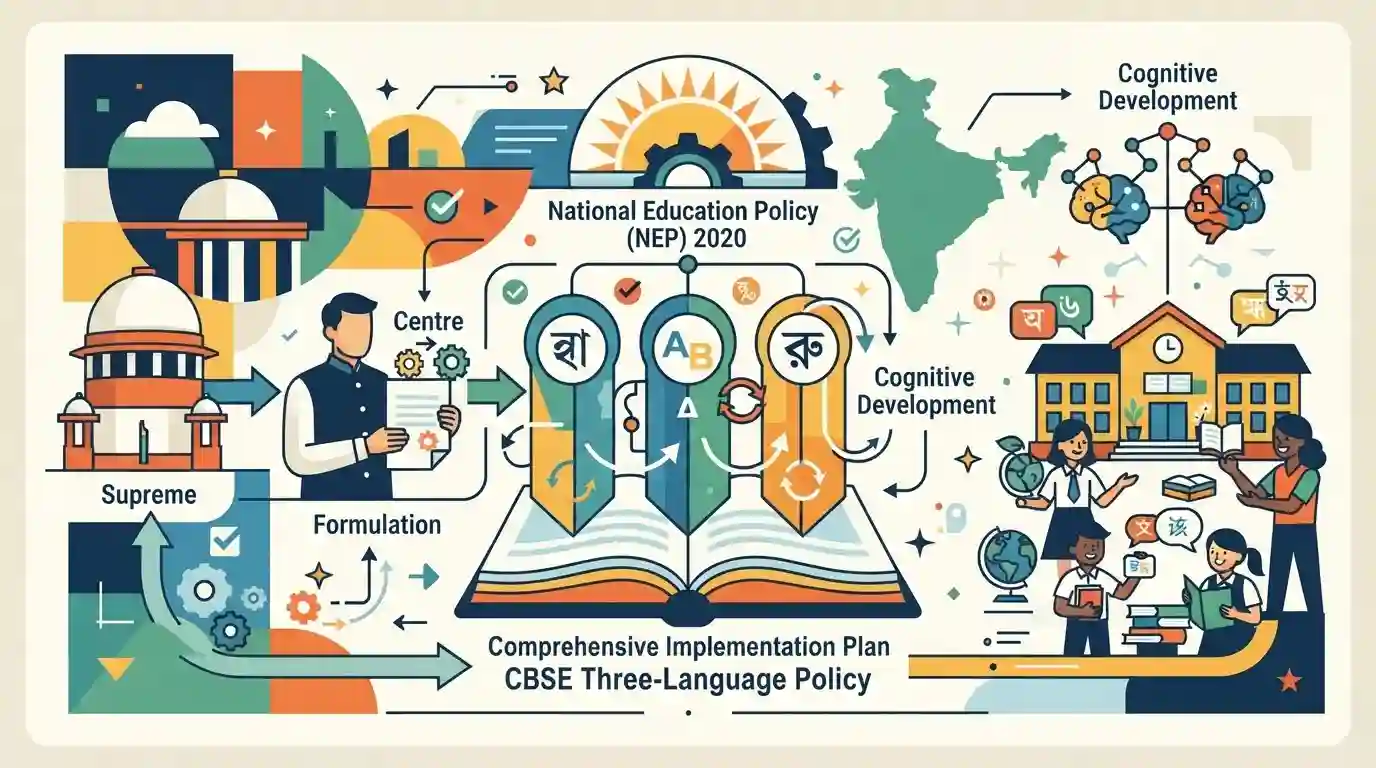
The Centre has informed the Supreme Court that a comprehensive implementation plan for the Central Board of Secondary Education (CBSE) three-language policy is currently under formulation, tying into the broader objectives of the National Education Policy (NEP) 2020 to promote multilingual education and cognitive development in schools.
Key Points
- The Centre informed the Supreme Court that it is working on an implementation plan for the CBSE's three-language policy.
- The policy aligns with the broader framework of the National Education Policy (NEP) 2020, emphasizing multilingualism in school education.
- The implementation plan aims to address structural, pedagogical, and administrative requirements across affiliated institutions.
- Language education policies in India often balance national integration, linguistic diversity, and cooperative federalism concerns.
Important Terms
National Education Policy 2020

A comprehensive framework introduced in July 2020 to overhaul India's education system from school to higher education, emphasizing foundational literacy, multilingualism, and a 5+3+3+4 curricular structure.
UPSC context
UPSC GS Paper II (Social Sector - Education, Human Resources) and Prelims; tests knowledge of major national reform policies and targets.
Three Language Policy
An educational formula recommending the study of three languages (including at least two native Indian languages) in schools to foster multilingualism, national integration, and cognitive development.
UPSC context
UPSC GS Paper II (Government Policies & Interventions, Education); tests understanding of language dynamics, federal policies, and cultural rights.
CBSE
The Central Board of Secondary Education, a national-level board of education in India for public and private schools, controlled and managed by the Union Government.
UPSC context
UPSC GS Paper II (Governance and Institutional Frameworks); tests knowledge of statutory educational bodies and policy rollouts in schools.
Supreme Court
India's apex judicial body under the Constitution, responsible for constitutional interpretation and adjudicating disputes regarding fundamental rights and policy implementation.
UPSC context
UPSC GS Paper II (Indian Constitution, Judiciary); tests judicial review, writ jurisdictions, and intervention in executive policy execution.
Prelims Trap
prescribes a rigid Centre-mandated language mix for all states without pedagogical flexibility
Aspirants often assume the Three-Language Formula under NEP 2020 prescribes a rigid Centre-mandated mix, whereas the policy allows structural and pedagogical flexibility as long as at least two of the three languages are native Indian languages.
Static Concepts Connected
What are the constitutional provisions regarding language and education in India?
- Article 29: Enshrines right to conserve distinct language, script, or culture under Article 29.
- Article 350A: Directs states to provide adequate facilities for instruction in mother tongue at primary stage to linguistic minority children under Article 350A.
- Article 351: Contains constitutional provisions for promotion and development of the Hindi language under Article 351.
Cross-Topic Patterns
Education Policies & Cooperative Federalism
Language policy execution intersects with cooperative federalism as states navigate central curriculum frameworks versus regional linguistic identities.
NEP 2020 & SDG 4 Commitments
NEP 2020 directly operationalizes SDG 4 targets, linking domestic school reforms to global human capital indices.

Expect statement-based questions on NEP 2020 language mandates, constitutional provisions on linguistic minorities, and cooperative federalism.
Linked PYQs · 2
Linked PYQs · 2
- 2020MainsGS2
National Education Policy 2020 is in conformity with the Sustainable Development Goal-4 (2030). It intends to restructure and reorient education system in India. Critically examine the statement.
- 2022MainsGS2
“While the national political parties in India favour centralisation, the regional parties are in favour of State autonomy.” Comment.
