Real estate fraud investigations and homebuyer protection measures
Source:The Hindu ↗
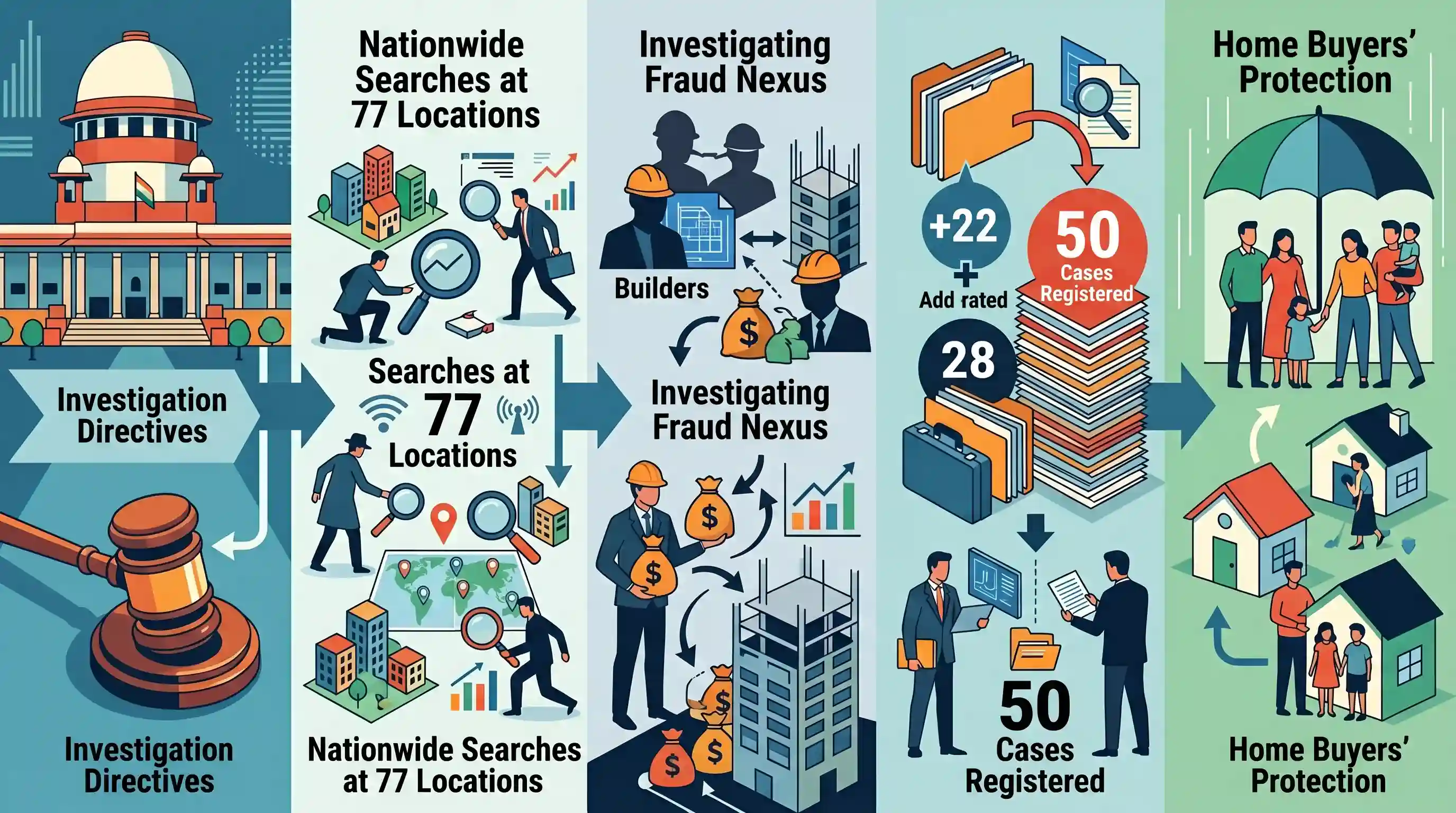
Why It Matters
The issue highlights systemic vulnerabilities in the real estate and financial sectors that adversely affect ordinary citizens. It underscores the critical role of the Supreme Court and central agencies like the CBI in enforcing accountability, curbing financial fraud, and protecting the rights of home buyers.
Summary
The Central Bureau of Investigation (CBI) has launched extensive searches at 77 locations across eight States and Union Territories to investigate an alleged nexus between real estate builders and financial institutions. Acting on directives from the Supreme Court, the agency has registered 22 new cases—bringing the total to 50—targeting fraudulent practices, diversion of funds, and financial irregularities that have cheated unsuspecting home buyers. The ongoing nationwide crackdown aims to gather crucial digital and documentary evidence to unravel the larger conspiracy in the housing real estate sector.
Key Points
- The CBI conducted searches at 77 locations across eight States and Union Territories as part of a nationwide crackdown.
- The raids are connected to 22 newly registered cases probing an alleged nexus between real estate builders and financial institutions.
- The investigation stems from Supreme Court directives to address large-scale cheating of home buyers through the diversion of funds and financial irregularities.
- With these new cases, the total number of FIRs registered by the CBI in this matter has reached 50.
Important Terms
Central Bureau of Investigation (CBI)

India's premier investigating agency, established in 1963, handling corruption, economic offenses, and high-profile crimes. It derives its powers from the Delhi Special Police Establishment Act, 1946.
UPSC context
GS Paper 2 (Polity); tests understanding of statutory vs. non-statutory bodies and federal investigative challenges.
Supreme Court
The highest judicial authority in India, empowered to direct CBI investigations regardless of state consent to ensure justice and uphold the rule of law.
UPSC context
GS Paper 2 (Judiciary); tests judicial activism and the court's role as a guardian of fundamental rights.
Real Estate (Regulation and Development) Act (RERA), 2016
A landmark 2016 law enacted to regulate the real estate sector, ensure transparency, protect home buyers from fraud, and prevent the illegal diversion of project funds.
UPSC context
GS Paper 3 (Economy/Infrastructure); crucial for understanding urban governance and consumer protection frameworks.
Corporate Fraud
Illegal or deceptive actions committed by a company or individuals to manipulate financial statements, evade taxes, or defraud stakeholders, often involving complex accounting schemes.
UPSC context
GS Paper 3 (Economic Development/Internal Security); relates to corporate governance and the impact of white-collar crime on the economy.
Diversion of Funds
The unauthorized use of project-specific capital for unrelated purposes, a common practice in real estate scams that leads to project delays and financial losses for buyers.
UPSC context
GS Paper 3 (Economy); identifies specific financial irregularities and the importance of audit mechanisms in project management.
Delhi Special Police Establishment (DSPE) Act, 1946
The parent legislation that governs the CBI, requiring the agency to obtain state government consent before investigating cases within a state's jurisdiction.
UPSC context
GS Paper 2 (Polity); relevant for federalism debates and the legal constraints on central agencies.
Prelims Trap
The CBI cannot investigate cases within a State's jurisdiction without the explicit consent of the respective State government under any circumstances.
While Section 6 of the DSPE Act requires state consent, Constitutional Courts (Supreme Court and High Courts) can mandate pan-India CBI investigations, bypassing this requirement.
Static Concepts Connected
What are the jurisdictional rules for CBI operations in Indian States?
- DSPE Act 1946: The CBI derives its investigative powers from this pre-independence Act, rather than a dedicated modern statute, making it a non-statutory body.
- State Consent Requirement: Under Section 6, the CBI requires explicit 'general' or 'case-specific' consent from a State government to investigate crimes within its territorial jurisdiction.
- Judicial Override: The Supreme Court and High Courts hold the authority to direct the CBI to investigate cases anywhere in the country, overriding the need for State consent.
What are the primary statutory protections for homebuyers facing defaulting builders?
- RERA Escrow Rule: Developers are legally mandated to deposit 70% of the funds collected from homebuyers into a separate, project-specific escrow account to prevent fund diversion.
- IBC Status: Following the 2018 amendment, homebuyers are legally recognized as "financial creditors," granting them voting rights in the Committee of Creditors during bankruptcy proceedings.
- Prevention of Corruption Act: A 2016 Supreme Court ruling categorizes even private sector bank employees as "public servants," bringing corrupt nexus actors under the CBI's purview.
Cross-Topic Patterns
Agency reach vs. Article 131 Federalism
State-level withdrawal of 'general consent' for the CBI has sparked original suits in the Supreme Court under Article 131, merging investigative governance with Centre-State federal friction.
RERA + IBC + PCA intersection
Tackling real estate fraud requires applying RERA (fund ring-fencing), IBC (creditor resolution), and PCA (prosecuting complicit private bankers), reflecting a complex cross-statute corporate governance challenge.

Expect a 2026 Prelims question blending CBI's DSPE jurisdiction with RERA escrow rules or the IBC 'financial creditor' status.
Linked PYQs · 2
Linked PYQs · 2
- 2021MainsGS2
The jurisdiction of the Central Bureau of Investigation (CBI) regarding lodging an FIR and conducting probe within a particular State is being questioned by various States. However, the power of the States to withhold consent to the CBI is not absolute. Explain with special reference to the federal character of India.
- 2013MainsGS3
Money laundering poses a serious security threat to a country's economic sovereignty. What is its significance for India and what steps are required to be taken to control this menace?
