CBI Arrests Railway Official in Vijayawada Bribery Case
Source:thehindu ↗
Why It Matters
Probity in governance and the role of investigative agencies like the CBI are core components of the APPSC GS syllabus. Understanding how corruption impacts infrastructure development and the mechanisms used to combat it is essential for both Prelims (agency mandates) and Mains (governance ethics).
Summary
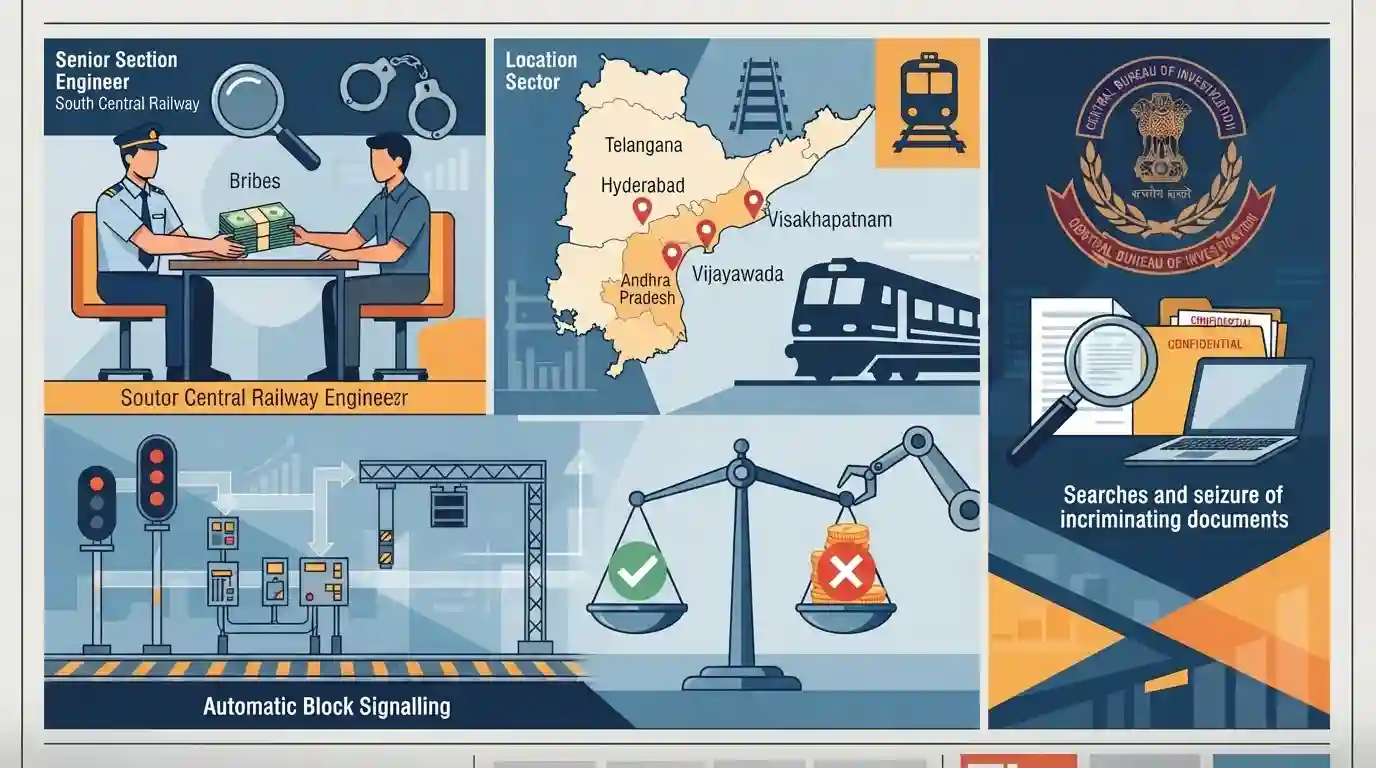
The Central Bureau of Investigation (CBI) arrested a Senior Section Engineer from the South Central Railway in Vijayawada, alongside a private individual, on bribery charges. The official allegedly accepted a ₹15 lakh bribe to facilitate the release of bonus payments for Automatic Block Signalling works assigned to two joint venture companies. Subsequent searches by the CBI across Visakhapatnam, Pithapuram, Vijayawada, and Hyderabad yielded incriminating documents. The case highlights anti-corruption enforcement and probity issues within large-scale public infrastructure projects.
Key Points
- The CBI arrested a Senior Section Engineer of the South Central Railway and a private associate in Vijayawada for accepting a ₹15 lakh bribe.
- The bribe was demanded in exchange for releasing a bonus related to Automatic Block Signalling works allotted to two joint venture companies.
- Following the arrests, the CBI conducted simultaneous searches in Visakhapatnam, Pithapuram, Vijayawada, and Hyderabad, recovering incriminating documents.
- The case underscores the ongoing challenges of corruption in public infrastructure projects and highlights the role of the CBI in enforcing accountability among public servants.
Important Terms
Central Bureau of Investigation (CBI)

India's premier investigating agency under the Ministry of Personnel, Public Grievances and Pensions. It probes high-profile corruption, economic offenses, and inter-state crimes.
UPSC context
APPSC Group 1 Paper III (Polity & Governance). Tests understanding of anti-corruption frameworks and federal-state policing challenges.
Prevention of Corruption Act, 1988
An Act of Parliament enacted to combat corruption in public offices. It penalizes public servants for accepting bribes and private entities for offering them.
UPSC context
APPSC Group 1 Paper III (Polity and Governance). Crucial for topics on administrative accountability, ethics, and anti-corruption laws.
South Central Railway
A major railway zone headquartered in Secunderabad, servicing states including Andhra Pradesh and Telangana. It handles pivotal passenger and freight transport in southern India.
UPSC context
APPSC Group 1 Paper IV (Economy of AP). Tests knowledge of state infrastructure, logistics connectivity, and economic development.
Indian Railways
The statutory body operating India's national railway system. It coordinates massive regional transport networks, infrastructure projects, and national logistical corridors.
UPSC context
APPSC Group 1 Paper IV (Economy & Development). Tests knowledge of physical infrastructure planning, logistics, and central-state project execution.
Vijayawada
A primary commercial and political city in Andhra Pradesh, located along the Krishna River. It is a major economic and railway transport hub.
UPSC context
APPSC Paper II (AP Geography) & Paper IV (AP Economy). Tests geography, transport infrastructure, and regional economic significance.
Prelims Trap
The Central Bureau of Investigation is a statutory body created by the Delhi Special Police Establishment Act, 1946.
CBI is not a statutory body. It was set up by an executive resolution in 1963, though it derives its powers from the DSPE Act.
Static Concepts Connected
What is the administrative and supervisory structure of the CBI?
- Not Statutory: CBI is an executive body established via a 1963 Home Ministry resolution, deriving investigative powers from the DSPE Act, 1946.
- CVC Superintendence: The Central Vigilance Commission (CVC) exercises superintendence over CBI only for offenses under the Prevention of Corruption Act, 1988.
- DoPT Control: Administrative, financial, and other non-corruption investigative control of the CBI vests with the Department of Personnel and Training (DoPT).
Cross-Topic Patterns
Infrastructure Safety + Corruption Costs
Delays in safety tech like Automatic Block Signalling due to bribery showcase how systemic corruption directly compromises public transit infrastructure safety.
Federal Police Jurisdiction
The interaction between State consent under DSPE Act Section 6 and the central mandate of CBI reflects ongoing federal-state friction over law enforcement.

APPSC may frame a multi-statement question on CVC's dual superintendence over CBI vs. the DoPT's administrative control.
Linked PYQs · 2
Linked PYQs · 2
- 2008APPSC_PRELIMSGS1
The Central Bureau of Intelligence detects economic offences through:
- 2023APPSC_PRELIMSGS1
What percentage of rail routes were electrified in India by March 2019?
