CBDT Removes Arrest Provisions from Tax Recovery Rules
Source:Indian Express ↗
ఇది ఎందుకు ముఖ్యం
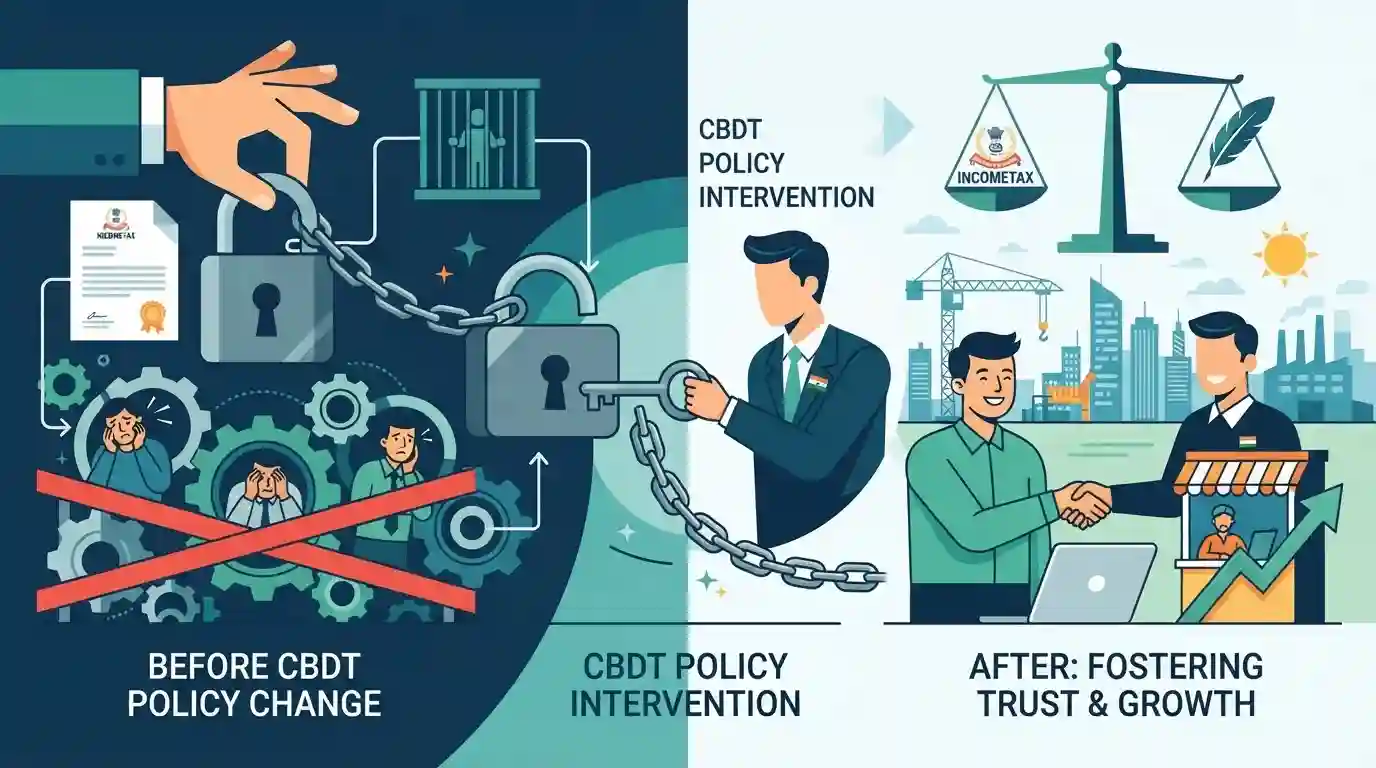
This policy shift by the CBDT represents a major milestone in tax administration reforms, moving away from coercive measures toward a trust-based tax regime, which directly impacts the ease of doing business and investor confidence in India.
సారాంశం
The Central Board of Direct Taxes (CBDT) has removed arrest and detention provisions from its tax recovery rules, marking a major step toward decriminalising tax administration and reducing taxpayer harassment, thereby improving the ease of doing business and fostering a trust-based tax regime in India.
ముఖ్య అంశాలు
- The Central Board of Direct Taxes (CBDT) has dropped contentious arrest and detention provisions from tax recovery rules to ease compliance and foster trust.
- The move aligns with the government's broader objective of decriminalising minor economic offences, reducing harassment, and improving the ease of doing business.
- Tax recovery mechanisms will now focus on civil and administrative measures rather than penal criminal detentions for general tax arrears.
ముఖ్యమైన పదాలు
Central Board of Direct Taxes (CBDT)

The apex statutory body in India responsible for framing policies and administering direct tax laws, functioning under the Department of Revenue within the Ministry of Finance.
UPSC context
GS Paper III (Indian Economy - Resource Mobilisation & Tax Reforms). Tests knowledge of fiscal administration and tax governance bodies in India.
Income Tax Act
The primary legislation governing taxation of income and profits in India, providing the legal framework for tax assessment, collection, and compliance.
UPSC context
GS Paper III (Indian Economy - Government Policies & Interventions). Tests understanding of direct taxation laws and regulatory frameworks.
అనుసంధానమైన స్థిర భావనలు
What are the statutory powers and structural mandate of the Central Board of Direct Taxes (CBDT)?
- Statutory Basis: Statutory backing under the Central Board of Revenue Act, 1963, functioning as a statutory authority under the Department of Revenue, Ministry of Finance.
- Core Mandate: Charged with framing policy, administering direct tax laws (Income Tax Act, Wealth Tax Act), and supervising the Income Tax Department.
- Administrative Powers: Exercises quasi-judicial powers through appellate mechanisms and issues binding circulars and notifications for tax administration.
అంతర-అంశ నమూనాలు
Tax Administration + Ease of Doing Business
The push to decriminalise minor economic offenses and tax infractions directly supports broader ease-of-doing-business initiatives and boosts private capital formation and investor confidence.
Civil Enforcement vs. Criminal Penalties
Shifting from penal incarceration to asset attachment aligns tax compliance with modern civil enforcement standards, reducing administrative overreach.

CBDT's removal of arrest provisions under Income-tax Rules is prime material for a statement-based prelims question on tax reforms.
అనుసంధాన PYQలు · 2
అనుసంధాన PYQలు · 2
- 2018MainsGS3
Comment on the important changes introduced in respect of the Long-term Capital Gains Tax (LCGT) and Dividend Distribution Tax (DDT) in the Union Budget for 2018-2019.
- 2025PrelimsGS1
With reference to the Government of India, consider the following information: Organization Some of its functions It works under I. Directorate of Enforcement Enforcement of the Fugitive Economic Offenders Act, 2018 Internal Security Division-I, Ministry of Home Affairs II. Directorate of Revenue Intelligence Enforces the Provisions of the Customs Act, 1962 Department of Revenue, Ministry of Finance III. Directorate General of Systems and Data Management Carrying out big data analytics to assist tax officers for better policy and nabbing tax evaders Department of Revenue, Ministry of Finance In how many of the above rows is the information correctly matched?
