CBDT Clarifies Continuation of Old Income Tax Regime
Source:Indian Express ↗
Why It Matters
Income tax policies directly influence citizen savings, investments, and domestic consumption. The coexistence of the dual tax regime provides flexibility, while improved refund timelines and strict STT/TCS tracking highlight the government's dual focus on taxpayer facilitation and robust resource mobilization.
Summary
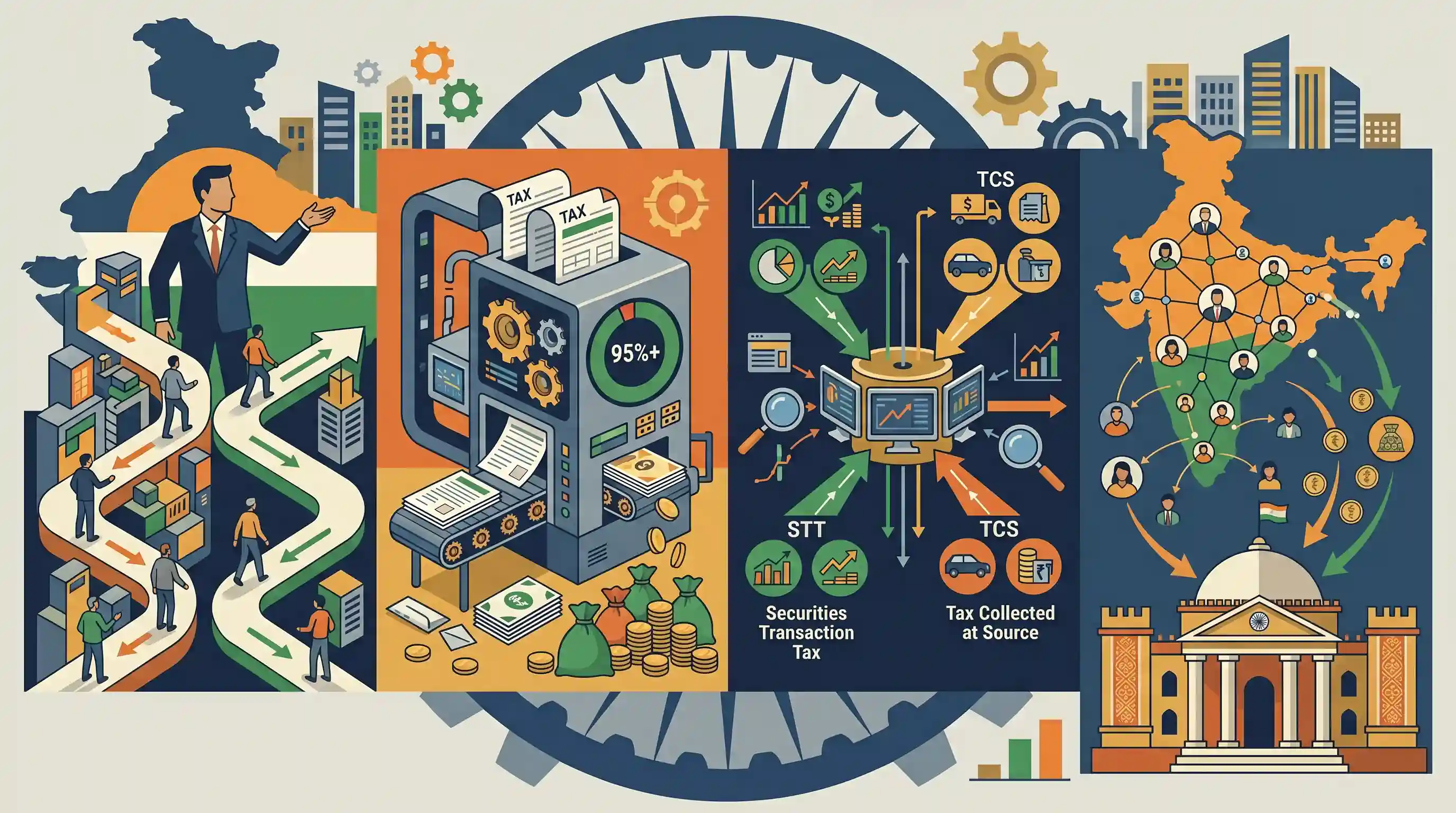
Central Board of Direct Taxes (CBDT) Chairman Ravi Agrawal has clarified that the government has no plans to phase out the old income tax regime, assuring taxpayers that it will coexist with the new simplified regime. Highlighting the enhanced efficiency of India's tax administration, Agrawal noted that over 95% of income tax refunds have already been disbursed. Furthermore, the CBDT is tightening its monitoring of Securities Transaction Tax (STT) and Tax Collected at Source (TCS) data to track financial flows, improve tax compliance, and broaden the direct tax base.
Key Points
- There is no 'sunset date' for the old income tax regime, meaning taxpayers can continue to opt for it and claim traditional exemptions (like Section 80C, HRA).
- Tax administration efficiency has notably improved, with the CBDT having already disbursed 95% of income tax refunds for the assessment year.
- Despite the continuation of the old regime, the simplified new tax regime is witnessing increasing adoption due to reduced compliance burdens and adjusted tax slabs.
- The tax department is actively utilizing data from Securities Transaction Tax (STT) and Tax Collected at Source (TCS) to track high-value transactions, profile taxpayers, and prevent tax evasion.
Important Terms
Central Board of Direct Taxes (CBDT)

A statutory authority under the Central Board of Revenue Act, 1963, that serves as the apex body for direct tax policy formulation and administration in India under the Ministry of Finance.
UPSC context
GS Paper-3 (Economy/Governance); tests knowledge of institutional structures and revenue administration mechanisms in India.
New Income Tax Regime
The default tax system (Section 115BAC) offering lower slab rates but removing most deductions and exemptions. It aims to simplify the tax structure and reduce compliance burdens for taxpayers.
UPSC context
GS Paper-3 (Economy); relevant for topics on fiscal policy, resource mobilization, and direct taxation reforms.
Old Income Tax Regime
The traditional tax system allowing various exemptions and deductions (like 80C, HRA, and health insurance) to reduce taxable income, coexisting with the new regime as an optional choice.
UPSC context
GS Paper-3 (Economy); tests understanding of tax-saving incentives and their impact on household savings and investment.
Securities Transaction Tax (STT)
A direct tax levied on the value of taxable securities transactions (shares, derivatives, or mutual funds) traded on recognized stock exchanges in India to curb tax evasion.
UPSC context
GS Paper-3 (Economy); relevant for capital market regulations and tools for tracking high-value financial transactions.
Tax Collected at Source (TCS)
A tax collected by the seller from the buyer at the time of sale for specified goods (e.g., motor vehicles, scrap, or foreign remittances) to ensure smooth revenue collection.
UPSC context
GS Paper-3 (Economy); tests mechanisms used by the government to widen the tax base and monitor financial flows.
Income Tax Department
The operational executive agency under the Ministry of Finance responsible for the collection and administration of direct taxes, functioning under the supervision of the CBDT.
UPSC context
GS Paper-3 (Economy); tests knowledge of the administrative machinery for resource mobilization and tax compliance.
Prelims Trap
TCS and STT are indirect taxes because they are collected at the point of transaction by the seller or exchange.
Despite being collected at the point of transaction (similar to GST), both TCS and STT are Direct Taxes administered by the Central Board of Direct Taxes (CBDT).
Static Concepts Connected
What is the difference between Tax Deducted at Source (TDS) and Tax Collected at Source (TCS)?
- TDS mechanism: Tax is deducted by the person making the payment (e.g., an employer paying a salary) before crediting the remaining amount to the payee.
- TCS mechanism: Tax is collected by the seller (receiver of money) from the buyer at the time of sale for specified high-value items like luxury cars.
- Shared Objective: Both are tools of direct tax collection aimed at leaving an audit trail and preventing tax evasion at the source of income generation or expenditure.
What is the statutory backing and mandate of the CBDT?
- Statutory Origin: It is a statutory authority established under the Central Board of Revenue Act, 1963.
- Nodal Ministry: It operates under the Department of Revenue, Ministry of Finance.
- Mandate: It formulates policies and administers the levy and collection of direct taxes (Income Tax, Corporate Tax, STT, Equalisation Levy) in India.
Cross-Topic Patterns
Big Data and tax administration (Project Insight)
CBDT leveraging STT and TCS data to track high-value transactions aligns with 'Project Insight', a GS-3 theme showing how Big Data is used to curb tax evasion without intrusive raids.
Tax regimes and gross domestic savings
The old regime incentivizes household savings via Section 80C exemptions, aiding capital formation. The new regime pushes consumption by increasing disposable income. Both reflect dual macroeconomic strategies for GS-3.

Expect a Prelims multi-statement question distinguishing direct vs indirect mechanisms of TCS, TDS, and STT in broadening India's tax base.
Linked PYQs · 3
Linked PYQs · 3
- 2019MainsGS3
Enumerate the indirect taxes which have been subsumed in the Goods and Services Tax (GST) in India. Also, comment on the revenue implications of the GST introduced in India since July 2017.
- 2022PrelimsGS1
Which one of the following situations best reflects "Indirect Transfers" often talked about in media recently with reference to India?
- 2014PrelimsGS1
The sales tax you pay while purchasing a toothpaste is a
