Varanasi Bar Association Seeks New Integrated Court Complex
Source:times-of-india ↗
Why It Matters
The development highlights state government intervention in subordinate court infrastructure and localized legal system demands, linking to civil and criminal administration, constitutional provisions of lower judiciary, and judicial reforms in UP.
Summary
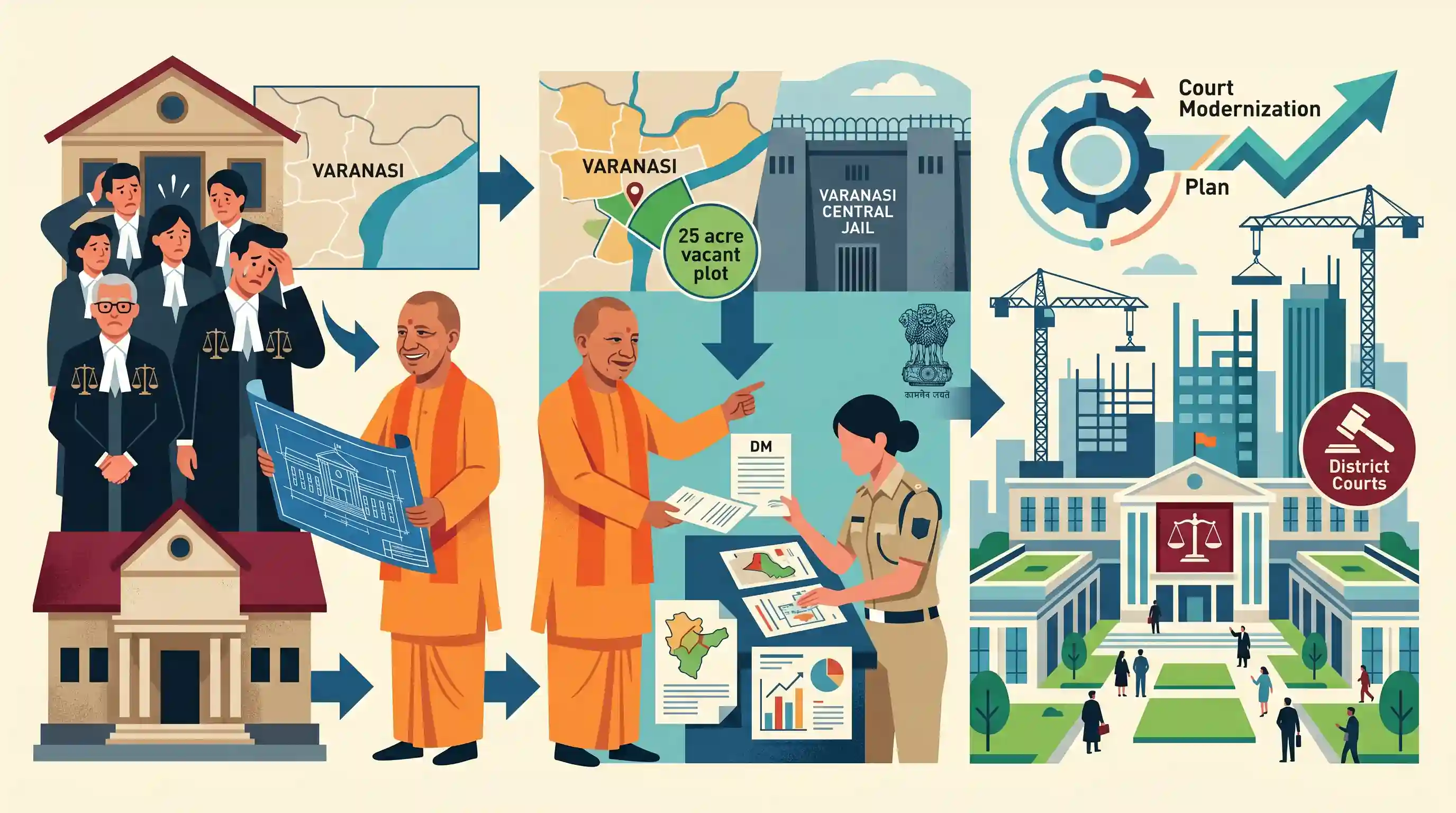
The Central Bar Association (CBA) of Varanasi met Uttar Pradesh Chief Minister Yogi Adityanath to demand a new integrated, modern court complex on 25 acres of vacant land near Varanasi Central Jail to resolve overcrowding for 9,500 local lawyers. The CM subsequently directed the Varanasi District Magistrate to submit land records and a detailed proposal to initiate development of a model judicial complex under the state's court infrastructure modernization plan.
Key Points
- A delegation of the Central Bar Association (CBA), Varanasi, led by its president Prem Prakash Gautam, met UP Chief Minister Yogi Adityanath at the Circuit House to request a new integrated court complex.
- The delegation proposed constructing the integrated judicial complex on 25 acres of vacant land near the Central Jail in Varanasi to bring the district court and civil court under a single campus.
- The Varanasi court experiences extreme space constraints, housing about 9,500 lawyers with nearly 750 new advocates joining in June alone, forcing many to work in the open.
- The proposed complex aims to house approximately 8,000 chambers (each accommodating two lawyers) along with modern facilities such as air-conditioned chambers, a library, hospital, canteen, and parking.
- CM Yogi Adityanath directed the Varanasi District Magistrate to submit complete land records and a detailed proposal for developing a model judicial complex equipped with modern amenities.
Important Terms
Integrated Court Complex

A unified judicial facility designed to house all district, subordinate, and commercial courts, tribunals, and support amenities under one roof to enhance administrative efficiency and litigant convenience.
UPSC context
GS Paper II (Judiciary & Infrastructure). Relates to modernizing the justice delivery system and simplifying administrative logistics.
Subordinate Judiciary
The hierarchy of trial courts operating below the state High Court at the district and lower levels, established and regulated under Articles 233 to 237 of the Indian Constitution.
UPSC context
GS Paper II (Polity & Constitution). Tests structural organization, appointment of lower judges, and issues of pendency.
Separation of Judiciary from Executive
A constitutional directive under Article 50 (DPSP) mandating the state to decouple judicial trial functions from the executive administration to safeguard judicial independence in the public services.
UPSC context
GS Paper II (Polity & Constitution). Explores DPSP, Article 50, checks and balances, and statutory division under the CrPC.
District Court
The principal civil and criminal court of original jurisdiction at the district level, presided over by a District Judge whose appointment is governed by Article 233 of the Constitution.
UPSC context
GS Paper II (Polity). Tests the organization, powers, and administrative control of grassroots courts in India.
Court Infrastructure Modernization
Systemic initiatives focused on upgrading the physical, technological, and digital architecture of lower courts to improve transparency, expand accessibility, and reduce massive case backlogs.
UPSC context
GS Paper II (Judiciary & Governance). Addresses the administrative, financial, and digital reforms required to resolve pendency.
Prelims Trap
The President of India appoints District Judges in consultation with the Chief Justice of India.
Under Article 233, the Governor of the state makes appointments, postings, and promotions of District Judges in direct consultation with the state's High Court, not the President or Chief Justice of India.
Static Concepts Connected
How is control over subordinate courts constitutionally distributed?
- Governor's role: The Governor of the state appoints, posts, and promotes District Judges in direct consultation with the State High Court.
- High Court control: Article 235 vests absolute administrative control (including postings, promotion, and leave of subordinate officers) directly in the High Court.
- Recruitment criteria: Direct recruitment of District Judges requires a minimum of seven years of practice as an advocate and recommendation by the High Court.
Who funds and manages subordinate judicial infrastructure?
- State responsibility: State governments bear primary responsibility for establishing and maintaining physical infrastructure for subordinate courts.
- Central assistance: The Union Ministry of Law provides supplementary financial help to states through the Centrally Sponsored Scheme for Judicial Infrastructure.
Cross-Topic Patterns
Judicial infrastructure vs administrative autonomy
Executive bottlenecks in judicial land and funding allocations drive persistent demands for an independent National Judicial Infrastructure Authority to secure administrative independence.
Decentralized justice and urban transit
Relocating court complexes to peripheral urban areas resolves city congestion but significantly impacts transport costs and physical access to justice for marginalized litigants.

Constitutional powers under Articles 233-235 and executive-judicial friction over infrastructure funding are prime areas for 2026.
Linked PYQs · 1
Linked PYQs · 1
- 2020UPPSC_PRELIMSGS1
Which of the following is not a correct match?
