Cauvery Water Management Authority Directive on Interstate Sharing
Source:The Hindu ↗
हे का महत्त्वाचे आहे
It illustrates the practical implementation and challenges of cooperative federalism and institutional dispute resolution mechanisms concerning shared natural resources like inter-state rivers.
सारांश
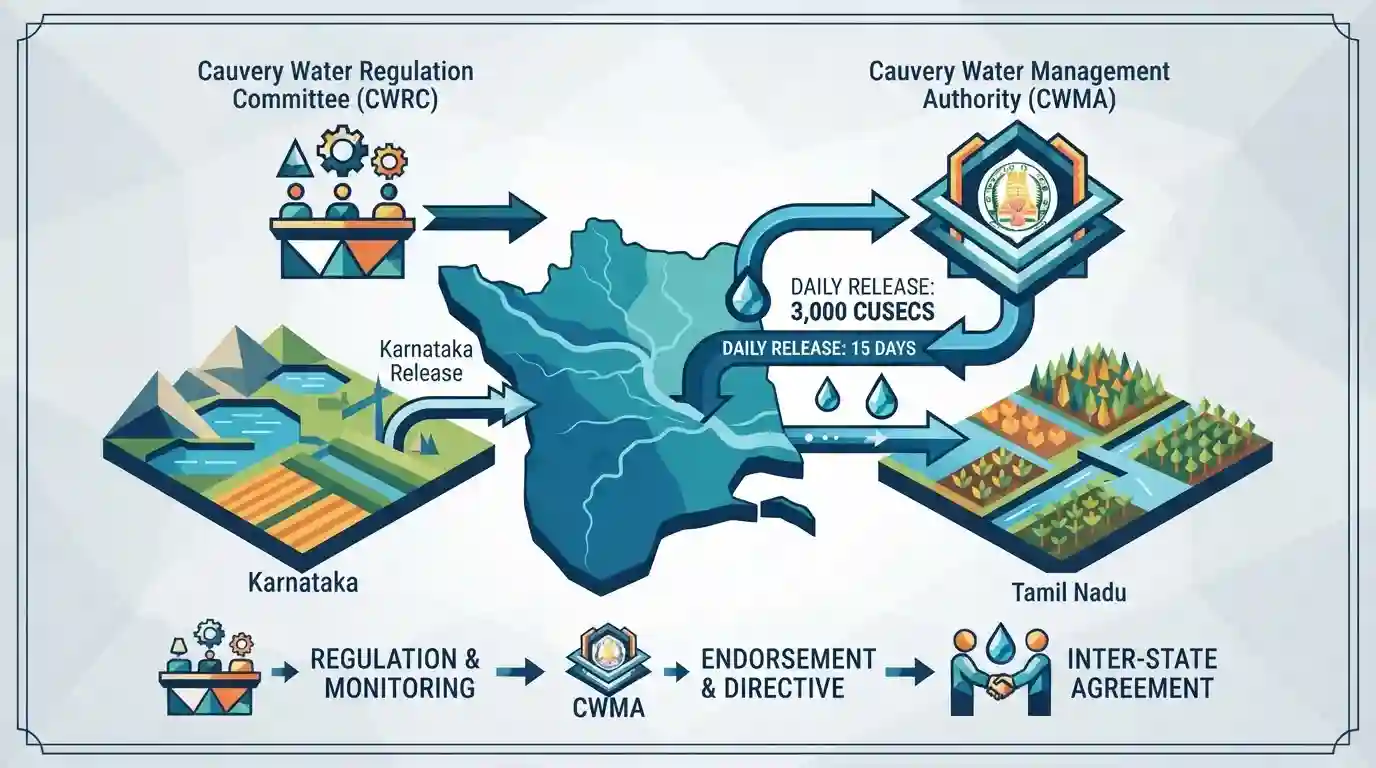
The Cauvery Water Management Authority (CWMA) has endorsed the Cauvery Water Regulation Committee's (CWRC) directive instructing Karnataka to release 3,000 cusecs of water daily to Tamil Nadu for 15 days, highlighting mechanisms for resolving inter-state water disputes.
मुख्य मुद्दे
- The Cauvery Water Management Authority (CWMA) upheld the directive of the Cauvery Water Regulation Committee (CWRC) requiring Karnataka to release 3,000 cusecs of water per day to Tamil Nadu for a 15-day period.
- The decision highlights the ongoing regulatory mechanism and institutional oversight established to manage inter-state water sharing disputes on the Cauvery river basin.
- Such rulings underscore the role of statutory bodies in mitigating friction between riparian states within India's federal structure.
महत्त्वाच्या संज्ञा
Cauvery Water Management Authority (CWMA)

A statutory body constituted by the Central Government under the Inter-State River Water Disputes Act, 1956, to implement the Cauvery Water Disputes Tribunal award as modified by the Supreme Court.
UPSC context
Important for GS Paper II (Polity & Governance - Statutory Bodies) and GS Paper III (Water Resources Management).
Cauvery Water Regulation Committee (CWRC)
The technical body functioning under the Cauvery Water Management Authority responsible for monitoring daily water storage, inflows, and basin data to recommend regular water releases.
UPSC context
Important for GS Paper II and III, testing institutional mechanisms for resolving inter-state river water disputes.
Inter-State River Water Disputes Act
An enactment empowering the Central Government to adjudicate and regulate inter-state river water disputes through tribunals and institutional authorities.
UPSC context
Core legal framework for GS Paper II (Federalism, Inter-state relations, and statutory mechanisms).
पूर्वपरीक्षा सापळा
The Cauvery Water Regulation Committee has final adjudicatory and binding powers to allocate inter-state river water independently of the CWMA.
Aspirants often confuse the Cauvery Water Management Authority (a statutory body with executive/quasi-judicial powers) with a judicial tribunal or the Cauvery Water Regulation Committee (which is purely a technical arm).
संबंधित स्थिर संकल्पना
What are the constitutional and statutory provisions governing inter-state river water disputes in India?
- Article 262: Empowers Parliament to by law provide for the adjudication of any dispute or complaint with respect to the use, distribution or control of inter-state rivers.
- Bar on Jurisdiction: Excludes the jurisdiction of the Supreme Court and all other courts in disputes relating to waters of inter-state rivers referred to a tribunal under the Act.
- ISRWD Act 1956: Enacted under Article 262 to set up ad-hoc tribunals for adjudicating water disputes when negotiations fail.
आंतर-विषय नमुने
Cauvery Dispute & Cooperative Federalism
Inter-state river water disputes test the limits of cooperative federalism, contrasting executive tribunal mechanisms with judicial finality under Article 131 and statutory adjudication acts.

CWMA vs CWRC distinction and Article 262 jurisdiction bars are prime targets for a statement-based Prelims question.
संबंधित PYQ · 2
संबंधित PYQ · 2
- 2015MainsGS2
The concept of cooperative federalism has been increasingly emphasized in recent years. Highlight the drawbacks in the existing structure and the extent to which cooperative federalism would answer the shortcomings.
- 2020PrelimsGS1
Which of the following Protected Areas are located in Cauvery basin ? 1. Nagarhole National Park 2. Papikonda National Park 3. Sathyamangalam Tiger Reserve 4. Wayanad Wildlife Sanctuary Select the correct answer using the code given below:
