GDP Deflator Mechanics and Jobless Growth Dynamics in India
Source:The Hindu ↗
Why It Matters
Understanding the distinction between real and nominal GDP, the function of the GDP deflator, and the implications of capital-intensive vs. labour-intensive growth are core macroeconomic concepts frequently tested in UPSC Prelims and Mains (GS3). It illustrates the 'jobless growth' phenomenon and the structural bottlenecks in India's economy.
Summary
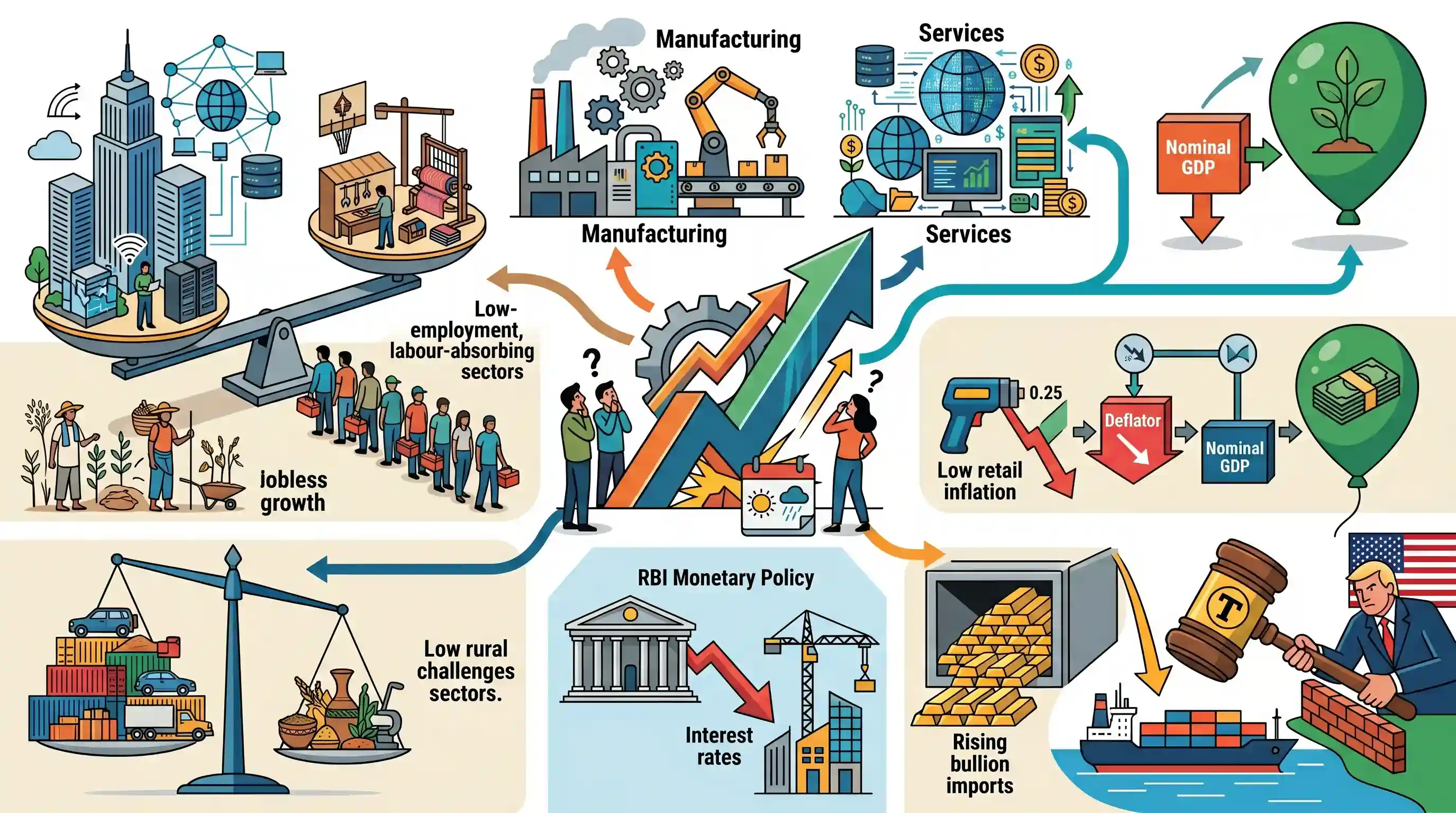
India's Q2 FY26 GDP growth surged to 8.2%, beating estimates due to strong performances in manufacturing and services. However, this headline number requires cautious optimism. The expansion is heavily skewed toward capital-intensive sectors such as infrastructure and technology, while high-employment, labour-absorbing sectors and rural consumption continue to lag, suggesting elements of 'jobless growth'. Additionally, a remarkably low retail inflation rate (0.25%) has depressed the GDP deflator, mechanically inflating real GDP relative to nominal GDP. RBI's rate cuts have spurred investment, yet external challenges loom large, including a historic $41.68 billion trade deficit, rising bullion imports, and the potential impact of U.S. tariffs.
Key Points
- India recorded an 8.2% GDP growth in Q2 FY26, driven primarily by manufacturing (9.1%) and services (9.2%).
- Retail inflation fell to 0.25%, leading to a GDP deflator below 1%, which mechanically inflated real GDP relative to nominal GDP.
- The RBI's three repo rate cuts this year, bringing the policy rate to 5.5%, supported capital-intensive and infrastructure-linked sector growth.
- The growth pattern is skewed, showing strong momentum in capital-intensive and high-skill sectors but lagging behind in labour-intensive sectors and rural consumption.
- External pressures include a historic trade deficit of $41.68 billion fueled by bullion imports and upcoming impact of U.S. tariffs.
Important Terms
GDP Deflator

A comprehensive inflation measure representing the ratio of Nominal GDP to Real GDP. It tracks price changes across all domestically produced goods and services, unlike the fixed-basket Consumer Price Index.
UPSC context
GS Paper 3 (Economy); critical for distinguishing production-led growth from price-led growth and assessing the 'realness' of GDP figures.
Jobless Growth
Economic expansion characterized by rising output (GDP) without a corresponding increase in employment. It often results from skewed growth in capital-intensive sectors over labor-absorbing industries like manufacturing.
UPSC context
GS Paper 3 (Employment/Inclusive Growth); vital for evaluating India's demographic dividend and the structural transition of the labor force.
Monetary Policy Committee (MPC)
A statutory 6-member body under the RBI Act, 1934, mandated to set the benchmark repo rate. It aims to maintain retail inflation (CPI) at 4% within a +/- 2% band.
UPSC context
GS Paper 3 (Monetary Policy); tests knowledge of institutional frameworks for price stability and the RBI's dual mandate of growth and inflation.
Real vs Nominal GDP
Nominal GDP measures output at current market prices, while Real GDP adjusts for inflation by using constant base-year prices to isolate actual changes in production volume.
UPSC context
GS Paper 3 (Growth/Development); fundamental for understanding national income accounting and how low inflation can mechanically inflate real growth percentages.
Trade Deficit
An economic condition where the value of a country's imports exceeds its exports. In India, persistent deficits often stem from heavy reliance on imported energy, electronics, and bullion.
UPSC context
GS Paper 3 (External Sector/BoP); essential for analyzing the Current Account Deficit (CAD), rupee stability, and global trade competitiveness.
Inclusive Growth
Growth that creates equitable opportunities for all sections of society while distributing benefits across various sectors, including rural consumption and labor-intensive industries.
UPSC context
GS Paper 3 (Inclusive Growth); a core developmental objective testing the ability to link economic data with social equity and poverty reduction.
Prelims Trap
A very low GDP deflator depresses Real GDP growth figures compared to Nominal GDP.
It is the exact opposite. A low GDP deflator mechanically *inflates* Real GDP growth relative to Nominal GDP, because Real GDP = (Nominal GDP / Deflator).
Static Concepts Connected
How does the GDP Deflator differ from CPI and WPI?
- Coverage basket: Covers all domestically produced goods and services; CPI and WPI only track a specific, fixed basket of goods.
- Imported goods: Excludes prices of imported goods entirely, whereas CPI includes the prices of imported consumer goods.
- Dynamic weighting: Uses variable weights based on current production (Paasche index), unlike the fixed weights utilized by CPI and WPI.
What drives 'jobless growth' in the Indian macroeconomic context?
- Capital-intensive skew: Economic expansion is led by technology, services, and infrastructure, which require high skills/capital but absorb relatively little unskilled labour.
- Structural leap: India transitioned rapidly to a services-led economy, missing the traditional, mass-employment manufacturing phase that historically absorbed surplus agricultural labour.
- Consumption lag: Failure to create mass employment leads to depressed rural wages and lagging bottom-pyramid consumption despite high headline GDP numbers.
Cross-Topic Patterns
Bullion imports + CAD pressures
Record trade deficits driven by gold/bullion imports directly stress the Current Account Deficit (CAD), often necessitating RBI forex intervention to stabilize the Rupee amidst external shocks.
Rate cuts + Global protectionism
RBI's growth-focused repo rate cuts risk capital flight if yield differentials narrow, especially as potential U.S. tariffs threaten export revenues, compounding India's external vulnerability.

A multi-statement Prelims question testing the mathematical relationship between the GDP deflator, inflation, and Real vs Nominal GDP is highly likely.
Linked PYQs · 5
Linked PYQs · 5
- 2023MainsGS3
Faster economic growth requires increased share of the manufacturing sector in GDP, particularly of MSMEs. Comment on the present policies of the Government in this regard.
- 2022MainsGS3
Economic growth in the recent past has been led by increase in labour productivity." Explain this statement. Suggest the growth pattern that will lead to creation of more jobs without compromising labour productivity.
- 2015MainsGS3
The nature of economic growth in India in recent times is often described as jobless growth. Do you agree with this view ? Give arguments in favour of your answer.
- 2018MainsGS3
How would the recent phenomena of protectionism and currency manipulations in world trade affect macroeconomic stability of India?
- 2019MainsGS3
Do you agree with the view that steady GDP growth and low inflation have left the Indian economy in good shape? Give reasons in support of your arguments.
