Globalization and Modernity Spark Cultural Conundrum in Indian Society
Source:The Hindu ↗
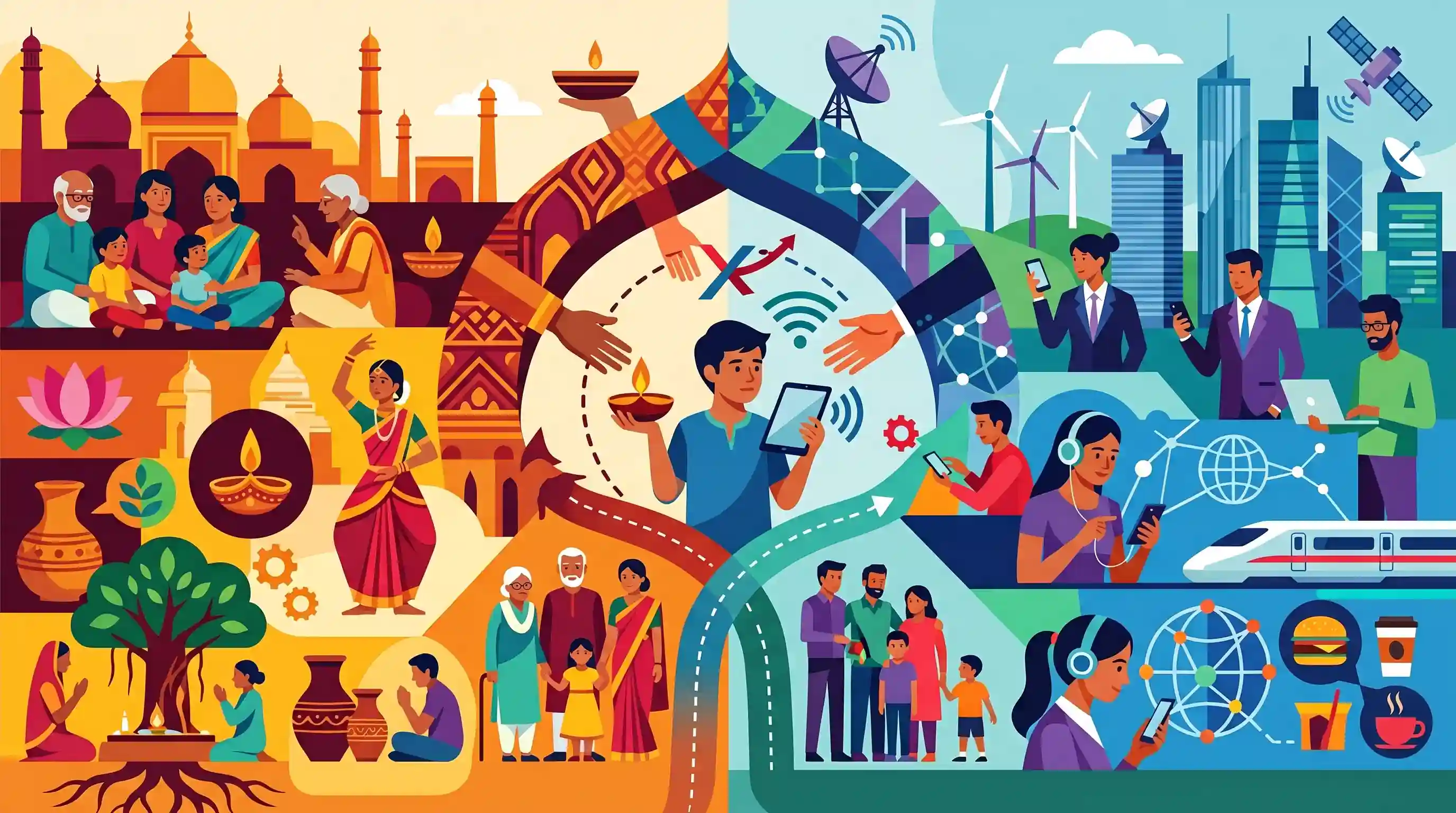
Why It Matters
This topic is highly relevant for GS Paper 1 (Indian Society) and GS Paper 4 (Ethics, Human Values). It provides foundational insights into how globalization and modern technology are reshaping traditional values, altering family structures, and creating cultural complexities, which are recurring themes in UPSC Mains.
Summary
The article explores the contemporary 'cultural conundrum' faced by society, highlighting the friction between traditional Indian values and modern influences brought about by globalization and technological advancements. It delves into how these rapid transitions impact social norms, family structures, and individual identities, raising questions about maintaining cultural continuity while embracing necessary progressive changes.
Key Points
- The growing tension between deep-rooted traditional Indian values and modern lifestyles driven by globalization.
- The impact of technological expansion, such as the internet, in instilling new cultural values that often conflict with traditional norms.
- The challenge of maintaining continuity in social values while adapting to progressive societal changes and diverse worldviews.
- The ethical and societal dimensions of changing family dynamics, shifting attitudes, and the resulting generation gap in a transitioning society.
Prelims Trap
Globalization has led to the homogenization and complete displacement of traditional Indian values.
UPSC options using extreme phrases like 'complete displacement' are usually wrong. Indian society adapts via 'compartmentalization' (selective modernization) rather than pure homogenization.
Static Concepts Connected
What is 'Compartmentalization' in Indian sociology?
- Definition: The practice of separating traditional personal spheres (family, rituals) from modern secular domains (work, education) to avoid cognitive dissonance.
- Milton Singer's Study: Observed by sociologist Milton Singer in industrial leaders who adopted modern business practices at work while maintaining orthodox traditions at home.
- Significance: Explains why rapid modernization and globalization in India have not led to the total Westernization or loss of traditional cultural identity.
Role of Family vs. Media in Value Inculcation
- Traditional Family Role: Historically acts as the primary, unconscious agent of socialization, passing down collectivist values, empathy, and respect for social hierarchies.
- Media & Tech Influence: Instills globalist, individualistic, and egalitarian values, often challenging traditional authority and widening the generation gap in transitioning societies.
- Nuclear Family Impact: The shift to nuclear families reduces informal moral policing and grandparental influence, making technology a dominant substitute for value formation.
Cross-Topic Patterns
Gig Economy + Nuclear Family shift
The economic shift toward individualistic, remote gig-work (GS3) accelerates the sociological breakdown of traditional joint families (GS1), reinforcing materialistic aspirations over community bonds.
Value Crisis + Digital Socialization
Unregulated digital expansion without traditional ethical frameworks creates societal vulnerabilities, bridging GS4 (digital ethics/values) with GS3 (internal security challenges via social media).

Expect a GS1 or GS4 Mains question asking to evaluate 'compartmentalization' as India's unique defense against globalized homogenization.
Linked PYQs · 5
Linked PYQs · 5
- 2016MainsGS1
To what extent globalization has influenced the core of cultural diversity in India? Explain.
- 2020MainsGS1
Is diversity and pluralism in India under threat due to globalisation ? Justify your answer.
- 2021MainsGS1
How does Indian society maintain continuity in traditional social values ? Enumerate the changes taking place in it.
- 2020MainsGS4
‘The current internet expansion has instilled a different set of cultural values which are often in conflict with traditional values.’ Discuss.
- 2016MainsGS4
Our attitudes towards life, work, other people and society are generally shaped unconsciously by the family and the social surroundings in which we grow up. Some of these unconsciously acquired attitudes and values are often undesirable in the citizens of a modern democratic and egalitarian society.
