Maharashtra Cattle Traders Boycott Over Vigilante Harassment Issues
Source:The Hindu ↗
Why It Matters
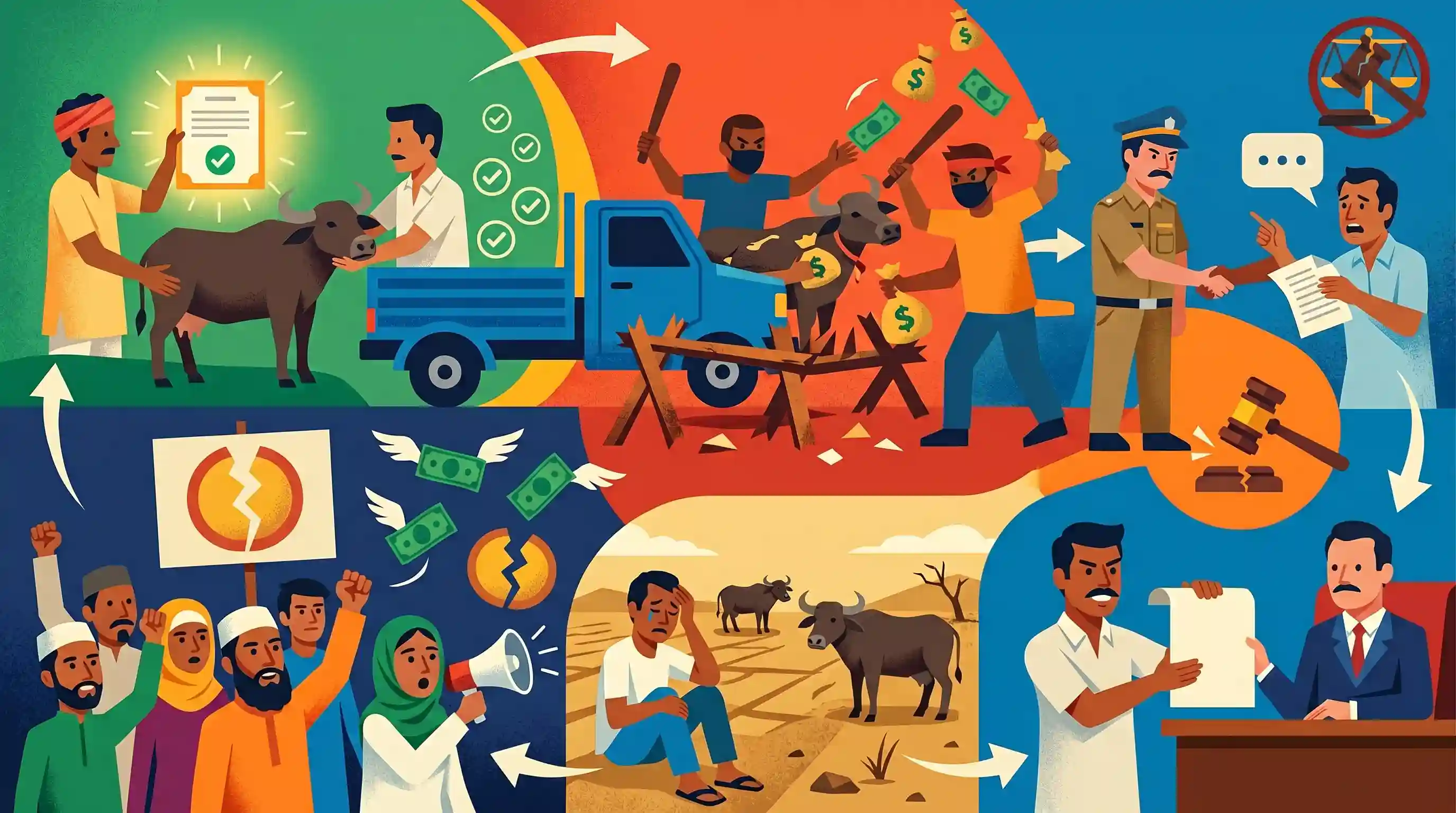
The issue highlights the dangers of extra-constitutional authorities (vigilantism) undermining the rule of law and the fundamental right to practice a lawful profession. It also demonstrates how social conflicts and poor governance can directly impact the rural economy by crippling the vital livestock supply chain that farmers depend on.
Summary
Cattle traders in Maharashtra, largely from the Muslim Qureshi community, have launched an indefinite boycott to protest persistent harassment, extortion, and violent attacks by self-styled 'gau rakshaks' (cow vigilantes), allegedly often aided by local police. Despite complying with the Maharashtra Animal Preservation (Amendment) Act, 2015—which permits the transport and slaughter of non-cow bovines like buffaloes with valid fitness certificates—traders face massive financial losses from illegal cattle seizures, legal fees, and forced maintenance payments (khavati). The All India Jamiatul Quresh (AIJQ) has approached state officials seeking protection and strict action against vigilantes. The ongoing harassment and the resulting boycott not only violate the legal rights of minority traders but also severely disrupt the rural agrarian ecosystem, as farmers depend on this trade cycle to replace aged livestock.
Key Points
- Cattle traders in Maharashtra, predominantly from the Muslim Qureshi community, announced an indefinite boycott starting July 21, 2025, to protest harassment and violence by cow vigilante groups (gau rakshaks).
- Traders face extortion, physical assaults, and seizure of cattle, with allegations that local police are often complicit or unhelpful.
- The traders operate legally under the Maharashtra Animal Preservation (Amendment) Act, 2015, which bans cow slaughter but permits the transport and slaughter of buffaloes and other bovines provided they have veterinary fitness certificates.
- Victims suffer severe financial distress due to legal costs, loss of business, and having to pay 'khavati' (maintenance fees) for cattle detained in gaushalas.
- The boycott threatens to disrupt the broader agricultural economy, as farmers rely heavily on these traders to sell their aged livestock and fund the purchase of productive animals.
Important Terms
Maharashtra Animal Preservation (Amendment) Act, 2015

A 2015 amendment to the 1976 Act that extended the ban on cow slaughter to bulls and bullocks, while allowing water buffalo slaughter subject to fitness certification.
UPSC context
GS II (Legislation) and GS III (Agriculture); tests understanding of animal husbandry laws and their socio-economic and constitutional implications.
Article 19(1)(g)
A fundamental right guaranteeing Indian citizens the freedom to practice any profession or carry on any occupation, trade, or business, subject to reasonable state restrictions.
UPSC context
GS II (Fundamental Rights); relevant for analyzing the legal balance between state-imposed trade bans and the economic rights of citizens.
All India Jamiatul Quresh (AIJQ)
A socio-economic organization founded in 1924 representing the Quresh community, primarily advocating for the rights of those employed in the livestock, meat, and leather industries.
UPSC context
GS II (Pressure Groups); tests the role of community-based organizations in securing minority rights and economic livelihoods.
Livestock Economy
The segment of the agrarian economy involving the rearing and trade of animals for milk, meat, and labor, providing a critical safety net for rural households.
UPSC context
GS III (Agriculture); examines the impact of trade disruptions and vigilantism on rural incomes, farm cycles, and stray cattle issues.
Rule of Law
The constitutional principle that law should govern a nation, ensuring that all individuals and the state are accountable to laws that are publicly promulgated and equally enforced.
UPSC context
GS II (Polity); central to discussions on extra-judicial vigilantism, mob violence, and the state's duty to protect citizens from harassment.
Maharashtra Animal Preservation Act, 1976
The original state law enacted to prohibit cow slaughter and preserve milch and draught animals, primarily to give effect to Article 48 of the Constitution.
UPSC context
GS II (Judiciary/State laws); relevant for tracing the evolution of cattle protection laws and the resulting legal challenges in India.
Prelims Trap
Article 48 of the Constitution mandates a uniform, nationwide ban on the slaughter of all bovines.
Article 48 is a non-justiciable DPSP. Also, livestock is a State Subject (Entry 15); bans vary by state and often exempt buffaloes to balance Article 19(1)(g) trade rights.
Static Concepts Connected
How does the Constitution balance animal slaughter bans with fundamental trade rights?
- Article 48 (DPSP): Directs the State to prohibit the slaughter of cows and draught cattle, but it is a non-justiciable directive, not an absolute constitutional mandate.
- Article 19(1)(g): Protects the right to trade. The SC ruled (Mohd. Hanif Quareshi) that total bans on all bovines regardless of economic utility violate this right.
- State Subject (Entry 15): Livestock preservation falls under the State List, meaning anti-slaughter laws vary significantly across India rather than being a uniform central law.
What are the key directives from the Tehseen Poonawalla (2018) judgment on mobocracy?
- Nodal Police Officers: States must designate a Superintendent of Police (SP) level officer in each district specifically to prevent mob violence and vigilantism.
- Fast-Track Courts: States are directed to set up designated fast-track courts in every district to try mob lynching and extra-judicial violence cases expeditiously.
- Victim Compensation: Mandated the formulation of a victim compensation scheme by state governments to provide relief for bodily injury, psychological harm, and loss of earnings.
Cross-Topic Patterns
Extra-judicial vigilantism & Rule of Law
Cow vigilantism undermines the state's monopoly on law enforcement. In Mains, explicitly link this 'mobocracy' to challenges in local policing, internal security, and the violation of fundamental minority rights.
Livestock trade as agrarian shock-absorber
The rural economy relies on selling unproductive livestock to purchase productive assets. Disrupting this legal trade cycle directly exacerbates farmer indebtedness and broader agrarian distress.

Expect a GS2 Mains question linking extra-judicial vigilantism to local police complicity and the breakdown of the Rule of Law.
Linked PYQs · 3
Linked PYQs · 3
- 2015MainsGS2
Khap Panchayats have been in the news for functioning as extra-constitutional authorities, often delivering pronouncements amounting to human rights violations. Discuss critically the actions taken by the legislative, executive and the judiciary to set the things right in this regard.
- 2015MainsGS3
Livestock rearing has a big potential for providing non-farm employment and income in rural areas. Discuss suggesting suitable measures to promote this sector in India.
- 2024MainsGS2
The Doctrine of Democratic Governance makes it necessary that the public perception of the integrity and commitment of civil servants becomes absolutely positive. Discuss.
