Lightning strikes and extreme weather disaster management
Source:The Hindu ↗
Why It Matters
Lightning remains one of the most fatal natural hazards in India. For UPSC aspirants, this highlights the tangible impacts of climate change on localized extreme weather events and underscores the necessity of moving from a reactive to a proactive disaster management approach, including building robust early warning infrastructure for rural populations.
Summary
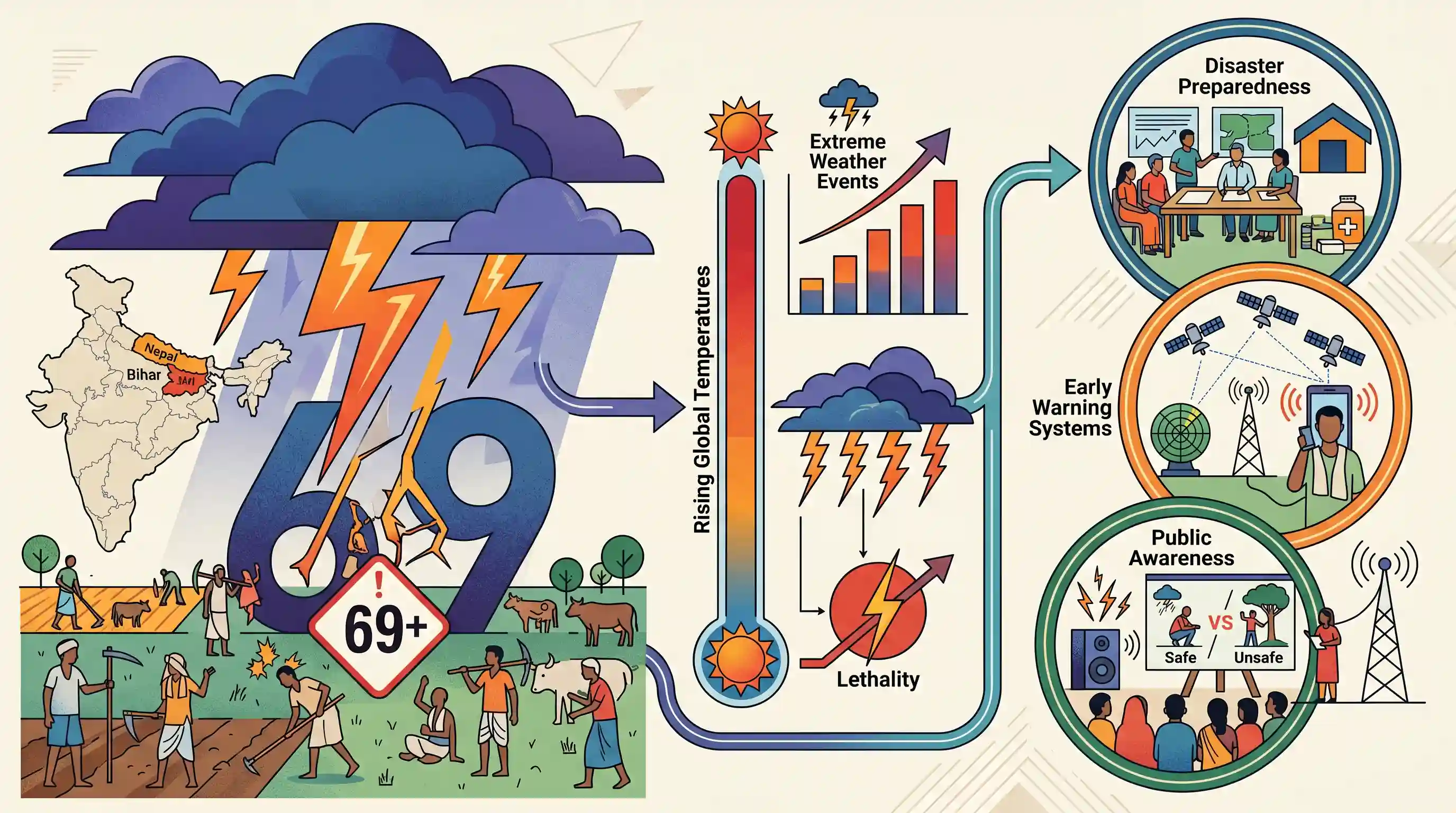
Severe thunderstorms accompanied by deadly lightning strikes have claimed at least 69 lives in India's Bihar state and neighbouring Nepal. The victims were predominantly farmers and rural workers who were outdoors during the extreme weather. Scientists and meteorological experts emphasize that rising global temperatures and climate change are fuelling a significant increase in both the frequency and lethality of lightning strikes in the region. With the India Meteorological Department (IMD) forecasting continued severe weather, the recurring tragedies underscore the critical need for improved disaster preparedness, widespread early warning systems, and targeted public awareness in vulnerable rural areas.
Key Points
- Severe thunderstorms and lightning strikes caused at least 69 fatalities in eastern India's Bihar state and neighbouring Nepal within a short span.
- Scientists attribute the alarming increase in the frequency and intensity of deadly lightning strikes across India to rising global temperatures and climate change.
- Historical data shows that lightning is a major natural disaster in India, having caused over 101,309 deaths between 1967 and 2020.
- Agricultural laborers and rural workers face the highest risk as they are often caught outdoors without adequate shelter or timely early warnings.
Important Terms
India Meteorological Department (IMD)

Established in 1875 under the Ministry of Earth Sciences, it is India’s principal agency for meteorological observations, weather forecasting, and seismology, providing critical early warnings for severe weather events.
UPSC context
GS Paper-I (Geography) and GS-III (Disaster Management); tests knowledge of institutional frameworks and national weather monitoring.
Lightning
A sudden electrostatic discharge between clouds or ground during thunderstorms. It is currently India’s deadliest natural hazard, with strike frequency increasing significantly due to climate change-induced atmospheric instability.
UPSC context
GS Paper-III (Disaster Management); tests understanding of hazards, climate change impacts, and mitigation strategies for rural populations.
Nor’westers (Kalbaishakhi)
Violent pre-monsoon convective thunderstorms occurring in eastern India (Bihar, West Bengal) and Nepal during April–June. Triggered by heating over the Chota Nagpur Plateau, they are locally known as Kalbaishakhi.
UPSC context
GS Paper-I (Geography); tests identification of local weather phenomena and their socio-economic impact in Eastern India.
Damini App
A specialized mobile application developed by the Indian Institute of Tropical Meteorology (IITM) to provide real-time lightning alerts and safety advice within a 40-kilometer radius of the user.
UPSC context
GS Paper-III (Disaster Management); tests knowledge of technology-led early warning systems and last-mile connectivity.
Sachet (Integrated Alert System)
India’s integrated, CAP-based platform for geo-targeted disaster alerts via SMS and cell broadcast, developed by C-DOT and the National Disaster Management Authority (NDMA) for real-time emergency communication.
UPSC context
GS Paper-III (Disaster Management); tests awareness of integrated technology for real-time emergency communication and governance.
National Disaster Management Authority (NDMA)
The apex statutory body for disaster management in India, chaired by the Prime Minister. It formulates national policies, plans, and guidelines for effective disaster prevention and response.
UPSC context
GS Paper-III (Disaster Management); tests understanding of national policy frameworks and mandates for handling natural calamities.
Prelims Trap
Lightning is officially classified as a nationally notified disaster under the Disaster Management Act, 2005.
Despite causing the highest number of natural hazard fatalities annually, lightning is not a nationally notified disaster. States use a 10% SDRF window to declare it a local disaster.
Static Concepts Connected
How does lightning occur during a thunderstorm?
- Convective Updrafts: Intense heating causes warm, moist air to rise rapidly, forming towering cumulonimbus clouds.
- Charge Separation: Collisions between rising water droplets and falling ice crystals create static electricity, with positive charges gathering at the top and negative charges at the bottom of the cloud.
- Electrical Discharge: When the electrical potential overcomes the air's resistance, a sudden flow of current occurs (cloud-to-cloud or cloud-to-ground) to neutralize the charges.
How is the State Disaster Response Fund (SDRF) constituted and utilized?
- Statutory Origin: It is constituted under Section 48 (1) of the Disaster Management Act, 2005, serving as the primary fund available with state governments for disaster response.
- Funding Pattern: The Centre contributes 75% for general category States and 90% for special category States/UTs.
- Local Disasters Quota: Under Finance Commission guidelines, states can use up to 10% of their SDRF allocation for "local disasters" (like lightning) that are not on the national notified list.
Cross-Topic Patterns
Agricultural labor vulnerability
Over 90% of lightning deaths occur in rural India, predominantly affecting agricultural laborers, highlighting a critical intersection between occupational hazards in the informal sector and extreme weather events.
Tech-driven early warning systems (Damini)
The IITM-developed Damini app joins systems like NAVIC and MEGHDOOT, representing India's expanding tech-driven early warning architecture aimed at bridging the rural last-mile gap.
Climate-induced convective instability
Rising surface temperatures increase atmospheric moisture and convective instability, directly linking global warming to a surge in localized multi-hazard events like intense lightning and squalls.

Expect a 2026 prelims statement testing if lightning is a "nationally notified disaster" versus its status under the 10% SDRF local quota.
Linked PYQs · 4
Linked PYQs · 4
- 2020MainsGS3
Discuss the recent measures initiated in disaster management by the Government of India departing from the earlier reactive approach.
- 2024MainsGS1
What is the phenomenon of 'cloudbursts'? Explain.
- 2022MainsGS3
Explain the mechanism and occurrence of cloudburst in the context of the Indian subcontinent. Discuss two recent examples.
- 2024MainsGS3
Flooding in urban areas is an emerging climate-induced disaster. Discuss the causes of this disaster. Mention the features of two such major floods in the last two decades in India. Describe the policies and frameworks in India that aim at tackling such floods.
