Caste enumeration included in upcoming national census
Source:Indian Express ↗
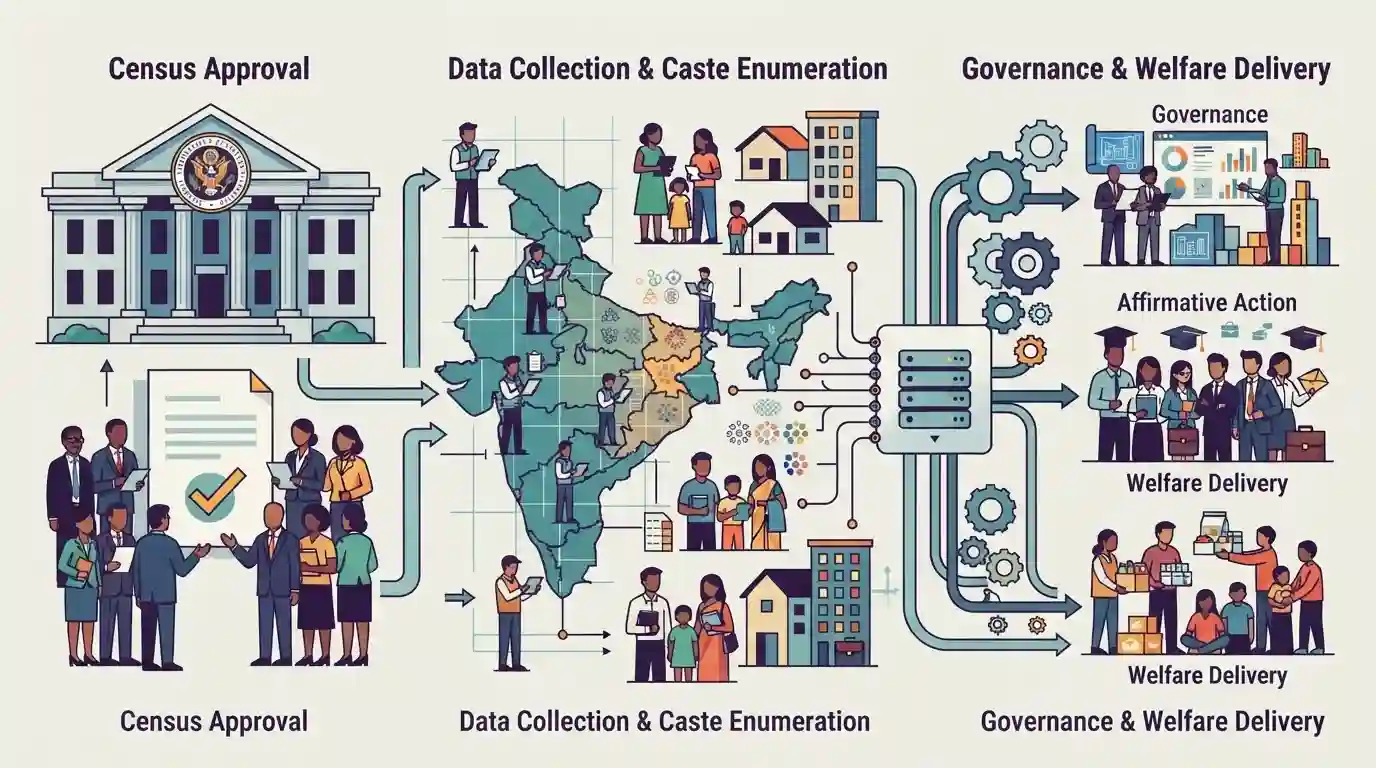
Why It Matters
The integration of caste enumeration into the national Census is a monumental policy and administrative decision that has profound implications for social justice frameworks, reservation policies, resource allocation, and socio-economic planning in India.
Summary
The Union government has approved Rs 11,718 crore for the upcoming two-phase Census 2027 exercise, which will explicitly include caste enumeration for the first time. The monumental administrative exercise aims to provide updated demographic data coupled with detailed caste-based metrics to shape governance, affirmative action, and welfare delivery.
Key Points
- The Union government has sanctioned Rs 11,718 crore for a two-phase Census exercise for 2027.
- For the first time, caste enumeration will be officially integrated into the Census process.
- The exercise will involve houselisting and housing census followed by population enumeration.
- This decision marks a major policy shift impacting social justice, resource allocation, and welfare policy design in India.
Important Terms
Census 2027

India's first fully digital decennial census exercise scheduled for 2027, conducted in two phases by the Ministry of Home Affairs, and notably including caste enumeration for the first time.
UPSC context
GS Paper II (Polity & Governance / Social Justice) - crucial for studying demographic data, welfare delivery, and inclusive development policies.
Union Government
The apex executive authority of the Indian republic, headed by the Prime Minister and Union Ministers, responsible for formulating national policies, administrative decisions, and financial allocations like the census budget.
UPSC context
GS Paper II (Indian Polity) - tests the structure, functioning, and executive decision-making powers of the central government under the parliamentary system.
Cabinet Committee on Economic Affairs (CCEA)
A key standing cabinet committee chaired by the Prime Minister, established under the Government of India (Transaction of Business) Rules, 1961, which directs and coordinates economic policy, investments, and major financial outlays.
UPSC context
GS Paper II (Indian Polity) - tests the role, composition, and functioning of extra-constitutional cabinet committees in economic governance and policy approval.
Prelims Trap
caste enumeration will be officially integrated into the Census process for the first time in history.
Aspirants often assume caste enumeration has never happened before in India, forgetting that the British administration routinely conducted caste censuses up to 1931. This is the first time in *independent* India's official decennial Census.
Static Concepts Connected
What are the constitutional and statutory provisions governing the Census of India?
- Constitutional Basis:: Union Subject: Population census is listed at Entry 69 of the Union List (Seventh Schedule) under Article 246 of the Constitution.
- Statutory Act:: Statutory backing: Conducted under the provisions of the Census Act, 1948, which empowers the Central Government to notify and conduct a census.
- Administrative Body:: Admin Control: Managed by the Office of the Registrar General and Census Commissioner, India, under the Ministry of Home Affairs.
- Legal Confidentiality:: Data Immunity: Section 15 of the Census Act, 1948 ensures individual census returns are strictly confidential and inadmissible as evidence in courts.
Cross-Topic Patterns
Caste Census + Affirmative Action Frameworks
The integration of caste data with decennial demographic tracking directly impacts the constitutionally mandated limits and dynamic revisions of reservations under Articles 15 and 16.
Census Enumeration + Digital Governance Infrastructure
Conducting the world's largest administrative exercise digitally requires robust cyber infrastructure, bridging local administrative machinery with national database grids.

Census Act 1948 provisions (especially confidentiality under Sec 15) and constitutional basis (Entry 69 List I) are high-yield prelims traps.
Linked PYQs · 2
Linked PYQs · 2
- 2021MainsGS2
Discuss the desirability of greater representation to women in the higher judiciary to ensure diversity, equity and inclusiveness.
- 2023PrelimsGS1
With reference to 'Scheduled Areas' in India, consider the following statements: 1. Within a State, the notification of an area as Scheduled Area takes place through an Order of the President. 2. The largest administrative unit forming the Scheduled Area is the District and the lowest is the cluster of villages in the Block. 3. The Chief Ministers of the concerned States are required to submit annual reports to the Union Home Ministry on the administration of Scheduled Areas in the States. How many of the above statements are correct?
