Caste Enumeration Integration in Upcoming National Census
Source:Indian Express ↗
આ શા માટે મહત્વનું છે
The inclusion of caste enumeration in the official decennial census is a landmark policy shift with profound implications for social justice, reservation policies, resource allocation, and electoral politics in India.
સારાંશ
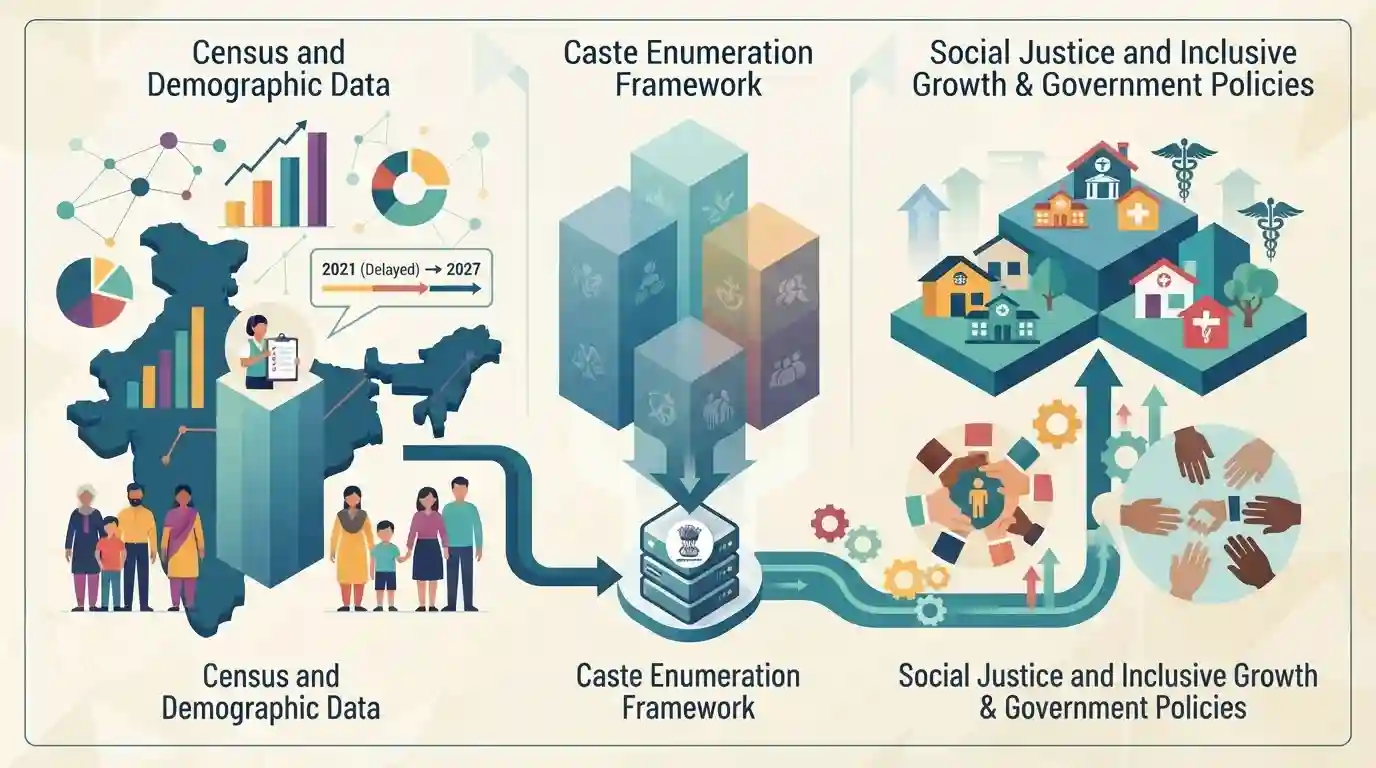
The Union government has sanctioned Rs 11,718 crore for the upcoming two-phase Census 2027, which will officially incorporate caste enumeration into its framework for the first time. The exercise, delayed from 2021, will serve as a crucial foundation for governance, demographic mapping, and targeted welfare distribution.
મુખ્ય મુદ્દા
- The Union government has approved the two-phase Census 2027, allocating Rs 11,718 crore for the massive exercise.
- For the first time, caste enumeration will be officially integrated as a core part of the census data collection process.
- The census operation was delayed from its usual 2021 schedule due to the COVID-19 pandemic and subsequent administrative delays.
- The census data is vital for evidence-based policymaking, resource allocation, and target delivery of welfare and social justice schemes.
મહત્વપૂર્ણ શબ્દો
Census 2027

The upcoming decennial population enumeration exercise in India, conducted in two phases, which will incorporate caste enumeration for the first time since 1931.
UPSC context
UPSC GS Paper I (Population and Associated Issues) and GS Paper II (Governance and Social Justice). Tests demographic mapping and policy formulation.
Office of the Registrar General and Census Commissioner
An attached office under the Ministry of Home Affairs responsible for conducting the decennial census of India under the provisions of the Census Act, 1948.
UPSC context
UPSC GS Paper II (Statutory Bodies, Administrative Framework). Evaluates institutional mechanisms for demographic data collection in India.
પ્રિલિમ્સ ટ્રેપ
Participation and providing demographic information in the decennial Census of India is entirely voluntary for citizens.
The Census Act 1948 makes providing truthful information mandatory for citizens; answering census questions is a legal obligation, not voluntary.
સંલગ્ન સ્થિર ખ્યાલો
What is the legal framework and constitutional basis for conducting the Census in India?
- Constitutional Basis: Union List Entry 69 of the Seventh Schedule places the Census under the exclusive legislative domain of Parliament.
- Statutory Framework: Census Act 1948 governs the collection of demographic data and legally binds citizens to provide truthful information.
- Executing Agency: Office of the Registrar General and Census Commissioner under the Ministry of Home Affairs conducts the decennial exercise.
How has caste data been historically handled in post-independence Indian Censuses?
- Post-1951 Policy: Full caste enumeration was discontinued post-1951, restricting official tabulations strictly to Scheduled Castes (SCs) and Scheduled Tribes (STs).
- SECC Precedent: Socio-Economic and Caste Census (SECC) was conducted separately in 2011, but its raw caste data was never officially published.
આંતર-વિષય પેટર્ન
Caste Census + Affirmative Action (GS-II)
Comprehensive demographic data combined with granular caste enumeration directly feeds into the empirical data required for sub-categorisation and affirmative action policy design.
Demography + Electoral Delimitation (GS-II)
The administrative machinery of the decennial census acts as the backbone for updating electoral rolls and delimitation exercises, tying demographic shifts to federal representation.

Census 2027 inclusion of caste + constitutional provisions (Art 340, Census Act 1948) ripe for multi-statement prelims Qs.
સંલગ્ન PYQ · 2
સંલગ્ન PYQ · 2
- 2023MainsGS2
“Development and welfare schemes for the vulnerable, by its nature, are discriminatory in approach.” Do you agree? Give reasons for your answer.
- 2026PrelimsGS1
With reference to the organisations under the Government of India, consider the following details : | Sl. No. | Organisation | Function | Controlling Union Ministry | | --- | --- | --- | --- | | 1. | Central Economic Intelligence Bureau (CEIB) | To coordinate between various law enforcement agencies | Ministry of Home Affairs | | 2. | Serious Fraud Investigation Office (SFIO) | To investigate complex corporate frauds | Ministry of Finance | | 3. | Central Bureau of Investigation (CBI) | To preserve values in public life and ensure the health of the national economy | Ministry of Personnel, Public Grievances and Pension | In how many of the above rows are the given details correctly matched ?
