Caste Census Role in Addressing Graded Inequality in Society
Source:Indian Express ↗
Why It Matters
The demand for a caste census is a highly debated topic at the intersection of Indian Society (GS1) and Social Justice (GS2). Understanding the nuances of caste stratification, such as 'graded inequality', is essential for answering questions on affirmative action, reservation, and social empowerment.
Summary
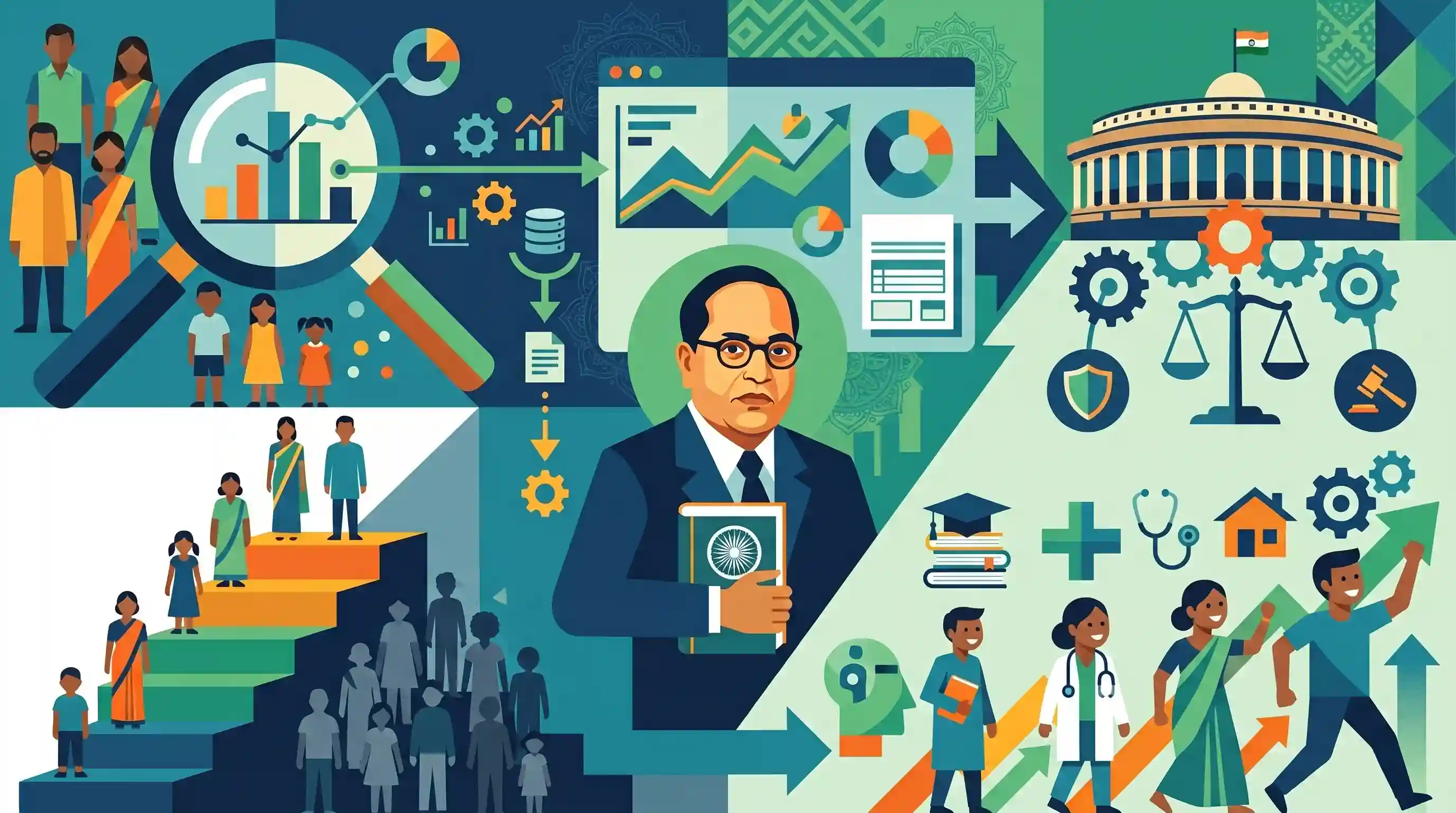
The article advocates for a nationwide caste census as a vital tool to measure and address the deep-rooted 'graded inequality' in Indian society. Referencing B.R. Ambedkar's sociological insights, it argues that empirical data on the demographic and socio-economic realities of various castes is indispensable for effective policy formulation. Such data would not only expose the extent of systemic marginalization but also help in rationalizing affirmative action and ensuring equitable resource distribution among backward classes.
Key Points
- Graded Inequality: The Indian caste system operates as a vertical hierarchy of 'graded inequality' rather than a simple division of labor, a concept extensively highlighted by Dr. B.R. Ambedkar.
- Evidence-based Policy: A comprehensive caste census is necessary to collect empirical data on the socio-economic, educational, and employment status of various caste groups, especially OBCs.
- Efficacy of Affirmative Action: Granular caste data is crucial for recalibrating existing reservation policies to ensure that the benefits reach the most marginalized and disadvantaged sub-castes.
- Social Justice: Quantifying the exact nature and extent of socio-economic disparity among castes is an essential prerequisite for dismantling systemic discrimination and achieving genuine social justice.
Important Terms
Socio-Economic Caste Census (SECC)

A comprehensive household survey (last in 2011) mapping economic status and caste demographics to identify welfare beneficiaries. Unlike the decennial Census, its data is usable for administrative targeting.
UPSC context
GS Paper II (Social Justice/Governance). Relevant for questions on poverty mapping, welfare targeting, and current debates on the national caste census.
Graded Inequality
A concept by B.R. Ambedkar describing the multi-layered caste hierarchy where each group is superior to those below it and inferior to those above, preventing unified social resistance.
UPSC context
GS Paper I (Social Issues) and Essay. Essential for analyzing the structural nature of the caste system and social fragmentation.
Affirmative Action
Constitutional policies, such as reservations in education and jobs (Articles 15 and 16), designed to provide substantive equality to historically marginalized groups like SCs, STs, and OBCs.
UPSC context
GS Paper II (Indian Constitution). Tests understanding of fundamental rights, judicial reviews (Indra Sawhney case), and tools for social justice.
Backward Classes
Socially and educationally underprivileged groups defined under Article 340, which empowers the President to appoint commissions to investigate their status and recommend upliftment measures.
UPSC context
GS Paper II (Vulnerable Sections). Key for questions on Article 340, the National Commission for Backward Classes (NCBC), and reservation criteria.
Mandal Commission
The 1979 commission that identified Other Backward Classes (OBCs) as 52% of India's population and recommended 27% reservation, fundamentally altering India's political and social landscape.
UPSC context
GS Paper II and Modern History. Crucial for understanding the historical evolution of OBC reservations and the legal cap on total quotas.
Rohini Commission
A 2017 commission established to examine the sub-categorization of OBCs to ensure more equitable distribution of reservation benefits among various communities within the category.
UPSC context
GS Paper II (Governance). Relevant for contemporary debates on rationalizing affirmative action and ensuring intra-category fairness.
Prelims Trap
"The decadal Census of India post-independence does not collect any data on caste."
False. The Census explicitly enumerates SCs and STs under constitutional mandate. The demand for a 'caste census' refers to enumerating OBCs and other castes, which dropped after 1931.
Static Concepts Connected
Which Constitutional articles empower and regulate backward classes?
- Article 340: Empowers the President to appoint a commission to investigate the socio-economic conditions of Socially and Educationally Backward Classes (SEBCs).
- Article 338B: Inserted by the 102nd Amendment Act, it granted constitutional status to the National Commission for Backward Classes (NCBC).
- Article 342A: Empowers the President, in consultation with the Governor, to specify the SEBCs in relation to a State or Union Territory.
How does the SECC (2011) differ from the Decadal Census?
- Legal Backing: The Decadal Census falls under the Census Act of 1948, making its individual data confidential. SECC data is open for use by government departments.
- Core Purpose: The Census provides broad demographic data, whereas the SECC's primary purpose was to identify beneficiaries for targeted state support and welfare schemes.
- Ministries Involved: SECC was jointly conducted by the Ministry of Rural Development, Ministry of Housing & Urban Poverty Alleviation, and the Registrar General of India.
Cross-Topic Patterns
OBC Sub-categorization & SC Verdicts
The push for OBC sub-categorization based on empirical data parallels recent Supreme Court constitutional bench rulings permitting states to sub-classify Scheduled Castes for targeted reservations.
Caste Data & Privacy Jurisprudence
The collection of granular, household-level socio-economic and caste data triggers debates around the Puttaswamy judgment's proportionality test and the handling of sensitive personal data under the DPDP Act.

Expect a 2026 prelims question mixing Article 340, the 102nd Amendment (NCBC), and the historical timeline of the 1931 Caste Census.
Linked PYQs · 5
Linked PYQs · 5
- 2022MainsGS1
Analyse the salience of 'sect' in Indian society vis-a-vis caste, region and religion.
- 2018MainsGS1
Caste system is assuming new identities and associational forms. Hence, caste system cannot be eradicated in India." Comment.
- 2020MainsGS1
Has caste lost its relevance in understanding the multi-cultural Indian Society? Elaborate your answer with illustrations.
- 2022MainsGS2
Discuss the role of the National Commission for Backward Classes in the wake of its transformation from a statutory body to a constitutional body.
- 2023PrelimsGS1
Consider the following organizations/bodies in India: 1. The National Commission for Backward Classes 2. The National Human Rights Commission 3. The National Law Commission 4. The National Consumer Disputes Redressal Commission How many of the above are constitutional bodies?
