Caste Census Legal Framework and Administrative Challenges
Source:Indian Express ↗
Why It Matters
Understanding the mechanics and implications of a Caste Census is critical for UPSC aspirants. It overlaps with core constitutional issues (Article 340, reservation policies), social justice frameworks (OBC sub-categorization), and governance logistics (Census Act, Delimitation).
Summary
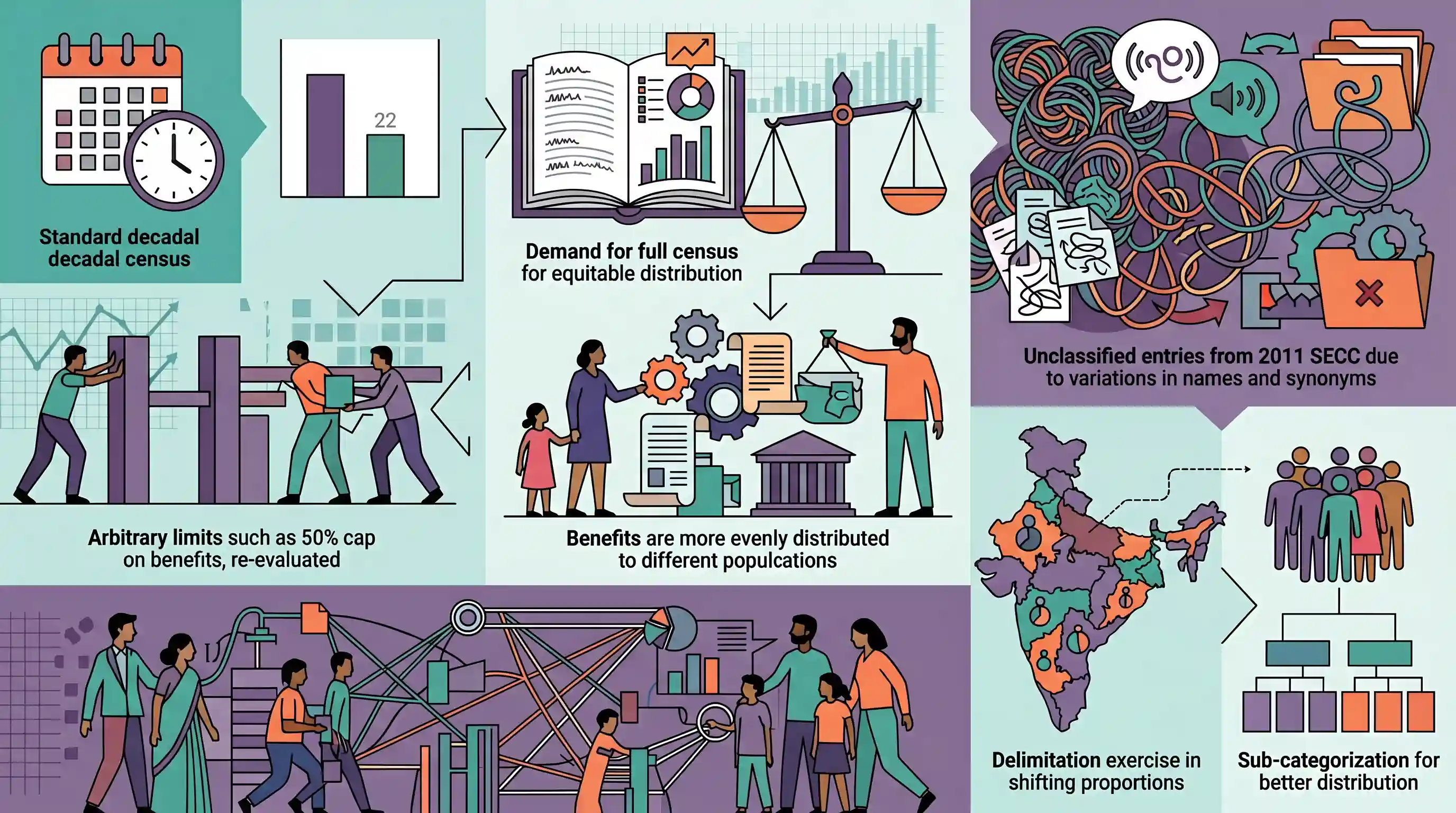
The demand for a nationwide Caste Census has profound political, legal, and administrative implications in India. Conducted primarily under the Census Act of 1948, the standard decadal census currently enumerates only Scheduled Castes and Scheduled Tribes. Proponents argue a full caste census is crucial for equitable distribution of affirmative action benefits and to bypass arbitrary reservation ceilings (e.g., the 50% cap set by the Indra Sawhney judgment). However, the implementation is fraught with logistical hurdles, as evidenced by the 2011 Socio-Economic and Caste Census (SECC), which yielded millions of unclassified caste entries due to phonetic variations and localized synonyms. Additionally, any new census data will be instrumental in the imminent Delimitation exercise and could be used to implement sub-categorization within the Other Backward Classes (OBC) quota, fundamentally reshaping India's political and social justice landscape.
Key Points
- The standard decadal census operates under the Census Act of 1948 and currently only enumerates Scheduled Castes (SCs) and Scheduled Tribes (STs), leaving Other Backward Classes (OBCs) uncounted since 1931.
- Proponents of a Caste Census aim to use the empirical data to breach the 50% reservation ceiling set by the Indra Sawhney judgment and to implement targeted sub-categorization among OBCs.
- The 2011 Socio-Economic and Caste Census (SECC) highlighted severe logistical challenges, yielding millions of confusing caste entries due to spelling variations, gotras, and overlapping regional synonyms.
- Upcoming census data will play a critical role in the political landscape by directly informing the next Delimitation exercise, which adjusts the boundaries and representation of electoral constituencies.
Important Terms
Census Act of 1948

Primary law governing India's decennial census. It empowers the government to conduct population counts and ensures individual data confidentiality, preventing use for administrative purposes.
UPSC context
GS-II/Polity. Tests legal basis for enumeration and data privacy in governance.
Collection of Statistics Act, 2008
Legislation for gathering socio-economic data. Unlike the Census Act, it allows sharing household-level information for identifying beneficiaries of welfare schemes.
UPSC context
GS-II/Governance. Key for understanding legal distinctions between population counts and welfare surveys.
102nd Constitutional Amendment Act
Constitutional amendment granting status to the NCBC and introducing Article 342A. It initially centralized the notification of Socially and Educationally Backward Classes.
UPSC context
GS-II/Constitution. Essential for federalism debates and the evolution of OBC identification powers.
Socio-Economic and Caste Census (SECC) 2011
A household-level survey mapping deprivation and caste identities. Unlike the general census, its data is used specifically for targeted welfare delivery.
UPSC context
GS-I/II (Social Justice). Tests use of deprivation data for welfare schemes.
Rohini Commission
Commission tasked with sub-categorizing Other Backward Classes (OBCs) to ensure reservation benefits are distributed equitably among marginalized sub-groups.
UPSC context
GS-II/Social Justice. Focuses on 'equity within equality' and reservation policy refinement.
Delimitation Commission
Statutory body mandated to redraw electoral boundaries based on census data. Its orders carry the force of law and cannot be challenged in court.
UPSC context
GS-II/Polity. Central to the post-2026 seat redistribution and electoral fairness debates.
Office of the Registrar General and Census Commissioner of India
Agency under the Ministry of Home Affairs responsible for conducting the decennial census and civil registration of births and deaths.
UPSC context
GS-II/Governance. Institutional framework behind India's massive demographic surveys.
Prelims Trap
"The decadal census under the Census Act of 1948 enumerates the population of SCs, STs, and OBCs."
The regular decadal census enumerates ONLY Scheduled Castes (SCs) and Scheduled Tribes (STs). OBC population data has not been systematically collected since 1931.
Static Concepts Connected
How does the Decadal Census differ legally from the SECC?
- Statutory Backing: The Decadal Census is governed by the Census Act, 1948. The SECC was conducted via executive order and lacks direct statutory backing.
- Data Confidentiality: Under Section 15 of the Census Act, individual data is strictly confidential. SECC data is open for use by government departments to target beneficiaries.
- Purpose: The Census maps general demographic indicators, while the SECC specifically maps socio-economic backwardness to distribute state benefits.
What were the key mandates of the Indra Sawhney (1992) judgment?
- 50% Ceiling: Vertical reservations must not exceed 50%, a cap that can only be breached in "extraordinary situations" (e.g., far-flung areas).
- Creamy Layer: Advanced sections among the OBCs must be excluded from affirmative action benefits to ensure quotas reach the truly disadvantaged.
- No Promotion Quota: Article 16(4) does not permit reservations in promotions (later circumvented by the 77th Constitutional Amendment).
Cross-Topic Patterns
Census + Delimitation + Women's Quota
The next census provides the demographic baseline for upcoming Delimitation, which is the constitutional prerequisite for enacting the 106th Amendment (Women's Reservation Act).
State Surveys vs. Union List
Because 'Census' is a Union List subject (Entry 69), states are leveraging the Collection of Statistics Act, 2008 or executive orders to conduct state-level 'caste surveys' instead.
OBC Sub-categorization (Rohini Commission)
A caste census would supply the empirical evidence required to implement the Justice Rohini Commission's blueprint for sub-categorizing OBCs, preventing quota-cornering by dominant sub-castes.

A 2026 Prelims question will likely test the legal distinction between the Census Act 1948 and SECC, alongside the Indra Sawhney 50% rule.
Linked PYQs · 3
Linked PYQs · 3
- 2018MainsGS1
Caste system is assuming new identities and associational forms. Hence, caste system cannot be eradicated in India." Comment.
- 2024PrelimsGS1
How many Delimitation Commissions have been constituted by the Government of India till December 2023?
- 2018MainsGS2
Whether National Commission for Scheduled Castes (NCSC) can enforce the implementation of constitutional reservation for the Scheduled Castes in the religious minority institutions? Examine.
