Karnataka Caste Census: Political Debates on Affirmative Action
Source:Indian Express ↗
Why It Matters
The issue of caste enumeration directly ties into GS1 (Society) and GS2 (Social Justice/Polity) syllabus areas. It reflects the ongoing debates over affirmative action, the necessity for empirical data on backwardness, and the functional role of Backward Classes Commissions in shaping public policy.
Summary
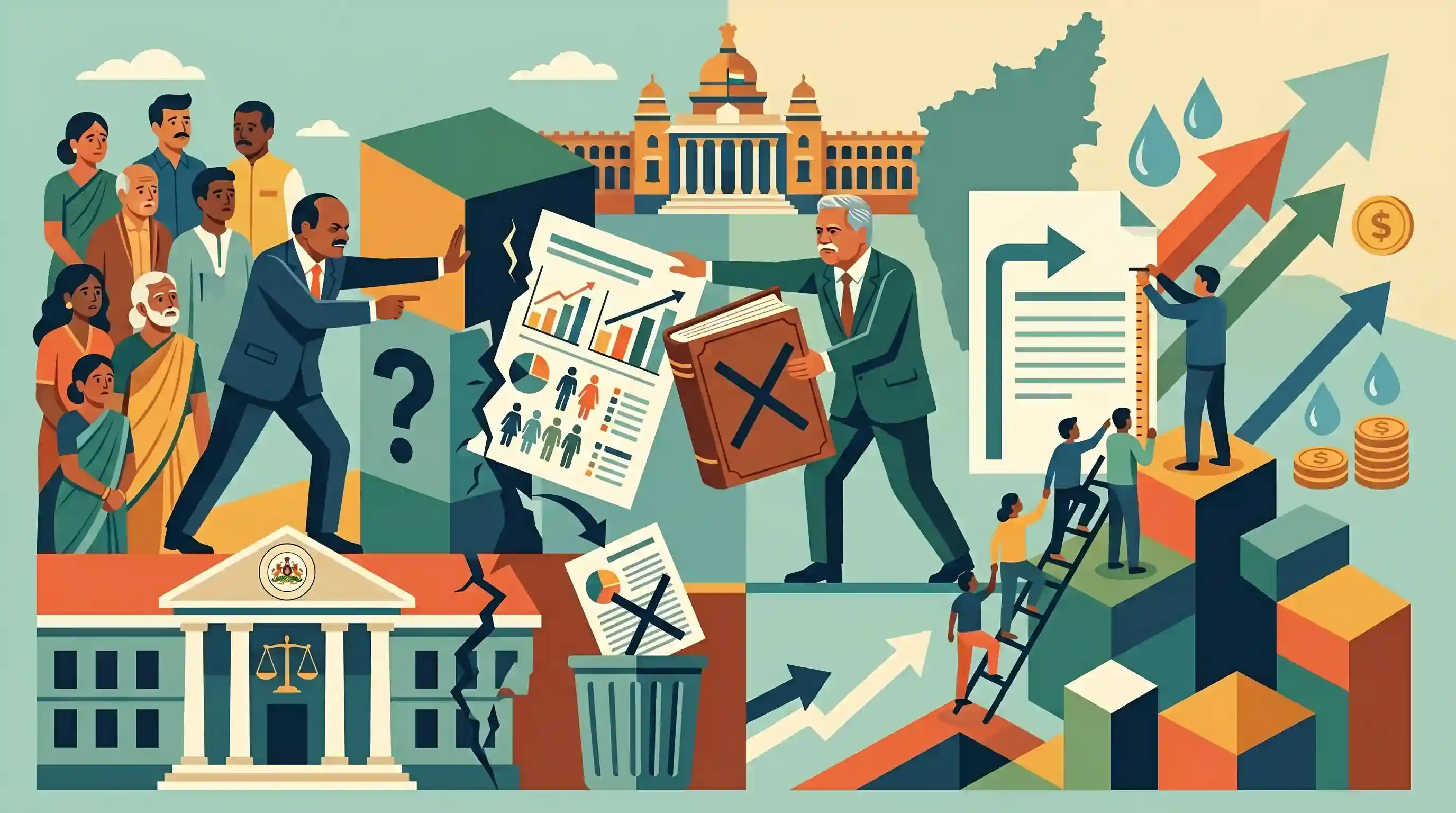
A political controversy has emerged in Karnataka following the state government's decision to scrap the 2015 Social and Educational Survey Report (commonly known as the caste census) and commission a fresh survey. Union Minister H D Kumaraswamy and Chief Minister Siddaramaiah have traded allegations over who is responsible for stalling the implementation of the original data compiled by the Karnataka State Commission for Backward Classes. The issue underscores the broader political and social complexities tied to caste enumeration in India.
Key Points
- The Karnataka government has decided to scrap the 2015 Social and Educational Survey Report (caste census) and initiate a fresh caste survey.
- Union Minister H D Kumaraswamy criticized Chief Minister Siddaramaiah for stalling the implementation of the original report.
- The report was compiled by the Karnataka State Commission for Backward Classes to assess the socio-economic status of various communities.
- The controversy highlights the political sensitivities, administrative challenges, and electoral calculations surrounding caste data and affirmative action policies.
Important Terms
Social and Educational Survey (Kantharaj Report)

A 2015 demographic study in Karnataka, led by H. Kantharaj, aimed at collecting socio-economic and educational data of various castes to reform reservation policies and welfare schemes.
UPSC context
GS Paper II: Governance and Social Justice; tests understanding of state-led data initiatives for affirmative action.
Karnataka State Commission for Backward Classes
A statutory body established under the Karnataka State Commission for Backward Classes Act, 1995, responsible for identifying backward classes and conducting surveys to assess their socio-economic status.
UPSC context
GS Paper II: Statutory and regulatory bodies; tests knowledge of state-level institutional frameworks for social equity.
Caste Census
The enumeration of population based on caste, aimed at providing empirical data for social justice policies; unlike the decadal census, it specifically identifies all caste groups.
UPSC context
GS Paper I: Social Empowerment and GS Paper II: Social Justice; focuses on the debate between data-driven policy vs. identity politics.
Janata Dal (Secular)
A regional political party in Karnataka, led by H. D. Deve Gowda, currently central to the debate over the implementation and 'scientific' validity of the 2015 caste survey.
UPSC context
GS Paper II: Functioning of political parties and regionalism; relevant for the 'Pressure Groups and Formal/Informal Associations' syllabus section.
Affirmative Action (Social Justice)
Policy measures, such as reservations, designed to promote the inclusion of historically marginalized groups in education, employment, and political representation to ensure substantive equality.
UPSC context
GS Paper II: Constitution of India and Welfare Schemes; tests the application of Articles 15(4) and 16(4).
Socially and Educationally Backward Classes (SEBC)
Groups identified by the state as disadvantaged due to social and educational factors, allowing them access to reservations and targeted development programs under Article 340.
UPSC context
GS Paper II: Mechanisms, laws, and institutions for the protection and betterment of vulnerable sections.
Prelims Trap
State governments possess concurrent constitutional powers to conduct a caste census.
Only the Union can conduct a Census (Entry 69, Union List). States circumvent this by conducting 'Socio-Economic Surveys'; they lack statutory power to perform a legal census.
Static Concepts Connected
What is the constitutional framework governing demographic enumeration in India?
- Union List: The subject of 'Census' falls exclusively under Entry 69 of the Union List (Seventh Schedule), giving Parliament sole legislative competence.
- State Limitations: States lack the authority to conduct a statutory census under the Census Act of 1948; they are constitutionally restricted to conducting 'socio-economic surveys'.
How do the legal statuses of National and State Backward Classes Commissions differ?
- NCBC Status: Elevated to a constitutional body under Article 338B via the 102nd Constitutional Amendment Act, 2018, granting it broader investigative powers.
- State Commissions Status: Remain statutory bodies created by respective state legislatures, a mandate originating from the Supreme Court's 1992 Indra Sawhney judgment.
Cross-Topic Patterns
Data deficit and affirmative action
The push for state caste surveys stems from the lack of OBC data since 1931, complicating the judicial demand for 'quantifiable data' to justify reservations under Articles 15 and 16.
Federalism and demographic enumeration
State-led caste surveys highlight emerging federal tensions, as states creatively navigate the Union's exclusive domain over the 'Census' by labeling their exercises as socio-educational data collection.

Expect a Prelims statement contrasting the Union's exclusive 'Census' mandate (Entry 69) with State-led 'socio-economic surveys'.
Linked PYQs · 3
Linked PYQs · 3
- 2022MainsGS2
Discuss the role of the National Commission for Backward Classes in the wake of its transformation from a statutory body to a constitutional body.
- 2024MainsGS1
Despite comprehensive policies for equity and social justice, underprivileged sections are not yet getting the full benefits of affirmative action envisaged by the Constitution. Comment.
- 2018MainsGS1
Caste system is assuming new identities and associational forms. Hence, caste system cannot be eradicated in India." Comment.
