Caste Census Phased Rollout and Social Justice Implications
Source:Indian Express ↗
কেন এটি গুরুত্বপূর্ণ
A caste census is a monumental policy decision that directly impacts affirmative action, resource distribution, federal governance, and social justice frameworks in India, making it critical for GS Paper 2 (Governance and Social Justice).
সারসংক্ষেপ
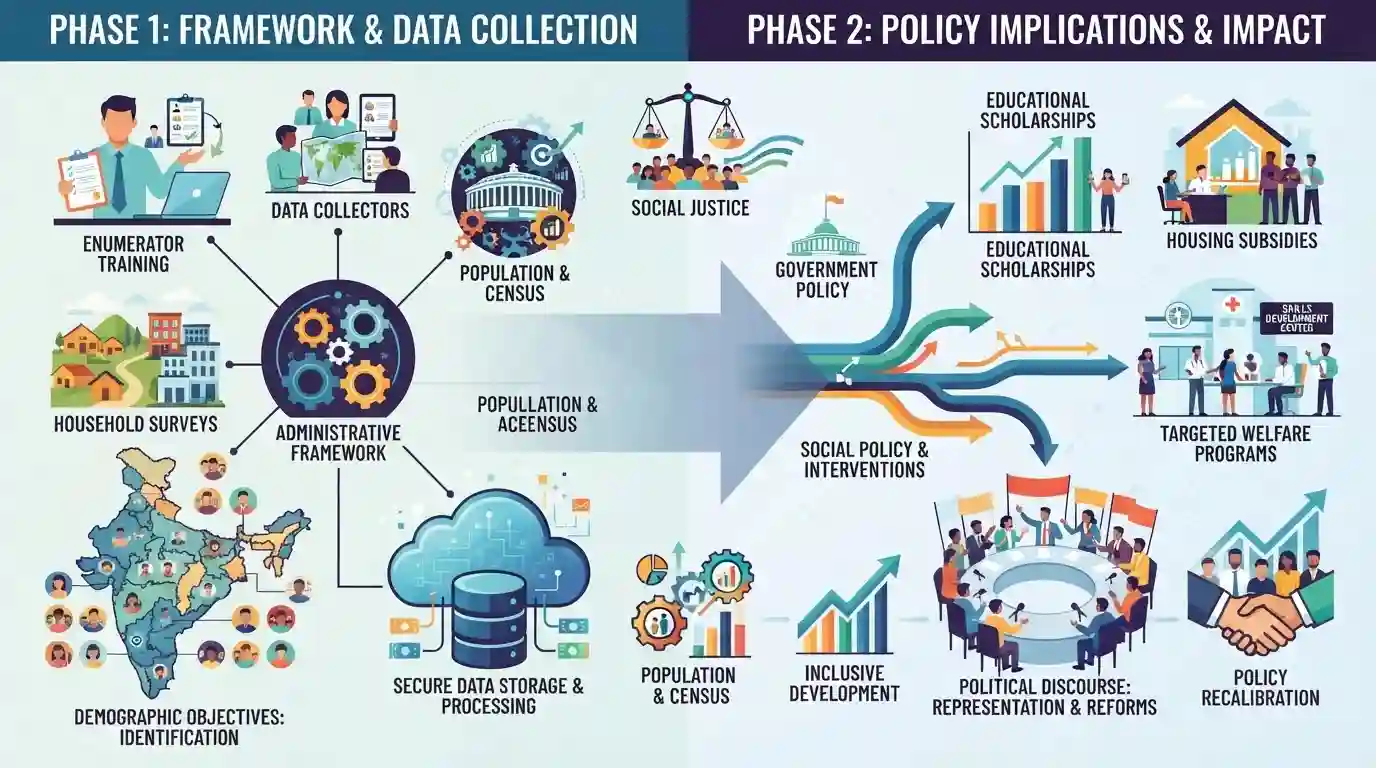
The article discusses the rollout of the caste census in two distinct phases, detailing its administrative framework, demographic objectives, and its significant implications for social policy and political discourse in India.
মূল বিষয়
- The caste census is structured to be conducted in two phases.
- It aims to map socio-economic status and demographic distributions across castes in India.
- The exercise carries profound implications for social justice, affirmative action policies, and resource allocation.
গুরুত্বপূর্ণ শব্দ
Caste Census

An official enumeration of India's population that systematically records caste identities alongside demographic and socio-economic data, aimed at assessing social inequalities and shaping targeted welfare policies.
UPSC context
UPSC GS Paper I (Indian Society - Salient features of Indian Society, Diversity) and GS Paper II (Social Justice, Governance). Tests understanding of demographic shifts and inclusive development policies.
প্রিলিমস ফাঁদ
Caste census and decennial population census share identical constitutional provisions under the State List.
Aspirants often assume Census is entirely a state subject because states conduct caste surveys; however, the Census of India is exclusively a Union List subject.
সংযুক্ত স্থির ধারণা
What are the constitutional and statutory provisions governing the Census in India?
- Union List:: Union List entry, Census is a central subject enumerated under Entry 69 of the Union List in the Seventh Schedule.
- Census Act 1948:: Statutory backing, It is governed by the Census Act of 1948, which empowers the Central Government to notify and conduct a census.
- Data Privacy:: Confidentiality, Individual data collected during the census is legally protected and cannot be used as evidence in any court of law.
আন্তঃবিষয় প্যাটার্ন
Caste Census versus Union List Census power
While the decennial Census falls under the Union List (Entry 69), states possess independent powers under Article 246 to collect socio-economic and caste data via state legislation.
Caste Data and the Indra Sawhney Ceiling
Detailed caste enumeration alters the empirical baseline for quotas, challenging the 50% ceiling established in the 1992 Indra Sawhney judgment.

Expect statement-based questions on constitutional lists for census powers vs state socio-economic surveys.
সংযুক্ত PYQ · 5
সংযুক্ত PYQ · 5
- 2024PrelimsGS1
The total fertility rate in an economy is defined as:
- 2023PrelimsGS1
Consider the following: 1. Demographic performance 2. Forest and ecology 3. Governance reforms 4. Stable government 5. Tax and fiscal efforts For the horizontal tax devolution, the Fifteenth Finance Commission used how many of the above as criteria other than population area and income distance?
- 2019PrelimsGS1
In the context of any country, which one of the following would be considered as part of its social capital?
- 2024MainsGS2
Public charitable trusts have the potential to make India's development more inclusive as they relate to certain vital public issues. Comment.
- 2023MainsGS2
The crucial aspect of development process has been the inadequate attention paid to Human Resource Development in India. Suggest measures that can address this inadequacy.
